
Mediterranean Southwest Europe (244–387 CE): Crisis, Reform, …
Years: 244 - 387
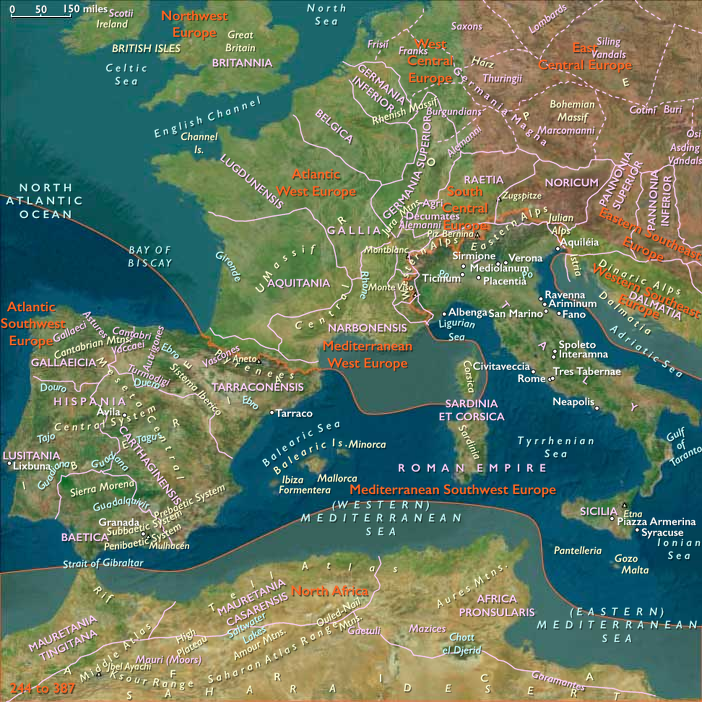
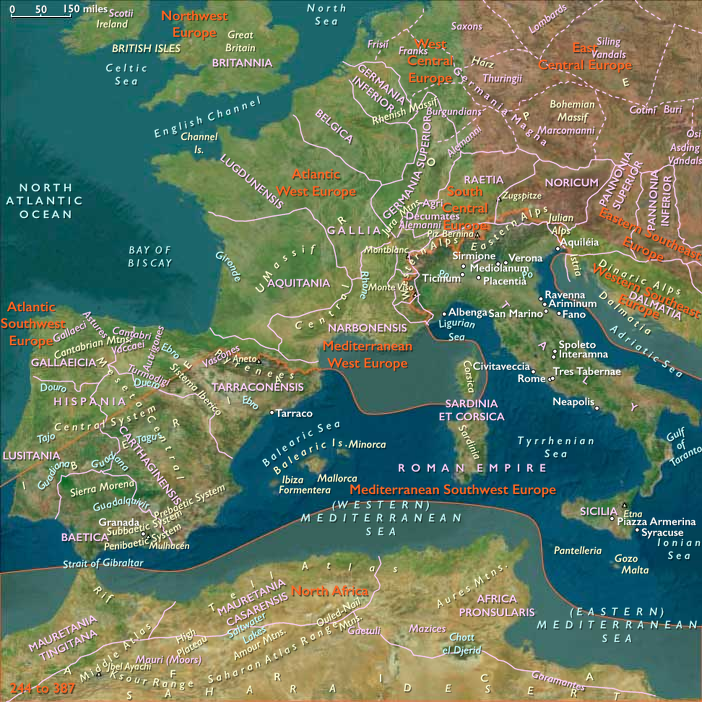
Mediterranean Southwest Europe (244–387 CE): Crisis, Reform, and Transformation
The age 244–387 CE in Mediterranean Southwest Europe encompasses a critical period marked by profound imperial instability, extensive administrative and economic reforms, significant cultural and religious developments, and major transformations within the Roman Empire.
Military Anarchy and Imperial Fragmentation (244–267 CE)
Following the collapse of the Severan dynasty, Rome descends into military anarchy, characterized by frequent changes in imperial leadership, widespread economic disruption, and intensified external pressures from Germanic and Persian incursions. Economic decline and provincial autonomy grow as centralized authority weakens.
Aurelian's Restoration and Economic Reforms (268–279 CE)
Emperor Aurelian (270–275 CE) briefly restores imperial unity, reconquering breakaway territories and initiating critical economic reforms. He constructs defensive fortifications such as Rome's Aurelian Walls, revitalizing stability and temporarily reversing economic deterioration.
Diocletian's Reforms and the Tetrarchy (280–303 CE)
Diocletian ascends in 284 CE, significantly reforming administrative, military, and economic structures through the establishment of the Tetrarchy—a system designed to stabilize governance by dividing power among four emperors. His policies include provincial restructuring, fortified frontiers, currency stabilization, and the Edict on Maximum Prices.
Collapse of the Tetrarchy and Constantine’s Rise (304–315 CE)
The Tetrarchy disintegrates following Diocletian’s retirement in 305 CE, leading to intense civil wars. Constantine the Great emerges victorious at the Battle of Milvian Bridge (312 CE), issuing the landmark Edict of Milan (313 CE), which grants religious tolerance to Christianity and reshapes imperial religious policy.
Constantine's Consolidation and the Council of Nicaea (316–327 CE)
Constantine consolidates imperial authority, establishing the new imperial capital, Constantinople, in 324 CE. His reign sees the First Council of Nicaea (325 CE), decisively shaping Christian doctrine through the Nicene Creed, significantly impacting religious uniformity and ecclesiastical structures.
Dynastic Rivalries and Imperial Instability (328–351 CE)
Following Constantine’s death, dynastic rivalries erupt among his sons—Constantine II, Constantius II, and Constans—leading to internal conflict, division of the empire, and instability. The assassination of Constans (350 CE) by the usurper Magnentius further destabilizes the empire, underscoring deep-seated political vulnerabilities.
Cultural Flourishing and Christian Symbolism (352–363 CE)
Cultural life thrives despite political uncertainties, notably illustrated by the sarcophagus of Junius Bassus (359 CE). Christian symbolism increasingly permeates artistic and intellectual expression, transforming classical Roman traditions through integration with Christian narratives and iconography.
Imperial Division and Valentinian Dynasty (364–375 CE)
Valentinian I divides imperial responsibilities with his brother Valens in 364 CE, establishing a precedent for administrative separation between Western and Eastern empires. His reign sustains regional prosperity, fortifies frontier defenses, and navigates religious tensions, reflecting complex internal dynamics.
Gothic Crisis and Imperial Struggles (376–387 CE)
The Gothic influx of 376 CE triggers severe crises, culminating in the catastrophic Battle of Adrianople (378 CE), where Emperor Valens perishes. Theodosius I’s subsequent rule attempts imperial recovery, notably through treaties integrating Gothic tribes as federate allies, and the Edict of Thessalonica (380 CE), which declares Nicene Christianity the empire’s official faith.
Legacy of the Age
The age 244–387 CE profoundly reshapes Mediterranean Southwest Europe through cycles of crisis, reform, and transformation. Among its enduring legacies are the restructuring of imperial governance, the rise and consolidation of Christianity as the official religion, and resilient cultural developments. The Roman influence deeply shapes Western civilization, evident in the widespread adoption of Romance languages derived from Latin, the numerical system, the modern Western alphabet and calendar, and the establishment of Christianity as a major world religion. Christianity, introduced into Spain in the first century, becomes widespread in urban centers by the second century but gains significant influence in rural areas only by the late fourth century. Despite the emergence of heretical sects, the Spanish Church remains subordinate to the Bishop of Rome, shaping the region’s religious identity for centuries.
People
- Aurelian
- Constans
- Constantine II
- Constantine the Great
- Constantius II
- Diocletian
- Gratian
- Iunius Bassus
- Magnentius
- Magnus Maximus
- Theodosius I
- Valens
- Valentinian I
Groups
- Hispania Tarraconensis (Roman province)
- Hispania Baetica (Roman province)
- Goths (East Germanic tribe)
- Britain, Roman
- Roman Empire (Rome): Non-dynastic
- Roman Empire: Tetrarchy
- Hispania Carthaginensis (Roman province)
- Roman Empire: Constantinian dynasty (Nicomedia)
- Christianity, Nicene
- Roman Empire: Constantinian dynasty (Constantinople)
- Gaul, Praetorian prefecture of
- Roman Empire: Valentinian dynasty (Rome)
- Roman Empire: Theodosian dynasty (Constantinople)
Topics
- Crisis of the Third Century (Roman Civil “War” of 235-84)
- Milvian Bridge, Battle of the
- Adrianople, Battle of
Subjects
Regions
Subregions
Related Events
Showing 10 events out of 60511 total
Years: 244 - 387
People
- Aurelian
- Constans
- Constantine II
- Constantine the Great
- Constantius II
- Diocletian
- Gratian
- Iunius Bassus
- Magnentius
- Magnus Maximus
- Theodosius I
- Valens
- Valentinian I
Groups
- Hispania Tarraconensis (Roman province)
- Hispania Baetica (Roman province)
- Goths (East Germanic tribe)
- Britain, Roman
- Roman Empire (Rome): Non-dynastic
- Roman Empire: Tetrarchy
- Hispania Carthaginensis (Roman province)
- Roman Empire: Constantinian dynasty (Nicomedia)
- Christianity, Nicene
- Roman Empire: Constantinian dynasty (Constantinople)
- Gaul, Praetorian prefecture of
- Roman Empire: Valentinian dynasty (Rome)
- Roman Empire: Theodosian dynasty (Constantinople)
Topics
- Crisis of the Third Century (Roman Civil “War” of 235-84)
- Milvian Bridge, Battle of the
- Adrianople, Battle of
Subjects
Regions
Subregions