
Mediterranean Southwest Europe (376–387 CE): Gothic Crisis …
Years: 376 - 387
Mediterranean Southwest Europe (376–387 CE): Gothic Crisis and Imperial Struggles
The era 376–387 CE in Mediterranean Southwest Europe is dominated by severe external pressures, internal divisions, and significant cultural and religious developments. The dramatic entry of Gothic tribes into the Roman Empire and subsequent military confrontations underscore the growing vulnerability of Roman borders and imperial cohesion.
Gothic Influx and the Battle of Adrianople
In 376 CE, large groups of Visigothic refugees cross into Roman territory to escape Hunnic invasions, triggering a profound military and humanitarian crisis. The failure of Roman authorities to adequately manage the settlement of these groups leads to escalating tensions and the catastrophic Battle of Adrianople in 378 CE, where Emperor Valens and much of his army perish. This event dramatically shifts power dynamics within the empire, exposing significant vulnerabilities.
Rise of Theodosius I and Imperial Recovery
Following Adrianople, Theodosius I emerges as a prominent military and political leader, becoming emperor in the East in 379 CE. His efforts focus on restoring stability, rebuilding Roman military forces, and negotiating strategic settlements with Gothic leaders. By 382 CE, he successfully establishes treaties that incorporate Goths into the empire as federate allies, temporarily stabilizing Roman frontiers.
Religious Consolidation under Theodosius
Theodosius I actively supports Nicene Christianity, significantly influencing religious policy throughout the empire. In 380 CE, he issues the Edict of Thessalonica, declaring Nicene Christianity the official imperial faith, leading to greater religious uniformity but also increasing tensions with non-Nicene groups and traditional pagan practices.
Political Realignments and Western Leadership
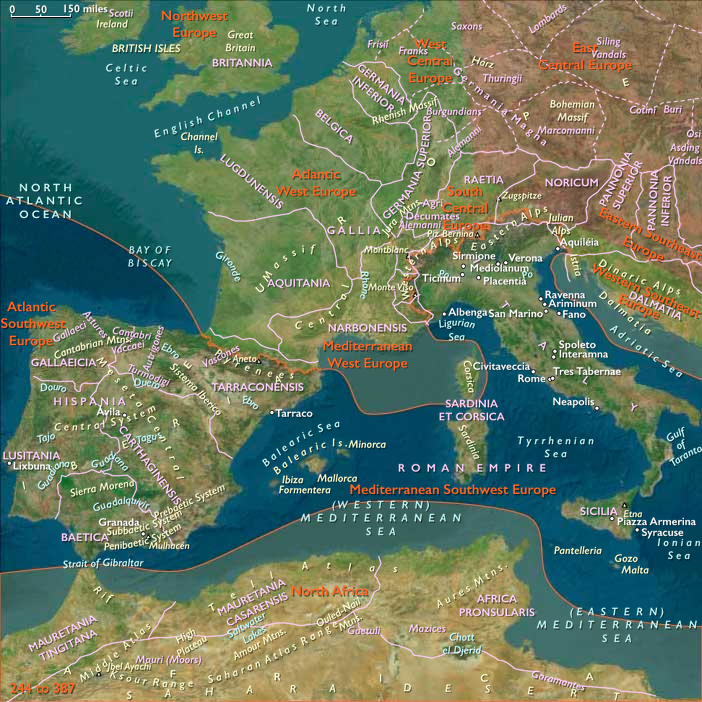
The Western Empire, under Gratian and later Valentinian II, experiences continuing political realignments and instability. Gratian’s reign (367–383 CE) is marked by internal dissent and military revolts, culminating in his assassination in 383 CE by the usurper Magnus Maximus, who briefly controls Britain, Gaul, and Spain, further complicating imperial governance.
Economic Resilience Amidst Instability
Despite these turbulent political developments, Mediterranean Southwest Europe continues to demonstrate economic resilience. Regional infrastructure, commerce, and agricultural productivity sustain relative prosperity, supported by effective local administration and ongoing trade networks.
Cultural Continuity and Christian Dominance
Cultural life remains dynamic, increasingly shaped by the prominence of Christianity. Artistic, literary, and philosophical activities reflect a rich synthesis of classical Roman heritage and Christian themes, illustrating the adaptability and vitality of Roman cultural traditions in a changing social environment.
Legacy of the Era
The era 376–387 CE highlights the complexity of managing external threats, internal divisions, and religious transformations. The Gothic crisis, the establishment of Nicene Christianity as the imperial religion, and ongoing political volatility significantly reshape the empire’s political and cultural landscape, laying foundations for profound historical transitions in Mediterranean Southwest Europe.
People
Groups
- Hispania Tarraconensis (Roman province)
- Hispania Baetica (Roman province)
- Goths (East Germanic tribe)
- Britain, Roman
- Hispania Carthaginensis (Roman province)
- Christianity, Nicene
- Gaul, Praetorian prefecture of
- Roman Empire: Valentinian dynasty (Rome)
- Roman Empire: Theodosian dynasty (Constantinople)
Topics
Subjects
Regions
Subregions
Related Events
Showing 10 events out of 30 total
Years: 376 - 387
People
Groups
- Hispania Tarraconensis (Roman province)
- Hispania Baetica (Roman province)
- Goths (East Germanic tribe)
- Britain, Roman
- Hispania Carthaginensis (Roman province)
- Christianity, Nicene
- Gaul, Praetorian prefecture of
- Roman Empire: Valentinian dynasty (Rome)
- Roman Empire: Theodosian dynasty (Constantinople)
Topics
Subjects
Regions
Subregions