
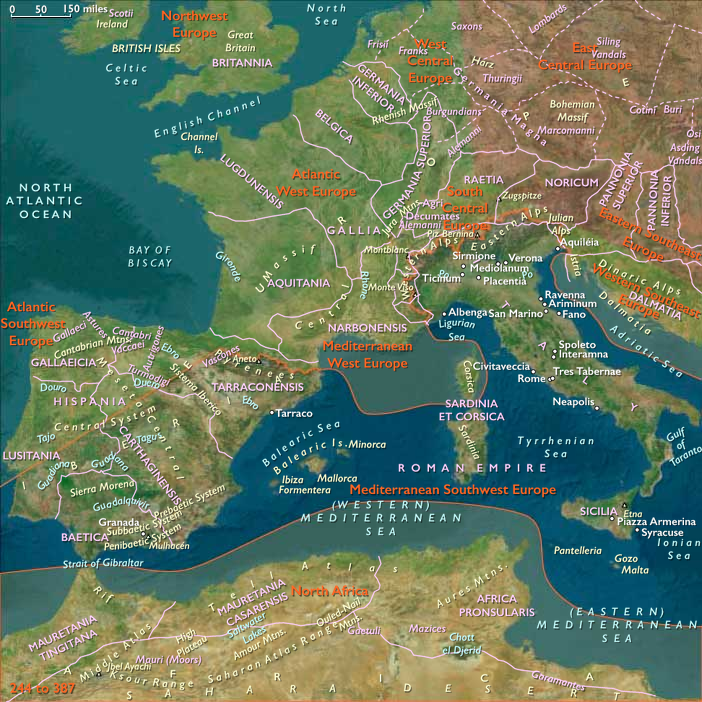
Mediterranean Southwest Europe (364–375 CE): Imperial Division …
Years: 364 - 375
Mediterranean Southwest Europe (364–375 CE): Imperial Division and Religious Tensions
The era 364–375 CE in Mediterranean Southwest Europe is marked by significant imperial divisions, religious tensions, and continued economic and cultural developments. This period follows the end of Julian the Apostate’s brief reign, highlighting the complexities of maintaining imperial stability amid increasing pressures both within and outside the empire.
Imperial Division and Valentinian Dynasty
In 364 CE, after the brief reign and death of Emperor Jovian, Valentinian I ascends the throne, quickly dividing imperial responsibilities by appointing his brother Valens as co-emperor in the East. This administrative split between the Western and Eastern Roman Empires establishes a significant long-term precedent, reflecting the growing complexities of governing an expansive and diverse empire.
Religious Tensions and Imperial Policies
Valentinian I, ruling the Western Empire, generally maintains a policy of religious toleration, avoiding active persecution and allowing Christianity to further consolidate its influence. However, religious tensions persist, particularly between Nicene Christians and various non-Nicene sects, continuing to influence political and social dynamics throughout Mediterranean Southwest Europe.
In contrast, Valens, ruling in the East, actively supports Arianism, intensifying sectarian divisions that indirectly impact the religious atmosphere of the Western provinces, further complicating intra-empire relations.
Economic Stability and Provincial Administration
The region continues to benefit from stable provincial governance and economic resilience due to the lasting impact of previous reforms. Infrastructure, trade, and commercial activities remain vibrant, enabling sustained regional prosperity despite broader imperial tensions.
Cultural and Intellectual Activity
Cultural and intellectual pursuits remain robust, further shaped by the increasing Christian influence on art, literature, and philosophical discourse. Traditional Roman cultural practices continue to blend with emerging Christian themes, contributing to an enriched and evolving cultural landscape.
Military Vigilance and Frontier Defenses
Valentinian I actively strengthens frontier defenses, particularly along the Rhine and Danube frontiers, to counter persistent external threats. These defensive measures provide relative stability, though military pressures remain a constant challenge to imperial authority and territorial integrity.
Legacy of the Era
The era 364–375 CE underscores the ongoing challenges faced by the Roman Empire, notably imperial divisions, religious controversies, and external pressures. Despite these difficulties, Mediterranean Southwest Europe demonstrates significant resilience through stable provincial administration, vibrant cultural and intellectual life, and sustained economic prosperity. These factors collectively shape the region’s historical trajectory, significantly influencing subsequent developments.
People
Groups
- Christianity, Arian
- Christianity, Nicene
- Roman Empire: Constantinian dynasty (Constantinople)
- Roman Empire: Valentinian dynasty (Rome)
Subjects
Regions
Subregions
Related Events
Filter results
Showing 10 events out of 59701 total
The Official Division of the Roman Empire (364 CE) and the Growing Vulnerability of the West
The division of the Roman Empire became official in 364 CE, when Emperor Valentinian I took control of the Western Roman Empire, while his brother Valens ruled the Eastern Roman Empire. This division, though initially intended as an administrative strategy, further weakened the empire’s ability to defend itself, especially in the West, where economic struggles and political instability left it increasingly vulnerable to barbarian incursions.
1. The Official Division of the Empire (364 CE)
- In 364 CE, after the brief rule of Jovian, the empire was officially divided:
- Valentinian I ruled the West, governing from Mediolanum (Milan) and Rome.
- Valens ruled the East, initially based in Constantinople, which would become the permanent capital of the Eastern Empire.
- The division reflected growing administrative challenges, as a single emperor could no longer effectively manage the vast empire.
2. Economic and Administrative Disruptions
- The Western Roman Empire faced severe financial problems, including:
- Declining tax revenues due to depopulation and economic decline.
- Increased military expenses to defend its borders.
- Corrupt administration and political infighting, which weakened the government.
- In contrast, the Eastern Roman Empire remained wealthier and more stable, with stronger trade connections to the Mediterranean and Asia.
3. Increased Barbarian Invasions
- As the West struggled, barbarian groups began launching more frequent and destructive raids.
- The most significant threats included:
- The Goths, who had been pressured by the advancing Huns and were seeking refuge within Roman borders.
- The Vandals and Alans, who began probing the empire’s western frontiers.
- The Franks and Alemanni, who continued to raid Gaul.
- These invasions further destabilized Roman control, as the Western Empire lacked the resources and manpower to defend its borders effectively.
4. Consequences of the Division
- While the Eastern Empire managed to reinforce its defenses, the West became increasingly vulnerable.
- The weakening of the Western military led to a reliance on barbarian mercenaries (foederati), who would later turn against Rome.
- The empire’s fragmentation made it easier for external enemies to exploit divisions between East and West.
5. Conclusion: A Precursor to the Fall of the West
The division of the Roman Empire in 364 CE was meant to strengthen imperial administration, but it ultimately led to a growing imbalance between East and West.
- While the Eastern Empire survived and thrived, the Western Empire spiraled into decline, ultimately collapsing in 476 CE.
- This period marked the beginning of the end for Rome in the West, as economic troubles, political instability, and barbarian invasions pushed it toward fragmentation and collapse.
Though the empire still endured, the events of 364 CE set the stage for the Western Roman Empire’s fall and the rise of medieval Europe.
East Central Europe (364–375 CE): Valentinian’s Frontier Consolidation and Persistent Gothic Pressure
Between 364 and 375 CE, East Central Europe—including Poland, Czechia, Slovakia, Hungary, and those portions of Germany and Austria lying east of 10°E and north of a line stretching from roughly 48.2°N at 10°E southeastward to the Austro-Slovenian border near 46.7°N, 15.4°E—experienced renewed Roman frontier consolidation under Emperor Valentinian I (364–375 CE), amid persistent external pressures from Gothic tribes. Valentinian strengthened frontier defenses along the Danube, reinforcing Roman provincial security in Pannonia and Noricum. Meanwhile, the Rugii remained stable in their settlements around the upper Tisza, and the proto-Slavic communities continued their resilience and adaptation within the Gothic sphere of influence.
Political and Military Developments
Valentinian’s Robust Frontier Policies
-
Emperor Valentinian I prioritized strengthening frontier defenses along the Danube, significantly reinforcing fortifications, increasing troop deployments, and improving defensive infrastructure.
-
Valentinian’s assertive military strategies provided a stronger barrier against repeated Gothic incursions, reducing their frequency and severity but not fully eliminating threats.
Continued Gothic Pressure
-
Gothic groups, while somewhat restrained by Valentinian’s fortified frontier, remained persistent threats, launching intermittent raids and maintaining diplomatic tensions, especially along vulnerable points in the Roman defenses.
Rugian Stability in Roman Pannonia
-
The Rugii maintained their established presence near the upper Tisza River, contributing positively to frontier stability. Their communities served as reliable diplomatic and economic partners for Roman authorities.
Economic and Technological Developments
Moderate Economic Recovery and Trade
-
Strengthened defenses under Valentinian allowed modest economic recovery along the frontier. Although cautious, cross-border trade between Romans, Rugii, and other neighboring tribes improved, increasing regional economic stability.
Frontier Infrastructure Strengthening
-
Infrastructure investment expanded, particularly regarding defensive fortifications, roads, and logistical networks, enhancing regional security and facilitating trade and communication.
Cultural and Artistic Developments
Artistic Adaptation and Integration
-
Cultural production along the frontier continued to reflect security concerns, though renewed stability allowed for more elaborate craftsmanship in metalwork, ceramics, and decorative artifacts.
-
Interaction among Romans, Rugii, and surrounding tribes fostered distinctive hybrid artistic styles, blending Germanic traditions and Roman techniques.
Proto-Slavic Cultural Continuity
-
Proto-Slavic communities remained culturally resilient, preserving traditional customs and practices despite ongoing external pressures from Gothic groups.
Settlement and Urban Development
Enhanced Frontier Towns
-
Frontier towns, including Carnuntum, Vindobona, and Aquincum, saw increased investment in fortifications and defensive infrastructure, becoming well-protected military and administrative centers.
Continued Stability of Rugian Settlements
-
Rugian communities consolidated their positions, becoming well-integrated, stable components of the regional landscape, benefiting from improved economic interactions and frontier defenses.
Social and Religious Developments
Stable Rugian Leadership
-
The Rugii maintained effective leadership structures, balancing diplomatic cooperation with Roman authorities and preserving tribal autonomy, contributing to regional stability.
Proto-Slavic Social Resilience
-
Proto-Slavic populations preserved strong social and religious traditions, maintaining internal cohesion and adapting successfully to the shifting regional environment under Gothic influence.
Long-Term Consequences and Historical Significance
The era 364–375 CE marked an important phase of frontier consolidation under Valentinian I. Roman defensive enhancements significantly improved regional stability, though Gothic pressures persisted. The enduring stability of Rugian and proto-Slavic communities provided valuable resilience, shaping East Central Europe’s political, cultural, and social landscape. These developments laid essential foundations for subsequent historical changes and transformations across the region in the late fourth century and beyond.
Eastern Southeast Europe (364–375 CE): Barbarian Invasions and Cultural Transitions
Settlement and Migration Patterns
Onset of Barbarian Invasions
Between 364 and 375 CE, Eastern Southeast Europe experienced intensified invasions by Germanic and Central Asian tribes, dramatically reshaping the region's demographic and cultural landscape. The first major incursions included those by the Visigoths, Ostrogoths, Gepids, and later the nomadic pastoralist Huns, who arrived around 370 from Central Asia. These groups swept across the Danube frontier, overwhelming Roman defenses and precipitating a wave of instability and population displacement.
Decline of Dacian Settlements
As Rome's power receded from the region, Dacia became increasingly vulnerable, transforming into a thoroughfare for invading tribes aiming for wealthier lands further west and south. Roman-built towns and settlements were progressively abandoned, infrastructure deteriorated, and rural life declined precipitously, leaving local populations exposed to frequent plundering and disruptions.
Economic and Technological Developments
Economic Collapse and Insecurity
The relentless incursions severely undermined economic stability, trade, and agriculture. Crumbling Roman roads became unsafe due to highwaymen and banditry, severely impacting trade and travel. While some fortified urban centers struggled to maintain economic activity, rural commerce and agricultural productivity dramatically decreased under continuous threat.
Infrastructure Decay
Roman infrastructure, once the backbone of regional connectivity and prosperity, fell into disrepair. Roads, aqueducts, and urban defenses deteriorated due to lack of maintenance, resources, and security, symbolizing the broader regional decline.
Cultural and Artistic Developments
Emergence of Dacian Ethnic Identity
Despite political and economic turmoil, this era marked the consolidation of a distinct Dacian ethnic identity, emerging from the fusion of Roman colonists, indigenous Getae, and coastal Greek populations. This cultural synthesis fostered new forms of linguistic expression and religious practices, laying foundations for later Romanian cultural heritage.
Linguistic Transition and Literacy
The Vulgar Latin language increasingly replaced the native Thracian tongue in commerce, administration, and daily life, significantly advancing literacy among local populations, especially those involved with the Roman military and administrative systems. This linguistic shift laid the groundwork for the evolution of the modern Romanian language.
Social and Religious Developments
Religious Syncretism and Continuity
A notable religious fusion occurred during this period, reflecting both Roman and indigenous influences. The local populace, having embraced deities from the Greco-Roman pantheon such as Jupiter, Diana, and Venus, also retained indigenous religious traditions, such as cremation rites originally practiced by the Getae, often incorporating Roman customs such as placing coins with cremated remains for Charon, the mythological ferryman of the dead.
Mithraic and Indigenous Beliefs
Some inhabitants continued the worship of Mithras, the Persian god of light popular among Roman legionnaires. These religious practices exemplified the diverse and syncretic spiritual landscape that persisted even amidst regional upheaval.
Long-Term Consequences and Historical Significance
The period from 364 to 375 CE represented a critical turning point for Eastern Southeast Europe, characterized by severe barbarian invasions, economic disintegration, infrastructure collapse, and profound cultural transformation. Despite these disruptions, significant cultural and linguistic developments took root, ultimately shaping the region's enduring ethnic, linguistic, and religious herita
Eastern Southeast Europe (364–375 CE): Barbarian Invasions and Cultural Transitions
Settlement and Migration Patterns
Onset of Barbarian Invasions
Between 364 and 375 CE, Eastern Southeast Europe experienced intensified invasions by Germanic and Central Asian tribes, dramatically reshaping the region's demographic and cultural landscape. The first major incursions included those by the Visigoths, Ostrogoths, Gepids, and later the nomadic pastoralist Huns, who arrived around 370 from Central Asia. These groups swept across the Danube frontier, overwhelming Roman defenses and precipitating a wave of instability and population displacement.
Decline of Dacian Settlements
As Rome's power receded from the region, Dacia became increasingly vulnerable, transforming into a thoroughfare for invading tribes aiming for wealthier lands further west and south. Roman-built towns and settlements were progressively abandoned, infrastructure deteriorated, and rural life declined precipitously, leaving local populations exposed to frequent plundering and disruptions.
Economic and Technological Developments
Economic Collapse and Insecurity
The relentless incursions severely undermined economic stability, trade, and agriculture. Crumbling Roman roads became unsafe due to highwaymen and banditry, severely impacting trade and travel. While some fortified urban centers struggled to maintain economic activity, rural commerce and agricultural productivity dramatically decreased under continuous threat.
Infrastructure Decay
Roman infrastructure, once the backbone of regional connectivity and prosperity, fell into disrepair. Roads, aqueducts, and urban defenses deteriorated due to lack of maintenance, resources, and security, symbolizing the broader regional decline.
Cultural and Artistic Developments
Emergence of Dacian Ethnic Identity
Despite political and economic turmoil, this era marked the consolidation of a distinct Dacian ethnic identity, emerging from the fusion of Roman colonists, indigenous Getae, and coastal Greek populations. This cultural synthesis fostered new forms of linguistic expression and religious practices, laying foundations for later Romanian cultural heritage.
Linguistic Transition and Literacy
The Vulgar Latin language increasingly replaced the native Thracian tongue in commerce, administration, and daily life, significantly advancing literacy among local populations, especially those involved with the Roman military and administrative systems. This linguistic shift laid the groundwork for the evolution of the modern Romanian language.
Social and Religious Developments
Religious Syncretism and Continuity
A notable religious fusion occurred during this period, reflecting both Roman and indigenous influences. The local populace, having embraced deities from the Greco-Roman pantheon such as Jupiter, Diana, and Venus, also retained indigenous religious traditions, such as cremation rites originally practiced by the Getae, often incorporating Roman customs such as placing coins with cremated remains for Charon, the mythological ferryman of the dead.
Mithraic and Indigenous Beliefs
Some inhabitants continued the worship of Mithras, the Persian god of light popular among Roman legionnaires. These religious practices exemplified the diverse and syncretic spiritual landscape that persisted even amidst regional upheaval.
Long-Term Consequences and Historical Significance
The period from 364 to 375 CE represented a critical turning point for Eastern Southeast Europe, characterized by severe barbarian invasions, economic disintegration, infrastructure collapse, and profound cultural transformation. Despite these disruptions, significant cultural and linguistic developments took root, ultimately shaping the region's enduring ethnic, linguistic, and religious herita
The Goths sack Roman fortresses along the Danube River.
A Dacian ethnic identity has arisen over the past two hundred years, as Roman colonists have commingled with the Getae and the coastal Greeks.
Literacy spreads, and Getae who enlist in the Roman army learn Latin.
A Vulgar Latin tongue gradually supersedes the Thracian language in commerce and administration and becomes the foundation of modern Romanian; a religious fusion also occurs.
Some Getae, even before the Roman invasion, had worshiped Mithras, the ancient Persian god of light popular in the Roman legions.
Worshipers faithful to Jupiter, Diana, Venus, and other gods and goddesses of the Roman pantheon have multiplied as Roman colonization has progressed.
The Dacians, however, retain the Getian custom of cremation, though now, amid the ashes they sometimes leave a coin for Charon, the mythological ferryman of the dead.
Barbarian tribes begin to prey upon the Roman Empire in the fourth century, and the fortunes of the Illyrian-populated lands sag.
The Germanic Goths and Asiatic Huns are the first to arrive, invading in mid-century.
Dacia without Rome's protection becomes a conduit for invading tribes who, targeting richer lands further west and south, plunder Dacian settlements in passing.
Dacian towns are abandoned, highwaymen menace travelers along crumbling Roman roads, and rural life decays.
The Visigoths, Huns, Ostrogoths, Gepids, and Lombards sweep over the land from the third to the fifth centuries.
The Huns, a nomadic pastoralist people from Central Asia, invade southeastern Europe around 370 and remain in the background, gradually subjugating many Germanic and other tribes.
The terrified Goths and related tribes burst through the Danube frontier into the Roman Empire, and the Balkans become once again a battlefield for German armies.
The Middle East: 364–375 CE
Shifts in Roman-Persian Relations and Regional Stabilization
The period from 364 to 375 CE in the Middle East follows the traumatic Roman defeats suffered under Emperor Julian, ushering in an era of cautious stabilization and diplomatic recalibration. Emperor Valens (364–378), inheriting a diminished eastern frontier, prioritizes securing the Roman border against renewed Sassanid Persian aggression under King Shapur II.
In 371 CE, Valens and Shapur conclude a critical peace treaty, ending the prolonged conflicts and establishing a diplomatic equilibrium. Under this treaty, the previously ceded city of Nisibis remains firmly under Persian control, solidifying Persian dominance in northern Mesopotamia. The frontier is fortified, and relations normalize, permitting a period of relative peace and economic recovery along the borderlands.
Simultaneously, this interval allows Valens to shift his attention northward, toward pressing threats posed by Gothic and other barbarian incursions into the Balkans. The stabilization of the Persian frontier proves crucial, enabling Rome to reposition military resources to more threatened frontiers.
Culturally, this era continues to witness the flourishing of Christian institutions across the Roman-controlled Middle East. Increasingly consolidated in major urban centers, the Church becomes deeply integrated into Roman administrative and social structures. Concurrently, the Persian-controlled territories, including Babylonia, remain centers of intellectual and religious diversity, particularly noted for the ongoing compilation and scholarly refinement of the Babylonian Talmud.
Thus, the era 364–375 CE represents a brief but critical period of diplomatic realignment and stabilization between the Roman and Sassanid empires, setting the stage for further geopolitical developments and ensuring cultural and religious evolution throughout the region.
Much is known about Samudragupta through coins issued by him and inscriptions.
These were of eight different types and all made of pure gold.
His conquests brought him the gold and also the coin-making expertise from his acquaintance with the Kushana.
Samudragupta was a patron of learning, a celebrated poet and a musician.
Several coins depict him playing on the Indian lyre or veena.
He gathered a galaxy of poets and scholars and took effective actions to foster and propagate religious, artistic and literary aspects of Indian culture.
Though he favored the Hindu religion like the other Gupta kings, he was reputed to possess a tolerant spirit vis-a-vis other religions.
A clear illustration of this is the permission granted by him to the king of Ceylon to build a monastery for Buddhist pilgrims in Bodh Gaya.
Samudragupta is sometimes called the 'Napoleon of India' because of the many wars he waged.
North Africa (364–375 CE)
Imperial Continuity, Economic Resilience, and Cultural Adaptation
Stability Under Valentinian and Valens
Between 364 and 375 CE, North Africa remains relatively stable under the co-emperors Valentinian I and Valens, who effectively manage imperial administration and reinforce regional governance. Their rule brings administrative continuity, supporting sustained economic prosperity and cultural vitality despite ongoing pressures within the broader Roman Empire.
Continued Military Vigilance and Frontier Security
Roman military units maintain a robust defense along strategic frontier fortifications, notably from Vescera (Biskra) to Ad Majores (Hennchir Besseriani). Consistent military vigilance effectively mitigates threats posed by Berber incursions and Saharan nomadic movements, safeguarding agricultural and commercial stability throughout the region.
Economic Strength and Agricultural Production
North Africa sustains its economic strength, driven by continued productivity in grain and olive oil—commodities essential to the broader Roman economy. Prominent commercial hubs, including Utica, Leptis Magna, and Caesarea (Cherchell), thrive economically, actively engaging in extensive Mediterranean trade networks.
Numidia and Mauretania: Persistent Stability and Cultural Integration
Numidia continues to benefit from stable Roman governance and infrastructural developments, ensuring regional social cohesion and sustained economic resilience. The integration of indigenous cultural practices within Roman administrative frameworks remains robust.
Mauretania similarly sustains economic prosperity through active commerce, particularly in grain, olive oil, and luxury commodities. The city of Caesarea continues as a significant commercial and cultural hub, consistently benefiting from Roman infrastructure investment and strategic trade activities.
Cyrenaica: Cultural Continuity and Economic Prosperity
Cyrenaica maintains scholarly excellence and economic stability. The Greek Pentapolis—Cyrene, Barce (Al Marj), Euhesperides (Benghazi), Teuchira (Tukrah), and Apollonia (Susah)—remains actively involved in Mediterranean trade and intellectual activities, reinforcing regional cultural vitality.
Tripolitania: Economic Prosperity and Cultural Heritage
Tripolitania continues its economic prosperity through substantial olive oil exports and dynamic trans-Saharan commerce facilitated by the Garamantes. Cities such as Leptis Magna maintain their distinctive Punic cultural heritage, sustaining a vibrant identity within the broader Roman context.
Berber, Garamantian, and Saharan Communities
Berber communities actively participate in coastal economic networks, particularly through cities such as Oea (Tripoli). Inland Berber tribes maintain traditional governance structures and indirectly benefit from thriving coastal commerce.
The Garamantes continue their pivotal role as facilitators of trans-Saharan trade, supporting sustained economic and cultural exchanges between sub-Saharan Africa and Mediterranean markets.
Pastoral communities, including the Mauri (Moors), remain crucial intermediaries in inland and coastal trade networks, significantly contributing to regional stability and economic integration.
Christian Influence and Cultural Adaptation
Christianity maintains its influential role across North Africa, reinforcing regional social cohesion and cultural identity. Christian communities continue demonstrating resilience and adaptability, shaping societal structures amid ongoing imperial and religious dynamics.
Continued Cultural Syncretism and Vibrancy
Dynamic interactions among diverse cultural and religious communities—Berber, Roman, Greek, Jewish, Garamantian, Mauri, and Saharan nomads—continue enriching North Africa’s cultural landscape. Persistent syncretism blending indigenous Berber practices with Roman, Greek, Phoenician, and Saharan traditions ensures cultural resilience and adaptability.
Regional Stability and Enduring Strategic Importance
By 375 CE, North Africa effectively navigates ongoing imperial challenges, maintaining robust economic productivity, vigilant defense strategies, and dynamic cultural exchanges. The region’s enduring stability and strategic importance remain firmly established within the broader Roman Empire.
Atlantic Southwest Europe (364–375 CE): Stability and Adaptation under Valentinian, Continued Christian Expansion, and Local Resilience
Between 364 and 375 CE, Atlantic Southwest Europe—including northern and central Portugal, Galicia, Asturias, Cantabria, and northern Spain south of the Franco-Spanish border (43.05548° N, 1.22924° W)—experienced a period of relative imperial stability and effective governance under Emperor Valentinian I (364–375 CE). Despite broader imperial challenges, including military threats along the Rhine and Danube frontiers, the region maintained internal peace, economic stability, and deepening integration of Christian institutions. Strong local governance, adaptive economic strategies, and vibrant cultural traditions continued to define this era, demonstrating sustained regional resilience.
Political and Military Developments
Effective Imperial Administration and Provincial Stability
-
Valentinian I’s reign (364–375 CE) restored relative imperial stability to the western provinces, including Atlantic Southwest Europe, through administrative reforms, military reorganization, and clearer governance structures. This imperial consolidation positively affected the region, reinforcing provincial security, effective taxation systems, and stable administration.
-
Local civic elites maintained critical roles in governance, efficiently managing provincial administration, fortified towns, and regional security, ensuring continued internal stability and cohesion.
Continued Stability and Integration of Northern Tribes
-
Northern tribal groups—particularly the Gallaeci, Astures, and Cantabri—remained peaceful, prosperous, and effectively integrated within provincial governance structures. Ongoing collaboration with provincial authorities strengthened regional governance and internal stability.
-
The Vascones successfully preserved territorial autonomy, diplomatic neutrality, cultural distinctiveness, and internal stability, significantly bolstering overall regional resilience.
Economic and Technological Developments
Economic Prosperity and Sustained Regional Production
-
The economy of Atlantic Southwest Europe remained resilient, supported by robust regional production in agriculture, livestock, mining (silver, copper, tin), timber, textiles, pottery, and continuing Mediterranean trade. Economic prosperity persisted through strengthened internal networks and adaptive local trade strategies, despite broader imperial challenges elsewhere.
-
Provincial elites managed resources efficiently, navigating imperial taxation demands effectively, ensuring sustained regional economic stability.
Continued Shift from Slavery to Localized Labor Systems
-
The region’s economic structure continued moving decisively away from traditional reliance on widespread slavery toward increasingly sustainable local labor systems, including tenant farming, semi-free labor (coloni), free artisans, and community-based labor arrangements.
Infrastructure Maintenance and Technological Adaptation
-
Infrastructure—including roads, aqueducts, bridges, urban fortifications, public amenities, and temples—continued receiving targeted maintenance and enhancements, significantly improving provincial connectivity, economic efficiency, and urban resilience.
-
Technological innovations continued locally, particularly in agriculture, metallurgy, and construction, sustaining productivity, economic stability, and regional prosperity.
Cultural and Religious Developments
Deepening Integration of Christian Institutions
-
Christianity continued to expand, becoming increasingly influential throughout the region. Christian institutions—churches, bishoprics, monasteries, and urban Christian communities—strengthened their social presence, profoundly influencing local governance, social structures, and cultural identities.
-
Bishops and clergy assumed prominent civic and administrative roles, further integrating Christian institutions into provincial governance, significantly reshaping local power dynamics and social cohesion.
Continued Cultural Resilience and Syncretic Traditions
-
Traditional indigenous cultural practices remained robust, dynamically blending with expanding Christian religious influences. Material culture—including metalwork, jewelry, pottery, and ceremonial artifacts—continued reflecting strong regional identities and cultural resilience.
-
Indigenous Iberian, Celtic, and traditional Roman religious practices persisted actively in rural and tribal communities, increasingly integrating Christian symbolism, beliefs, and rituals, creating a distinct syncretic cultural landscape.
Civic Identity and Provincial Integration under Valentinian
-
Civic identity continued adapting to Valentinian’s effective imperial administration and deepening Christian integration. Regional identities blended strong local traditions, universal Roman citizenship, and expanding Christian affiliations, reinforcing regional coherence amid broader imperial developments.
Notable Tribal Groups and Settlements
-
Lusitanians: Maintained economic prosperity, cultural vibrancy, and significant integration of Christian institutions, deeply influencing local governance and regional identity.
-
Vettones and Vaccaei: Preserved regional stability, autonomy, and economic resilience, effectively managing religious shifts and integrating Christian practices into local society.
-
Gallaeci, Astures, Cantabri: Continued prosperous and culturally resilient governance, actively preserving indigenous traditions while increasingly adopting Christianity.
-
Vascones: Successfully maintained diplomatic neutrality, territorial autonomy, cultural distinctiveness, and internal stability, significantly reinforcing regional resilience.
Long-Term Significance and Legacy
Between 364 and 375 CE, Atlantic Southwest Europe:
-
Experienced enhanced provincial stability and effective governance under Valentinian I, successfully navigating broader imperial challenges through strong local administrative frameworks.
-
Sustained resilient economic prosperity and adaptive labor structures, significantly transitioning away from slavery toward sustainable local labor arrangements.
-
Saw deepening Christian institutional integration, profoundly reshaping cultural identities, social structures, and regional governance frameworks, setting critical foundations for future regional historical and cultural developments.
This era reinforced Atlantic Southwest Europe's historical legacy as a stable, economically resilient, culturally vibrant region undergoing substantial religious and social transformations, laying enduring foundations for its long-term identity and institutional stability.
Years: 364 - 375
People
Groups
- Christianity, Arian
- Christianity, Nicene
- Roman Empire: Constantinian dynasty (Constantinople)
- Roman Empire: Valentinian dynasty (Rome)
