
Mediterranean Southwest Europe (477–334 BCE): Iberian Artistry …
Years: 477BCE - 334BCE
Mediterranean Southwest Europe (477–334 BCE): Iberian Artistry and Regional Power Shifts
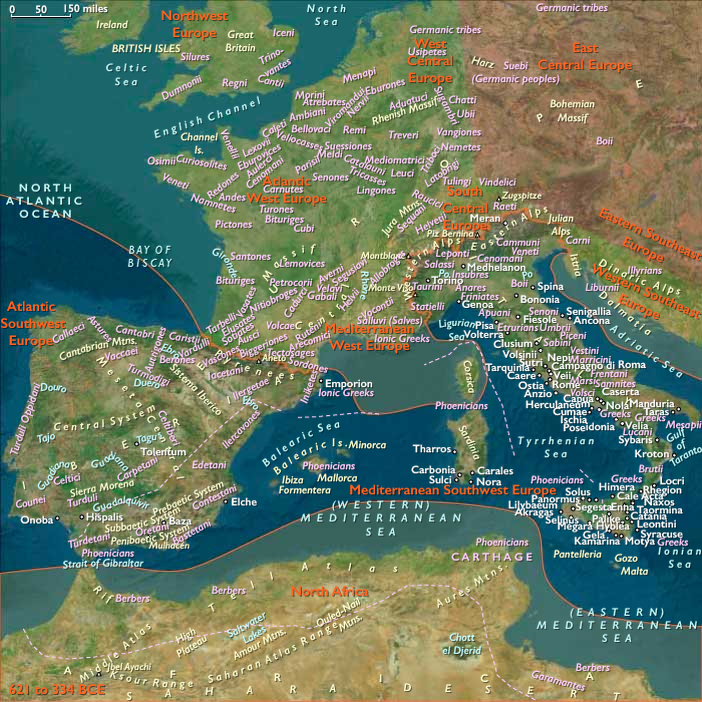
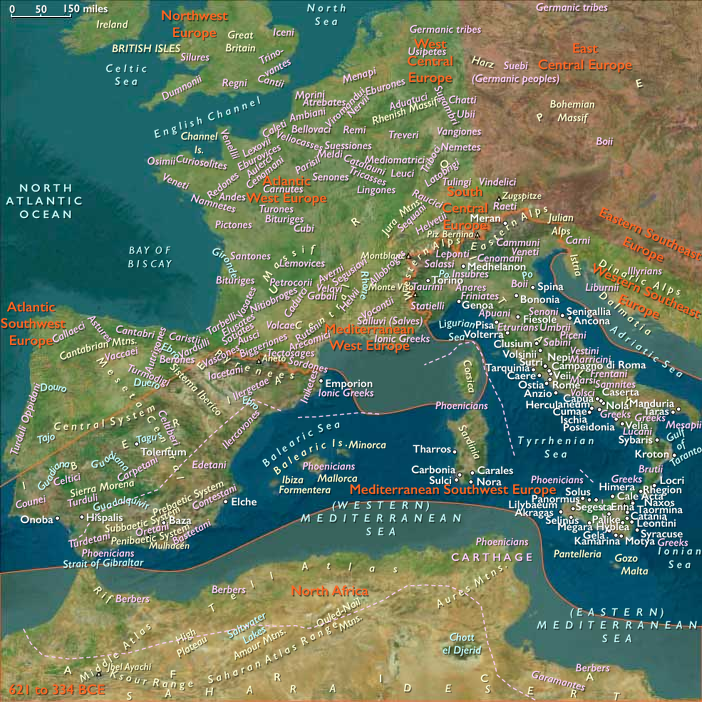
The age 477–334 BCE in Mediterranean Southwest Europe is defined by artistic cultural achievements in Iberia, evolving political and territorial dynamics in Italy, Sicily, and conflicts involving emerging powers like Rome and Carthage.
Iberian Culture and Art
The Iberian Peninsula witnesses significant cultural and artistic achievements, especially from the ancient Iberian people known as the Bastetani or Bastuli. Their territory spans present-day Almería, Granada, Albacete, eastern Málaga, southeastern Jaén in Andalusia, and western Murcia. Prominent towns include Baria (present-day Villaricos), Bailo (Cádiz), Abdera, Sexi, Malaca, and Carteia. Notably, Iberian sculpture reaches a high point with the creation of iconic works such as the Lady of Baza (la Dama de Baza), a limestone female figure displaying traces of painted stucco decoration discovered in 1971 near Granada.
Another significant Iberian sculpture is the famous Lady of Elche, a Phoenician-influenced, polychrome stone bust depicting a regal woman from around the fourth century BCE. This sculpture, believed to have associations with the Carthaginian goddess Tanit, demonstrates a blend of Iberian craftsmanship and Hellenistic artistic influences. Its construction, featuring an aperture at the rear, suggests it likely functioned as a funerary urn.
Etruscan and Roman Transformations
Throughout this period, the power of the Etruscans steadily declines, challenged by incursions from both Rome and Celtic tribes. The city of Veii, a rich Etruscan center, falls to Rome in 396 BCE after a prolonged siege led by General Marcus Furius Camillus. Subsequently, Roman territorial expansion continues, notably with the capture of Sutri and Nepi in 387 BCE, followed by Caere and its port of Pyrgi in 384 BCE.
Additionally, in response to increasing social tensions, Rome undergoes significant political restructuring. The plebeian class gains greater political rights, most notably after 367 BCE, when one of the two Roman consuls is consistently chosen from the plebeians, allowing broader representation in the Senate.
Greek Colonization and Sicilian Conflicts
Sicily remains a focal point of Greek colonization and conflicts during this age. Notably, the Greek city of Poseidonia falls under domination by the Lucanians before 400 BCE, subsequently renamed Paestum. Furthermore, conflicts between Greek colonies such as Selinus and Segesta draw in Carthaginian involvement. The Second Sicilian War (410–404 BCE) begins after Carthage, under Hannibal Mago, intervenes to support Segesta, dramatically shaping Sicilian geopolitics.
In 344 BCE, Timoleon of Corinth intervenes decisively in Sicilian affairs, defeating the tyrant Hicetas and a Carthaginian army at the Battle of the Crimissus, resulting in a peace treaty in 338 BCE that restricts Carthaginian influence in Sicily.
Roman-Latin and Samnite Wars
The era is also marked by critical military conflicts, such as the Latin War (340–338 BCE), which concludes with the dissolution of the Latin League and the expansion of Roman territorial control. Concurrently, the First Samnite War (343–341 BCE) sees Rome drawn into conflict with the warlike Samnites, initially siding with the city-state of Capua. Although this first conflict ends quickly, it foreshadows prolonged future struggles between Rome and Samnium.
Celtic Expansion
Celtic tribes, notably the Senones, significantly impact northern Italy, crossing the Alps around 400 BCE. By 390 BCE, under King Brennus, they sack Rome after defeating Roman forces at the Allia River, causing extensive destruction and prompting a costly Roman tribute.
Legacy of the Era
The age 477–334 BCE profoundly shapes Mediterranean Southwest Europe, characterized by significant artistic achievements, shifting geopolitical landscapes in Italy and Sicily, the rise of Rome as a dominant regional power, and ongoing cultural integration influenced by Iberian, Greek, Roman, and Carthaginian interactions. These developments lay the groundwork for the subsequent classical civilizations and the broader historical trajectory of the region.
People
- Brennus
- Dion
- Dionysius II of Syracuse
- Hannibal (Mago)
- Hicetas of Leontini
- Lucius Aemilius Mamercinus Privernas
- Marcus Furius Camillus
- Timoleon
Groups
- Sicily, classical
- Italy, classical
- Celts
- Corinth, City-State of
- Segesta, (Elymian-Ionian Greek) city-state of
- Syracuse, Corinthian city-state of
- Selinus, (Dorian Greek) city-state of
- Etruria
- Latin League
- Gauls
- Roman Republic
- Lucani
- Sidicini
- Bastetani
- Samnium
Topics
- Sicilian Wars, or Carthaginian-Syracusan Wars
- Sicilian War, Second, or Second Carthaginian-Syracusan War
- Roman–Gallic wars
- Rome, Celtic Sack of
- Allia, Battle of the
- Samnite War, First
- Latin War
- Crimissus, Battle of the
Subjects
Regions
Subregions
Related Events
Showing 10 events out of 22 total
Years: 477BCE - 334BCE
People
- Brennus
- Dion
- Dionysius II of Syracuse
- Hannibal (Mago)
- Hicetas of Leontini
- Lucius Aemilius Mamercinus Privernas
- Marcus Furius Camillus
- Timoleon
Groups
- Sicily, classical
- Italy, classical
- Celts
- Corinth, City-State of
- Segesta, (Elymian-Ionian Greek) city-state of
- Syracuse, Corinthian city-state of
- Selinus, (Dorian Greek) city-state of
- Etruria
- Latin League
- Gauls
- Roman Republic
- Lucani
- Sidicini
- Bastetani
- Samnium
Topics
- Sicilian Wars, or Carthaginian-Syracusan Wars
- Sicilian War, Second, or Second Carthaginian-Syracusan War
- Roman–Gallic wars
- Rome, Celtic Sack of
- Allia, Battle of the
- Samnite War, First
- Latin War
- Crimissus, Battle of the
Subjects
Regions
Subregions