
Mediterranean Southwest Europe (100–243 CE): Imperial Zenith, …
Years: 100 - 243
Mediterranean Southwest Europe (100–243 CE): Imperial Zenith, Cultural Flourishing, and Emerging Instability
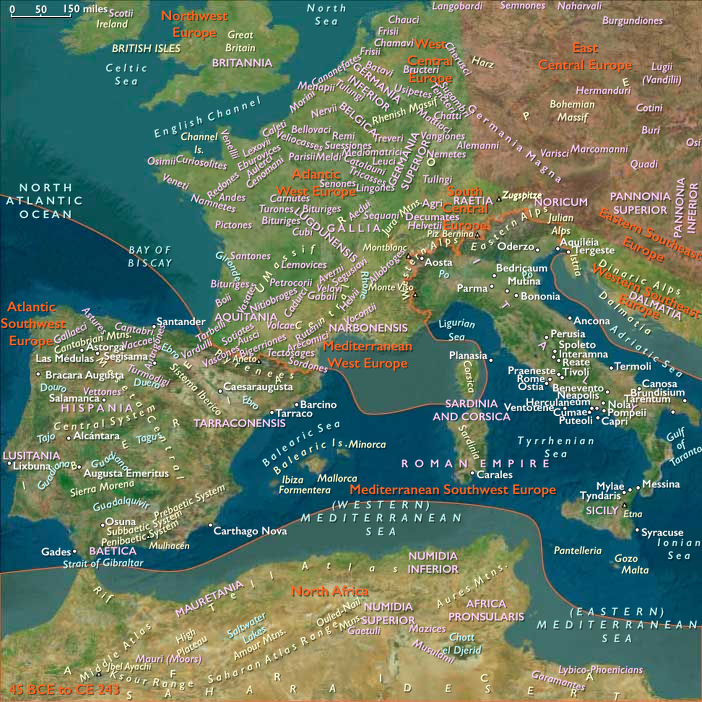
The age 100–243 CE in Mediterranean Southwest Europe—covering Italy, southern and eastern Iberia, Andorra, and the islands of the Western Mediterranean except Corsica—marks the peak and initial decline of Roman imperial power. The period witnesses remarkable territorial expansion, significant cultural contributions from prominent Hispano-Roman figures, intense religious debates, and escalating internal tensions that culminate in political crisis.
Trajan’s Golden Age and Imperial Expansion (100–111 CE)
Under Emperor Trajan (r. 98–117 CE), the Roman Empire reaches its territorial zenith, encompassing nearly five million square kilometers. Trajan, born in Hispania to a colonial Roman family, significantly strengthens the empire through military campaigns, particularly the Dacian Wars, extensive infrastructure projects, and judicial reforms. The Hispano-Roman elite increasingly contribute to Roman society, with the region fully integrated into the imperial structure by the end of the first century CE.
Cultural Reflections and Societal Critiques (112–123 CE)
The satirist Juvenal critically assesses Roman society, immortalizing phrases such as "bread and circuses" and "who will watch the watchers?" His writings underscore cultural introspection and societal concerns during a period of relative stability and economic growth.
Architectural and Cultural Innovations under Hadrian (124–135 CE)
Emperor Hadrian (r. 117–138 CE), another Hispano-Roman, significantly transforms Rome’s architectural landscape, notably with the Pantheon and the Temple of Trajan. Hadrian’s urban reforms and infrastructural projects underline a period of sustained prosperity and cultural patronage.
Continued Stability under Antoninus Pius (136–147 CE)
Hadrian's successor, Antoninus Pius, maintains administrative efficiency, judicial fairness, and regional prosperity. Infrastructure and cultural activities continue robustly, ensuring prolonged stability and intellectual vibrancy.
Religious Debates and Christian Expansion (148–159 CE)
During Pope Anicetus’s pontificate, Rome becomes a significant center for Christian theological debates, exemplified by Polycarp’s visit and discussions on Paschal observances. This era solidifies Christianity’s role as an increasingly influential intellectual and religious presence within Roman society.
Marcus Aurelius and Philosophical Flourishing (160–171 CE)
Emperor Marcus Aurelius (r. 161–180 CE), also of Hispano-Roman descent, embodies Stoic philosophy, producing his reflective masterpiece, Meditations. Concurrently, Christian intellectuals, notably Justin Martyr and Tatian, actively engage with Greek philosophical traditions, deeply influencing Christian theology and apologetics.
Marcus Aurelius’s Military and Philosophical Leadership (172–183 CE)
Marcus Aurelius balances philosophical pursuits with military responsibilities, particularly during the Marcomannic Wars. Cultural and artistic expressions, exemplified by intricately carved Roman sarcophagi, continue to thrive despite external challenges.
Commodus’s Decline and Imperial Instability (184–195 CE)
Commodus's troubled reign drastically destabilizes Rome through extravagance and erratic governance. His assassination precipitates a period of political upheaval, starkly contrasting with previous imperial stability.
Severan Dynasty’s Restoration and Economic Revival (196–207 CE)
Septimius Severus restores stability, consolidating military strength, implementing administrative reforms, and revitalizing the economy. His reign fortifies imperial borders and fosters continued regional prosperity.
Caracalla’s Citizenship Reform and Internal Struggles (208–219 CE)
Emperor Caracalla’s Constitutio Antoniniana profoundly reshapes Roman society, granting citizenship to nearly all free inhabitants. Despite internal tensions and familial strife, infrastructure projects and economic stability persist.
From Chaos to Stability under Alexander Severus (220–231 CE)
The turbulent reign of Elagabalus yields to Alexander Severus, whose moderate governance and judicial reforms stabilize the empire temporarily. His efforts maintain economic vitality and cultural activity despite rising external threats.
Late Severan Instability and the Third Century Crisis (232–243 CE)
Alexander Severus’s later reign faces significant military pressures, culminating in his assassination in 235 CE, which triggers the prolonged "Crisis of the Third Century." This period reveals deep vulnerabilities within the imperial structure.
Legacy of the Age
The period from 100–243 CE represents the Roman Empire at its apex, characterized by territorial expansion, cultural and intellectual achievements, and extensive contributions from Hispano-Romans like Trajan, Hadrian, Marcus Aurelius, Seneca, Lucanus, and Martial. Despite eventual instability, the advancements in governance, citizenship rights, infrastructure, and intellectual life during this era significantly influence Roman society, laying enduring foundations for European cultural and historical development.
People
- Alexander Severus
- Antoninus Pius
- Caracalla
- Commodus
- Elagabalus
- Hadrian
- Justin Martyr
- Juvenal
- Marcus Aurelius
- Martial
- Pope Saint Anicetus
- Septimius Severus
- Tatian
- Trajan
- Ulpian
Groups
- Christians, Early
- Roman Empire (Rome): Nerva-Antonine dynasty
- Roman Empire (Rome): Severan dynasty
- Roman Empire (Rome): Non-dynastic
Topics
- Dacian War, First
- Dacian War, Second
- Marcomannic Wars
- Crisis of the Third Century (Roman Civil “War” of 235-84)
Subjects
- Writing
- Architecture
- Decorative arts
- Conflict
- Mayhem
- Faith
- Government
- Custom and Law
- Philosophy and logic
- Theology
Regions
Subregions
Related Events
Showing 10 events out of 61429 total
Years: 100 - 243
People
- Alexander Severus
- Antoninus Pius
- Caracalla
- Commodus
- Elagabalus
- Hadrian
- Justin Martyr
- Juvenal
- Marcus Aurelius
- Martial
- Pope Saint Anicetus
- Septimius Severus
- Tatian
- Trajan
- Ulpian
Groups
- Christians, Early
- Roman Empire (Rome): Nerva-Antonine dynasty
- Roman Empire (Rome): Severan dynasty
- Roman Empire (Rome): Non-dynastic
Topics
- Dacian War, First
- Dacian War, Second
- Marcomannic Wars
- Crisis of the Third Century (Roman Civil “War” of 235-84)
Subjects
- Writing
- Architecture
- Decorative arts
- Conflict
- Mayhem
- Faith
- Government
- Custom and Law
- Philosophy and logic
- Theology
Regions
Subregions