
Mediterranean Southwest Europe (1828–1971 CE): Nation-Building, Dictatorship, …
Years: 1828 - 1971
Mediterranean Southwest Europe (1828–1971 CE): Nation-Building, Dictatorship, and the Reinvention of Mediterranean Economies
Geography & Environmental Context
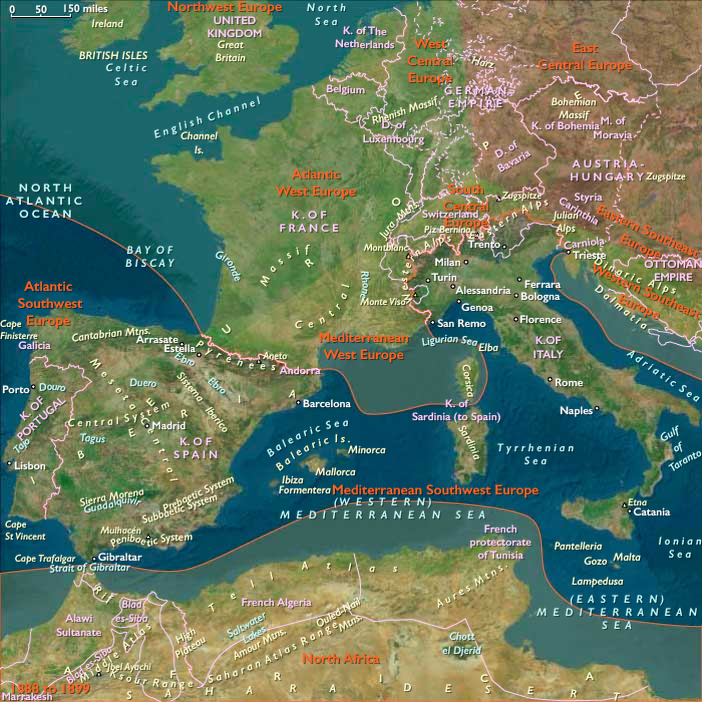
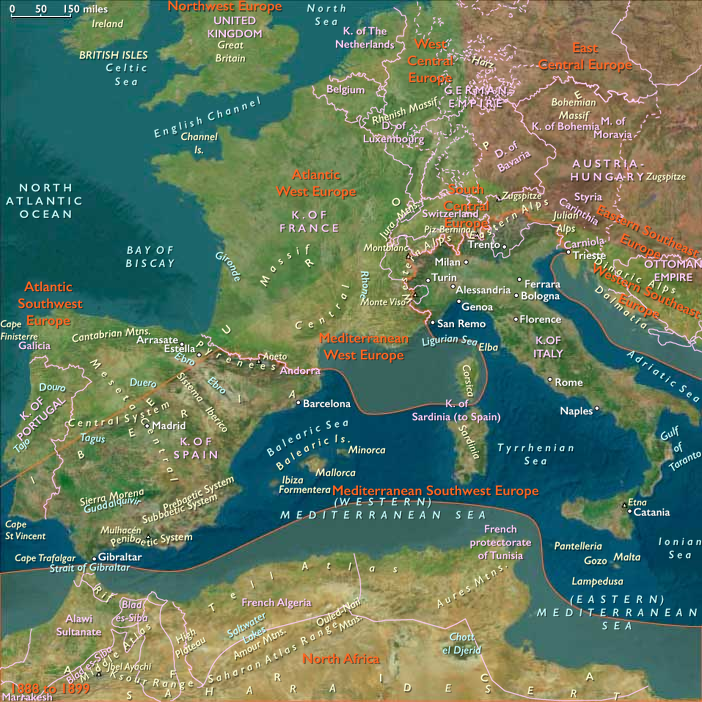
Mediterranean Southwest Europe encompasses Italy (including Sardinia and Sicily), Malta, southeastern Spain (Andalusia, Murcia, Valencia, Catalonia’s southern coast, and the Balearic Islands). Anchors include the Po Valley and northern Italian plain, the Apennines, Mount Vesuvius and Etna, the Sicilian interior, the Ebro and Guadalquivir valleys, the Balearic archipelagos, and Malta’s limestone plateaus. This is a region of rugged Mediterranean coastlines, volcanic soils, and irrigated plains that supported agriculture, industry, and rapidly growing urban centers such as Rome, Milan, Naples, Palermo, Barcelona, Valencia, Seville, Palma de Mallorca, and Valletta.
Climate & Environmental Shifts
The climate remained characteristically Mediterranean: hot, dry summers and cool, wet winters. Drought cycles in Andalusia and Sicily produced periodic crop failures in the 19th century, while devastating floods affected northern Italy (notably the Adige flood of 1882). Volcanic eruptions at Etna and Vesuvius (most famously 1906 and 1944) threatened nearby settlements. Reforestation and irrigation works expanded in the 20th century, particularly under Fascist Italy’s land reclamation schemes (Pontine Marshes) and Spain’s Franco-era irrigation projects.
Subsistence & Settlement
-
Agriculture:
-
Italy: Wheat in the south; olives, vines, and citrus across peninsular and insular zones; dairy and maize in the Po Valley.
-
Spain: Wheat, citrus, rice (Valencia), and olives; Andalusia’s latifundia coexisted with smallholders.
-
Malta: Dryland farming of wheat and barley with reliance on imported food.
-
-
Industry:
-
Italy’s “industrial triangle” (Milan–Turin–Genoa) became Europe’s key steel, textile, and automotive hub.
-
Barcelona developed as Spain’s textile and industrial center.
-
Naples, Palermo, Andalusian cities lagged behind, locked in agrarian economies.
-
-
Urban growth: Rome became Italy’s capital (1871); Barcelona and Valencia expanded port industry; Valletta was transformed by British naval dominance. By the mid-20th century, rapid urbanization created sprawling suburbs and modernist housing.
Technology & Material Culture
-
Transport: Railways (Piedmont, Catalonia, Andalusia, Naples–Rome) and modern ports transformed connectivity in the 19th century. After WWII, motorways and airports (Milan Malpensa, Rome Fiumicino, Barcelona El Prat, Palma de Mallorca) anchored tourism.
-
Industry & energy: Coal in Asturias and Sardinia; hydroelectric in the Alps and Pyrenees; Fiat (Turin) symbolized Italian industrial growth; postwar petrochemicals reshaped Sicilian and Andalusian coasts.
-
Everyday life: Rural material culture—stone farmhouses, terraced vineyards, hand looms—gave way to urban consumer goods: radios, Vespa scooters, Fiat cars, and televisions by the 1960s.
Movement & Interaction Corridors
-
Migration:
-
19th century: Italians emigrated en masse to the Americas (Argentina, Brazil, the U.S.), and Spaniards to Cuba, Mexico, and Argentina.
-
20th century: Postwar flows sent workers to France, Germany, Switzerland, and Belgium; remittances fueled local economies.
-
-
Colonial ties:
-
Spain retained colonies in Africa until mid-20th century; Italy pursued expansion (Libya, East Africa, Albania, Dodecanese).
-
Malta, as a British fortress colony, was central in Mediterranean naval strategy until independence (1964).
-
-
Tourism: Began in the 19th century with aristocratic visits to Naples, Sicily, and the Balearics; exploded in the 1950s–60s with charter flights to Mallorca, Ibiza, Costa del Sol, Amalfi, and Capri.
-
War corridors: Italian unification wars (Risorgimento), Spanish Civil War (1936–1939), both World Wars, and Cold War naval deployments in Malta all militarized the region.
Cultural & Symbolic Expressions
-
Nationalism: Italy’s Risorgimento (Mazzini, Garibaldi, Cavour) culminated in unification (1861–1871). Spain oscillated between monarchy, republic, dictatorship, and Franco’s authoritarianism (1939–1975). Malta blended Catholic and British influences, asserting independence mid-century.
-
Arts & literature: Italian Romanticism (Verdi), Futurism, and postwar neorealist cinema (Rossellini, De Sica). Spanish cultural figures (Goya’s late works, Gaudí’s Barcelona architecture, Picasso, Miró, Lorca) shaped global modernism.
-
Religion & tradition: Catholicism dominated, with papal authority central in Italy; local fiestas, processions, and Mediterranean folk traditions persisted.
-
Tourist imagery: Romantic depictions of Capri, Amalfi, and Andalusia, later mass-marketed as sun-and-sea resorts, reshaped cultural perception of the Mediterranean.
Environmental Adaptation & Resilience
-
Agrarian reform: Land reforms in Italy (1950s–60s) and Spain (Franco’s agrarian policy) redistributed holdings, though inequality persisted.
-
Irrigation: Expansion of canals and reservoirs modernized citrus and rice production in Valencia and Sicily.
-
Terracing: Maintained soil fertility in hilly regions; mechanization after 1950 reduced reliance on labor-intensive terrace farming.
-
Urban resilience: Cities devastated in WWII (Naples, Rome, Barcelona, Valletta) were rebuilt with modernist architecture and new transport systems.
Political & Military Shocks
-
Italy: Unification (1861–71); Fascist rule (1922–43); WWII defeat and transition to republic (1946).
-
Spain: Carlist Wars; colonial loss in 1898; Civil War (1936–39) leading to Franco’s dictatorship; neutrality in WWII; tourism-led development by the 1960s.
-
Malta: Great Siege memories lived on under British rule; WWII bombardments earned it the George Cross; independence achieved in 1964.
-
Allied & Axis strategy: Mediterranean ports and islands were pivotal in both World Wars, especially Sicily, Malta, and Gibraltar’s approaches.
Transition
Between 1828 and 1971, Mediterranean Southwest Europe moved from agrarian economies under monarchy and empire toward industrialization, dictatorship, and postwar integration. Italy unified and industrialized unevenly, its north surging ahead while the south lagged. Spain suffered civil war and Francoist repression, yet by the 1960s pivoted toward mass tourism. Malta endured as a fortress colony, emerging into independence. Across the region, emigration and remittances provided lifelines, while the rise of modern tourism, consumer culture, and European integration marked the final transformation of this Mediterranean arc into a keystone of 20th-century Europe.
People
- Alfonso XII of Spain
- Alfonso XIII of Spain
- António de Oliveira Salazar
- Benito Mussolini
- Camillo Benso, Count of Cavour
- Dom Mintoff
- Francisco Franco
- Giorgio Borg Olivier
- Giuseppe Mazzini
- Guillem d' Areny-Plandolit
- Isabella II of Spain
- Marcello Caetano
- Victor Emanuel II
Groups
- Papal States (Republic of St. Peter)
- Andorra, Principality of
- Malta
- Austria, Archduchy of
- Portugal, Bragança Kingdom of
- Spain, Bourbon Kingdom (first restoration) of
- Sardinia, Kingdom of
- Sicilies, Kingdom of the Two
- Italy, Kingdom of
- Italy, Kingdom of
- Austria-Hungary
- Spain, Regency of
- Spain, Savoyard Kingdom of
- Italy, Kingdom of
- Spain, Bourbon Kingdom (second restoration) of
- Italian Eritrea
- Italian Somaliland
- Portugal, (First) Republic of
- Italian North Africa
- Portugal, (Second) Republic of
- Italian Tripolitania
- Italian Cyrenaica
- Vatican City
- Spain (Spanish Republic, Second)
- Portugal, (New) State of
- Spain, Franconian Regency of (Spanish State)
- Italian Social Republic (Salo Republic)
- Italy (Italian Republic)
- European Economic Community (EEC)
Topics
- Colonization of the Americas, Spanish
- Colonization of Asia, Spanish
- Spanish American wars of independence
- Italian unification
- Young Italy
- Carlist War, First
- Carlist War, Second
- Carlist War, Third
- Spanish-American War
- World War, First (World War I)
- World War, Second (World War II)
Subjects
Regions
Subregions
Years: 1828 - 1971
People
- Alfonso XII of Spain
- Alfonso XIII of Spain
- António de Oliveira Salazar
- Benito Mussolini
- Camillo Benso, Count of Cavour
- Dom Mintoff
- Francisco Franco
- Giorgio Borg Olivier
- Giuseppe Mazzini
- Guillem d' Areny-Plandolit
- Isabella II of Spain
- Marcello Caetano
- Victor Emanuel II
Groups
- Papal States (Republic of St. Peter)
- Andorra, Principality of
- Malta
- Austria, Archduchy of
- Portugal, Bragança Kingdom of
- Spain, Bourbon Kingdom (first restoration) of
- Sardinia, Kingdom of
- Sicilies, Kingdom of the Two
- Italy, Kingdom of
- Italy, Kingdom of
- Austria-Hungary
- Spain, Regency of
- Spain, Savoyard Kingdom of
- Italy, Kingdom of
- Spain, Bourbon Kingdom (second restoration) of
- Italian Eritrea
- Italian Somaliland
- Portugal, (First) Republic of
- Italian North Africa
- Portugal, (Second) Republic of
- Italian Tripolitania
- Italian Cyrenaica
- Vatican City
- Spain (Spanish Republic, Second)
- Portugal, (New) State of
- Spain, Franconian Regency of (Spanish State)
- Italian Social Republic (Salo Republic)
- Italy (Italian Republic)
- European Economic Community (EEC)
Topics
- Colonization of the Americas, Spanish
- Colonization of Asia, Spanish
- Spanish American wars of independence
- Italian unification
- Young Italy
- Carlist War, First
- Carlist War, Second
- Carlist War, Third
- Spanish-American War
- World War, First (World War I)
- World War, Second (World War II)
Subjects
Regions
Subregions