
Mediterranean Southwest Europe (1948–1959 CE): Postwar Recovery, …
Years: 1948 - 1959
Mediterranean Southwest Europe (1948–1959 CE): Postwar Recovery, Authoritarian Continuities, and Steps Toward Modernization
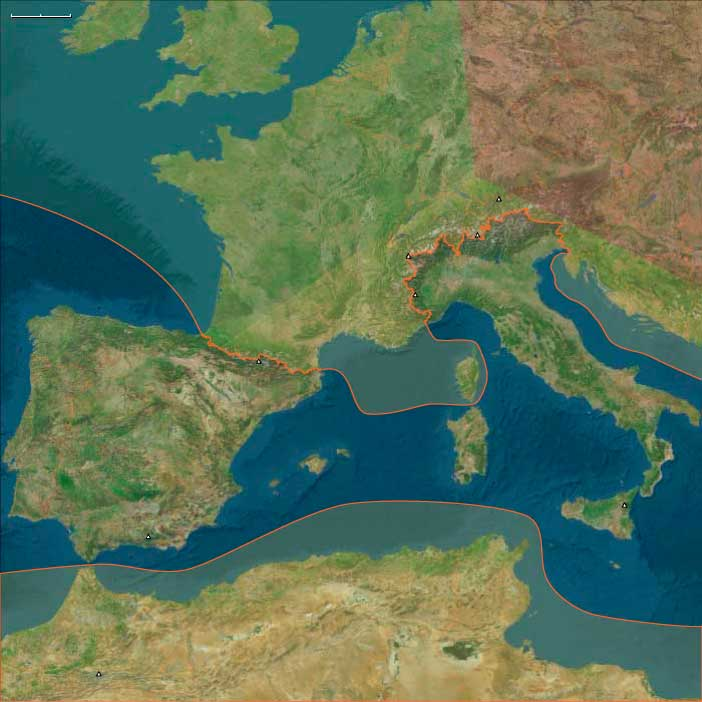
From 1948 to 1959 CE, Mediterranean Southwest Europe—comprising the Italian Peninsula, southern and eastern Spain, southern Portugal, Andorra, the Balearic Islands, Sicily, Sardinia, and Malta—experiences significant reconstruction, economic transformation, continuing authoritarianism, and the early stages of European integration.
Italy: Economic Miracle and Democratic Stabilization
Italy rapidly rebuilds after World War II, benefiting significantly from the Marshall Plan (1948–1952), which injects crucial funds into the devastated economy. This influx of aid initiates an "economic miracle" (miracolo economico), characterized by industrial expansion, infrastructure rebuilding, and the growth of the manufacturing and automobile industries—highlighted by the global rise of companies like Fiat.
Politically, Italy stabilizes under the leadership of Prime Ministers such as Alcide De Gasperi, who guides the country through postwar recovery and firmly positions Italy within Western alliances, joining NATO in 1949. The nation also becomes a founding member of the European Economic Community (EEC) in 1957, significantly strengthening its economic and political integration within Europe.
Spain: Franco’s Continued Rule and Economic Isolation
In Spain, General Francisco Franco maintains his authoritarian regime, continuing to suppress political dissent, maintain press censorship, and uphold strict social conservatism. International isolation following World War II initially restricts Spain's economic recovery, but by the early 1950s, shifting Cold War dynamics lead to gradual reintegration into Western diplomatic and economic spheres.
The 1953 Pact of Madrid marks a critical turning point as the United States provides economic and military assistance in exchange for military bases on Spanish territory, easing Spain's isolation. Despite political repression, Spain begins experiencing modest economic improvements, setting the stage for accelerated growth in subsequent decades.
Portugal: Salazar’s Stability and Economic Challenges
Portugal remains under the authoritarian control of António de Oliveira Salazar and his Estado Novo regime. Despite political stability and continued neutrality during the early Cold War, economic stagnation persists due to conservative economic policies, rigid social structures, and delayed industrial modernization.
However, by the late 1950s, Portugal begins cautious steps toward economic liberalization, including joining the European Free Trade Association (EFTA) as a founding member in 1960, signaling the regime’s willingness to engage more actively with Western Europe’s economic developments.
Malta: Toward Greater Autonomy
Malta, having demonstrated its strategic value during World War II, increasingly seeks political autonomy from British colonial rule. In 1947, Malta achieves internal self-government, and in the subsequent years, Maltese leaders, particularly Dom Mintoff, advocate for greater political and economic independence, laying the foundation for eventual independence.
The postwar period sees Malta developing a diversified economy focused increasingly on tourism and light industry, reducing its dependency on British military expenditures.
Andorra: Stability and Incremental Modernization
In Andorra, the principality continues its path of stable, incremental economic modernization, focusing heavily on tourism and trade. During this period, the government makes concerted efforts to improve infrastructure and strengthen its international economic relationships. Andorra maintains political stability and neutrality, benefiting from its peaceful and prosperous position amidst broader European transformations.
Regional Realignments and Early European Integration
By the end of 1959, Mediterranean Southwest Europe has significantly evolved from its immediate postwar conditions. Italy emerges economically vibrant and politically stable, deeply integrated into the Western European economic system. Spain and Portugal, though still authoritarian, begin opening their economies to international influences. Malta steadily moves toward independence, and Andorra continues its peaceful economic growth.
This era lays crucial groundwork for substantial political, social, and economic shifts that characterize Mediterranean Southwest Europe in the latter half of the 20th century.
People
Groups
- Andorra, Principality of
- Malta
- United States of America (US, USA) (Washington DC)
- Britain (United Kingdom of Great Britain and Northern Ireland)
- Portugal, (New) State of
- Spain, Franconian Regency of (Spanish State)
- Italy (Italian Republic)
- European Economic Community (EEC)
Topics
Subjects
Regions
Subregions

Years: 1948 - 1959
People
Groups
- Andorra, Principality of
- Malta
- United States of America (US, USA) (Washington DC)
- Britain (United Kingdom of Great Britain and Northern Ireland)
- Portugal, (New) State of
- Spain, Franconian Regency of (Spanish State)
- Italy (Italian Republic)
- European Economic Community (EEC)
Topics
Subjects
Regions
Subregions