
Mediterranean Southwest Europe (1876–1887 CE): Political Consolidation, …
Years: 1876 - 1887
Mediterranean Southwest Europe (1876–1887 CE): Political Consolidation, Cultural Revival, and Economic Tensions
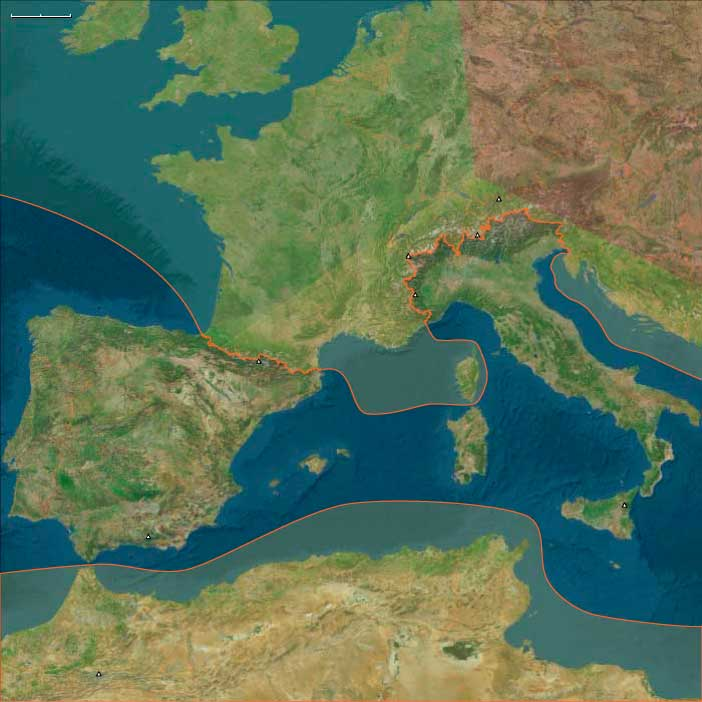
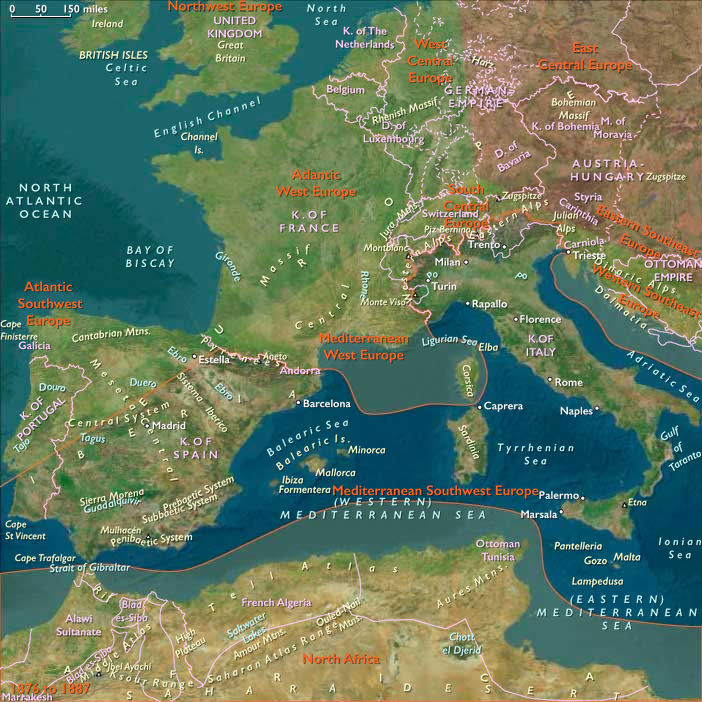
The era from 1876 to 1887 CE in Mediterranean Southwest Europe—encompassing the Italian Peninsula, southern and eastern Spain, southern Portugal, Andorra, the Balearic Islands, Sicily, Sardinia, and Malta—witnesses the consolidation of national states, the emergence of cultural revival movements, and significant economic tensions and transformations.
Spain: Restoration Stability and Political Manipulation
Following the Bourbon Restoration under Alfonso XII (r. 1875–1885), Spain experiences relative stability but at the expense of genuine democratic governance. The political system, inspired by the British model, quickly devolves into a tightly controlled two-party mechanism marked by electoral manipulation and patronage. Local political bosses, or caciques, dominate electoral outcomes through extensive patronage networks, ensuring predictable alternations between Conservative and Liberal parties. Although superficially stable, this arrangement fosters political cynicism and undermines genuine democratic participation.
Upon Alfonso XII's death in 1885, Spain enters a regency period under his widow, Maria Cristina of Austria, governing on behalf of their unborn son, Alfonso XIII, whose birth in 1886 secures dynastic continuity. The young king's future reign promises to be fraught with the inherited weaknesses of Spain's manipulated political system and unresolved regional tensions.
Italy: Consolidation as a Great Power
The Kingdom of Italy solidifies its status as a significant European power during this period. Governed under the constitutional framework provided by the Albertine Statute of 1848, Italy continues its pursuit of liberal parliamentary governance. However, while Northern Italy rapidly industrializes, contributing to national wealth and prestige, Southern Italy and rural regions remain economically stagnant and politically marginalized. This economic imbalance fuels widespread emigration, creating influential Italian diasporas abroad, and energizes the growth of the Italian Socialist Party, which begins to challenge traditional political elites.
Culturally, Italy continues to flourish, particularly through the operatic works of Giuseppe Verdi, whose grand operas embody the Romantic ideal and significantly contribute to the strengthening of national identity.
Andorra: National Awakening and Economic Conflict
In Andorra, significant cultural and economic developments characterize this era. The principality actively participates in the Catalan Renaixença, a cultural revival celebrating Catalan language and identity. Notable literary figures such as Jacint Verdaguer reside in Andorra, contributing to the growing cultural and national consciousness.
Economically, tensions arise in 1880–1881 when the authorities of Andorra's Co-Princes ban casinos and gambling establishments, provoking a popular uprising known as the Revolution of 1881. Revolutionaries, led by figures like Joan Pla i Calvo and Pere Baró i Mas, temporarily seize power, promoting casino and spa resort developments funded by foreign capital. However, loyalist forces swiftly suppress the revolution through the Treaty of the Bridge of Escalls, leading to renewed political uncertainty and economic debates that divide the populace.
Malta: Continued Stability under British Rule
Malta remains relatively stable under British colonial rule, experiencing economic growth and infrastructure expansion due to its strategic naval position. The island continues to benefit from British investment, with sustained emphasis on maritime trade and defense, although underlying tensions regarding colonial governance and local identity occasionally surface.
Conclusion: Stability, Culture, and Emerging Challenges
The years 1876 to 1887 in Mediterranean Southwest Europe highlight contrasting developments: Spain's manipulated political stability, Italy's economic divides alongside cultural flourishing, Andorra's national and economic tensions, and Malta’s colonial stability. Collectively, these dynamics underscore the region's complex evolution as it navigates political realignments, cultural revivals, and economic transformations, setting the stage for future challenges and opportunities.
People
- Alfonso XII of Spain
- Alfonso XIII of Spain
- Giuseppe Verdi
- Guillem d' Areny-Plandolit
- Isabella II of Spain
- Jacint Verdaguer i Santaló
- Maria Christina of Austria
- Pope Pius X
- Victor Emanuel II
Groups
- Papal States (Republic of St. Peter)
- Andorra, Principality of
- Malta
- Austria, Archduchy of
- Austrian Empire
- Spain, Bourbon Kingdom (first restoration) of
- Sardinia, Kingdom of
- Sicilies, Kingdom of the Two
- Italy, Kingdom of
- Spain, Regency of
- Spain, Savoyard Kingdom of
- Spain, Bourbon Kingdom (second restoration) of
Topics
Subjects
Regions
Subregions
Years: 1876 - 1887
People
- Alfonso XII of Spain
- Alfonso XIII of Spain
- Giuseppe Verdi
- Guillem d' Areny-Plandolit
- Isabella II of Spain
- Jacint Verdaguer i Santaló
- Maria Christina of Austria
- Pope Pius X
- Victor Emanuel II
Groups
- Papal States (Republic of St. Peter)
- Andorra, Principality of
- Malta
- Austria, Archduchy of
- Austrian Empire
- Spain, Bourbon Kingdom (first restoration) of
- Sardinia, Kingdom of
- Sicilies, Kingdom of the Two
- Italy, Kingdom of
- Spain, Regency of
- Spain, Savoyard Kingdom of
- Spain, Bourbon Kingdom (second restoration) of
Topics
Subjects
Regions
Subregions