
Mediterranean Southwest Europe (1828–1839 CE): Nationalism, Civil …
Years: 1828 - 1839
Mediterranean Southwest Europe (1828–1839 CE): Nationalism, Civil War, and Constitutional Struggles
The era 1828–1839 CE marks a tumultuous period in Mediterranean Southwest Europe, characterized by the rise of nationalism, intense constitutional debates, and civil conflict, significantly shaping the political landscape of Spain and Italy.
Italian Nationalism and the Risorgimento
In Italy, the early nineteenth century sees a powerful surge of nationalist sentiment aimed at uniting the fragmented Italian states into a single nation. This movement, eventually known as the Risorgimento, gains momentum through the efforts of revolutionaries and intellectuals such as Giuseppe Mazzini, a fervent advocate for Italian unity and republican ideals. Mazzini founds the influential revolutionary organization Young Italy in the early 1830s, which promotes a broad-based nationalist and republican agenda, becoming central to the spread of revolutionary ideas throughout Italy.
Despite these nationalist aspirations, Italian states remain under varying degrees of foreign influence, particularly Austrian dominance in the north and Bourbon rule in the south, conditions that fuel ongoing revolutionary agitation and ideological conflict.
Dynastic Crisis and the Carlist Wars in Spain
Spain faces a significant dynastic crisis following the death of King Ferdinand VII in 1833, leading to the outbreak of the First Carlist War (1833–1839). The conflict arises from the disputed succession between Ferdinand’s daughter, Isabella II, whose regency is held by her mother, Maria Cristina, and Ferdinand’s brother, Don Carlos, who claims the throne based on traditional male-only succession laws.
The war splits Spain along ideological and regional lines. The Carlists, traditionalist supporters of Don Carlos, include agrarian interests, regionalists, and devout Catholics, primarily strong in Aragon and Basque Navarre. They fiercely oppose the liberal, centralizing, and anticlerical forces backing Maria Cristina and Isabella II. British support for the liberal side helps prevent a decisive Carlist victory.
The conflict sees prolonged and intense fighting, especially in the mountainous Basque regions. A Carlist advance toward Madrid in 1837 ultimately fails, leading to a compromise settlement in 1839, known as the Convention of Vergara, which recognizes Basque regional privileges (fueros) while confirming Isabella II’s succession. However, the Carlist movement remains influential, leading to further uprisings later in the century.
Andorra's Stability Amidst Regional Turmoil
In contrast to broader regional unrest, Andorra maintains its historical stability during this era. The principality continues under the traditional dual sovereignty of the Bishop of Urgell and the French head of state, preserving its economic independence and relative autonomy despite periodic political changes in neighboring Spain and France.
Cultural and Intellectual Currents
The broader cultural and intellectual climate in Mediterranean Southwest Europe continues to reflect Enlightenment principles mingled with emerging nationalist ideas. Revolutionary and liberal ideals permeate public discourse, influencing literature, political thought, and public life, further fueling movements toward national unity and constitutional reform.
Conclusion: Foundations for Future Transformations
Between 1828 and 1839, Mediterranean Southwest Europe experiences profound political turmoil, driven by nationalist aspirations, civil war, and constitutional struggles. These developments lay critical foundations for the transformative events of the mid-nineteenth century, shaping the future trajectory of nations in this region.
People
- Ferdinand VII of Spain
- Giuseppe Mazzini
- Carlos María Isidro of Spain
- Isabella II of Spain
- Maria Christina of the Two Sicilies
Groups
- Andorra, Principality of
- Basque people
- Puerto Rico (Spanish Colony)
- Cuba (Spanish Colony)
- Spain, Bourbon Kingdom (first restoration) of
- Sardinia, Kingdom of
Topics
Subjects
Regions
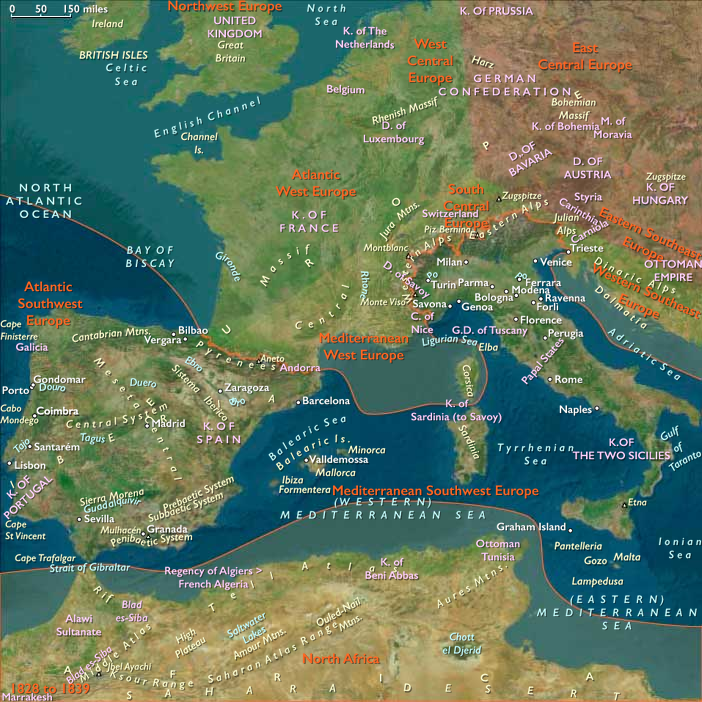
Subregions
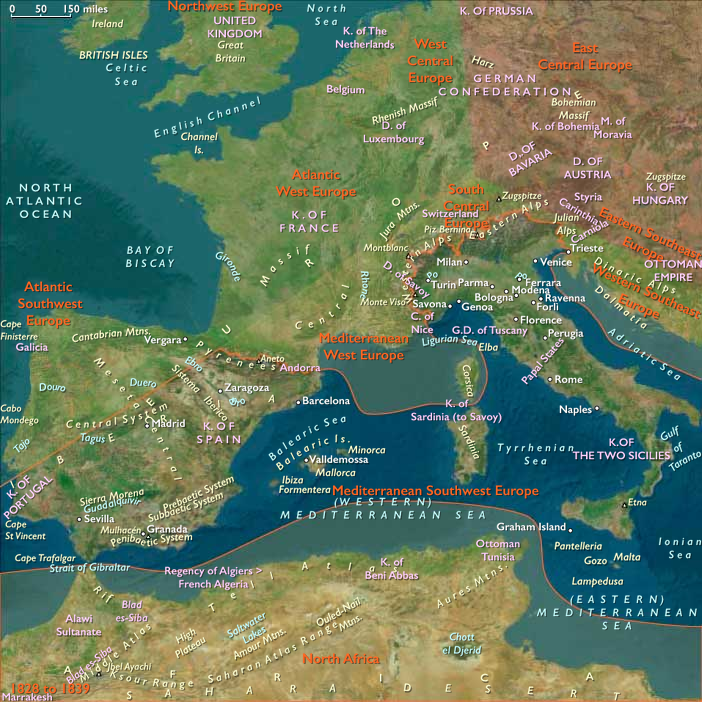
Years: 1828 - 1839
People
- Ferdinand VII of Spain
- Giuseppe Mazzini
- Carlos María Isidro of Spain
- Isabella II of Spain
- Maria Christina of the Two Sicilies
Groups
- Andorra, Principality of
- Basque people
- Puerto Rico (Spanish Colony)
- Cuba (Spanish Colony)
- Spain, Bourbon Kingdom (first restoration) of
- Sardinia, Kingdom of
Topics
Subjects
Regions
Subregions