
Mediterranean Southwest Europe (1684–1827 CE): Enlightenment, Revolution, …
Years: 1684 - 1827
Mediterranean Southwest Europe (1684–1827 CE): Enlightenment, Revolution, and Imperial Decline
The period 1684–1827 CE in Mediterranean Southwest Europe encompasses significant political, social, and economic transformations marked by Enlightenment reforms, revolutionary movements, and shifting imperial dynamics, profoundly influencing the future course of the region.
Shifts in Power and the Enlightenment
In the early eighteenth century, the War of the Spanish Succession (1702–1714) drastically reshapes the political landscape. Austria emerges as the dominant foreign power in Italy, replacing Spain, and the House of Savoy expands its influence into Piedmont and Sardinia. Despite these territorial adjustments, Spain retains its internal unity and much of its colonial empire, although its political power in Europe is significantly reduced.
Under Charles III of Spain (r. 1759–1788), Spain experiences a period of enlightened despotism, promoting economic and governmental reforms inspired by Enlightenment ideals. However, anticlericalism and aggressive state centralization provoke social and political tensions, and reforms falter without sustained royal patronage.
Spanish Decline and Colonial Losses
Spain’s economic and military decline accelerates under Charles IV (r. 1788–1807), whose rule is overshadowed by Manuel de Godoy, the influential and unpopular chief minister. Godoy's shifting alliances embroil Spain in the Napoleonic Wars, draining resources and weakening internal stability.
The Peninsular War (1808–1814) significantly disrupts Spanish governance. Napoleon’s imposition of his brother, Joseph Bonaparte, as King of Spain provokes widespread resistance and guerrilla warfare, severely undermining French control and galvanizing Spanish nationalism. Following the war, Ferdinand VII regains the throne but struggles to reestablish authority, especially amidst attempts to reconquer rebellious American colonies.
By 1825, nearly all Spanish colonies in the Americas have achieved independence, leaving only Cuba and Puerto Rico under Spanish control. Spain’s failed military efforts to suppress these independence movements exacerbate its economic strain and internal divisions.
Revolutionary Turmoil and Liberal Aspirations
In 1820, Major Rafael de Riego leads a successful pronunciamiento, reinstating the liberal Constitution of 1812 and ushering in the Constitutional Triennium (1820–1823). The liberal reforms introduced during this period, advocating equality, centralized governance, and economic liberalism, face fierce conservative opposition.
In 1823, a French intervention, requested by Ferdinand VII and supported by European conservative powers, crushes the liberal government, restoring royal absolutism. Despite this setback, liberal ideals continue to influence Spain’s political discourse and revolutionary activities throughout the nineteenth century.
Italy's Evolving Political Landscape
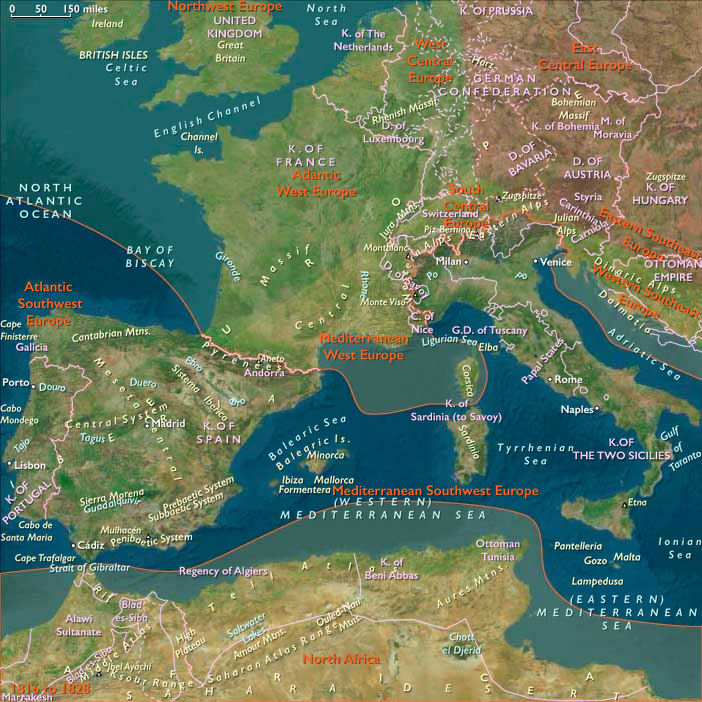
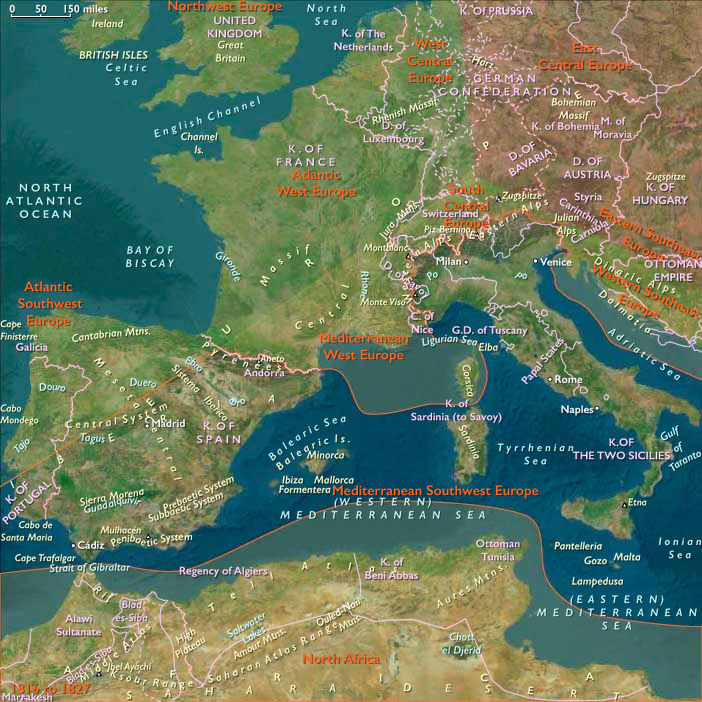
Following the Congress of Vienna (1814–1815), Italian regions undergo substantial territorial and political reorganizations. Northern and central Italy, previously part of Napoleonic client states, revert to traditional rulers, with Austria maintaining significant influence. Genoa’s integration into the Kingdom of Sardinia marks the end of its historic independence, reinforcing the House of Savoy’s regional power.
In southern Italy, regions that briefly flourished under Joachim Murat as king of Naples revert to Bourbon control, yet revolutionary sentiments and the influence of French Revolutionary ideals persist, sowing seeds for future conflicts and nationalist movements.
Stability in Andorra
Andorra maintains its traditional co-principality status, experiencing relative stability despite broader regional upheavals. The principality briefly experiences changes under Napoleonic rule but quickly reasserts its historical autonomy and economic independence in 1814.
Cultural and Intellectual Developments
Throughout this period, cultural and intellectual life flourishes, notably in Italy, where Enlightenment and neoclassical ideas profoundly impact the arts. The painter Jacques-Louis David exemplifies the neoclassical revival, influencing European art through his studies and experiences in Rome.
Conclusion: A Region Transformed
From 1684 to 1827, Mediterranean Southwest Europe witnesses profound changes—Enlightenment reforms, revolutionary upheavals, and shifting imperial structures redefine political boundaries and cultural landscapes. These transformations set the stage for ongoing struggles between liberal and conservative forces, significantly shaping the region’s subsequent history.
People
- Charles III of Spain
- Charles IV of Spain
- Ferdinand VII of Spain
- Jacques-Louis David
- Joachim Murat
- Joseph Bonaparte
- Manuel de Godoy, Prince of the Peace
- Napoleon
- Rafael del Riego
Groups
- Andorra, Principality of
- Austria, Archduchy of
- Sardinia, Kingdom of
- Spanish Empire
- Naples, Kingdom of
- Puerto Rico (Spanish Colony)
- Cuba (Spanish Colony)
- Spain, Habsburg Kingdom of
- Savoy, Duchy of
- Spain, Bourbon Kingdom of
- Sardinia, Kingdom of (Savoy)
- Naples and Sicily, Bourbon Kingdom of
- Piedmontese Republic
- Sardinia, Kingdom of
- Austrian Empire
- Naples, Bonapartist Kingdom of
- Spain, Bonapartist Kingdom of
- Spain, Bourbon Kingdom (first restoration) of
- Sardinia, Kingdom of
- Savoy, (restored) Duchy of
Topics
- Colonization of the Americas, Spanish
- Enlightenment, Age of
- Spanish Succession, War of the
- Spanish American wars of independence
- Trienio Liberal (Spanish Civil War of 1820-23)
- Franco-Spanish War of 1823
Subjects
Regions
Subregions
Years: 1684 - 1827
People
- Charles III of Spain
- Charles IV of Spain
- Ferdinand VII of Spain
- Jacques-Louis David
- Joachim Murat
- Joseph Bonaparte
- Manuel de Godoy, Prince of the Peace
- Napoleon
- Rafael del Riego
Groups
- Andorra, Principality of
- Austria, Archduchy of
- Sardinia, Kingdom of
- Spanish Empire
- Naples, Kingdom of
- Puerto Rico (Spanish Colony)
- Cuba (Spanish Colony)
- Spain, Habsburg Kingdom of
- Savoy, Duchy of
- Spain, Bourbon Kingdom of
- Sardinia, Kingdom of (Savoy)
- Naples and Sicily, Bourbon Kingdom of
- Piedmontese Republic
- Sardinia, Kingdom of
- Austrian Empire
- Naples, Bonapartist Kingdom of
- Spain, Bonapartist Kingdom of
- Spain, Bourbon Kingdom (first restoration) of
- Sardinia, Kingdom of
- Savoy, (restored) Duchy of
Topics
- Colonization of the Americas, Spanish
- Enlightenment, Age of
- Spanish Succession, War of the
- Spanish American wars of independence
- Trienio Liberal (Spanish Civil War of 1820-23)
- Franco-Spanish War of 1823
Subjects
Regions
Subregions