
Mediterranean Southwest Europe (1792–1803 CE): Turbulence, War, …
Years: 1792 - 1803
Mediterranean Southwest Europe (1792–1803 CE): Turbulence, War, and Artistic Transition
The era 1792–1803 CE in Mediterranean Southwest Europe is marked by political upheaval, shifting alliances due to revolutionary turmoil in France, social and economic stress, and evolving artistic styles reflecting changing sensibilities at the dawn of the nineteenth century.
Political Turmoil and Shifting Alliances
In Spain, Charles IV (r. 1788–1808) nominally continues his father's Enlightenment-inspired reforms, but the period is dominated by political instability. Real power increasingly rests with his queen's favorite, Manuel de Godoy, who rapidly rises to chief minister, becoming Spain’s de facto ruler. Initially aligning with Britain and other European monarchies against revolutionary France in 1793, Godoy’s policies fail militarily, prompting a strategic shift. By 1796, he allies Spain with France, submitting to Napoleon Bonaparte's ambitions. Spain cedes control of Louisiana back to France and commits resources and soldiers to support French military operations, weakening its autonomy and economy.
Social and Economic Strains
Continued war and shifting alliances severely strain the region’s economy. In Spain, heavy taxation and economic mismanagement under Godoy exacerbate rural and urban poverty. Discontent grows among peasants, artisans, and even sections of the nobility who resent the rising costs and loss of prestige due to Spain’s subordinate role in European politics. Unrest simmers beneath the surface, occasionally flaring into localized revolts driven by economic hardship and anti-French sentiment.
Artistic and Cultural Transformations
Throughout Italy, the profound influence of Jacques-Louis David and neoclassical ideals continue to shape artistic expression, even as early Romantic themes gain prominence. Artists across the region increasingly explore personal, emotional, and historical subjects reflective of the broader European tensions and intellectual movements of the era. Archaeological discoveries at Pompeii and Herculaneum remain influential, inspiring artists and architects alike, fueling European fascination with antiquity and shaping neoclassical aesthetics.
Malta under the Order of Saint John
In Malta, the governance of Grandmaster Ferdinand von Hompesch zu Bolheim (1797–1798) briefly sustains prior administrative improvements but faces a critical juncture with Napoleon’s expedition in 1798. The French invasion swiftly ends the rule of the Knights of Saint John, radically transforming Malta’s political landscape. The Maltese initially welcome French Enlightenment-inspired reforms; however, resentment over economic hardship, religious interference, and cultural insensitivity rapidly intensifies, leading to widespread unrest and ultimately British intervention by 1800.
Conclusion: Precarious Stability and Looming Change
The period 1792–1803 CE marks a crucial turning point for Mediterranean Southwest Europe. Political instability, war-induced economic strain, evolving artistic expression, and dramatic shifts in governance lay the foundations for profound transformations as the region enters the nineteenth century, anticipating further upheaval and the reshaping of European dynamics.
People
- Charles IV of Spain
- Ferdinand von Hompesch zu Bolheim
- Jacques-Louis David
- Manuel de Godoy, Prince of the Peace
- Napoleon
Groups
- Papal States (Republic of St. Peter)
- Malta
- Christians, Roman Catholic
- Austria, Archduchy of
- Knights of Malta, Sovereign and Military Order of the
- Jesuits, or Order of the Society of Jesus
- Habsburg Monarchy, or Empire
- Spain, Bourbon Kingdom of
- Britain, Kingdom of Great
- Naples and Sicily, Bourbon Kingdom of
- Louisiana (Spanish colony)
- French First Republic
- Malta Protectorate
- Britain (United Kingdom of Great Britain and Ireland)
- Louisiana (French colony)
Topics
Subjects
Regions
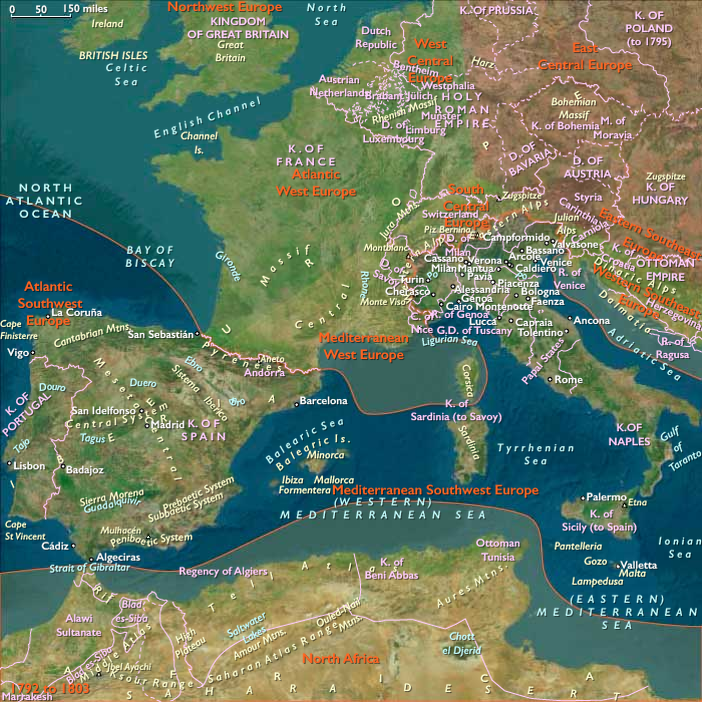
Subregions
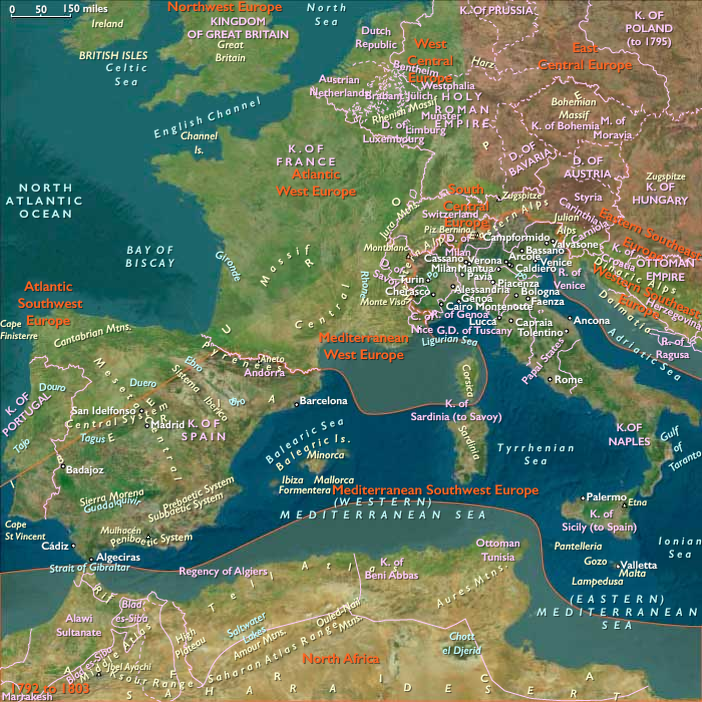
Years: 1792 - 1803
People
- Charles IV of Spain
- Ferdinand von Hompesch zu Bolheim
- Jacques-Louis David
- Manuel de Godoy, Prince of the Peace
- Napoleon
Groups
- Papal States (Republic of St. Peter)
- Malta
- Christians, Roman Catholic
- Austria, Archduchy of
- Knights of Malta, Sovereign and Military Order of the
- Jesuits, or Order of the Society of Jesus
- Habsburg Monarchy, or Empire
- Spain, Bourbon Kingdom of
- Britain, Kingdom of Great
- Naples and Sicily, Bourbon Kingdom of
- Louisiana (Spanish colony)
- French First Republic
- Malta Protectorate
- Britain (United Kingdom of Great Britain and Ireland)
- Louisiana (French colony)
Topics
Subjects
Regions
Subregions