
Mediterranean Southwest Europe (1540–1683 CE) Empire, …
Years: 1540 - 1683
Mediterranean Southwest Europe (1540–1683 CE)
Empire, Faith, and the Baroque Sea
Geography & Environmental Context
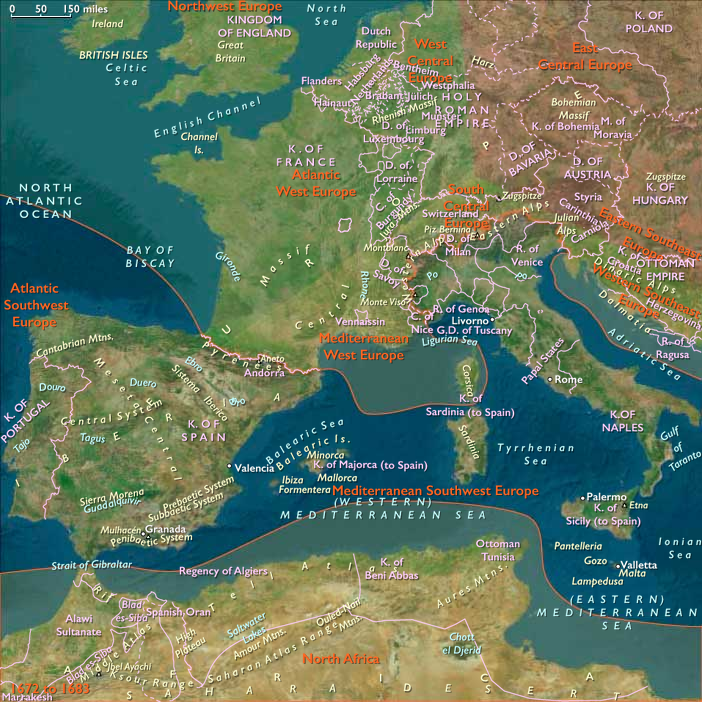
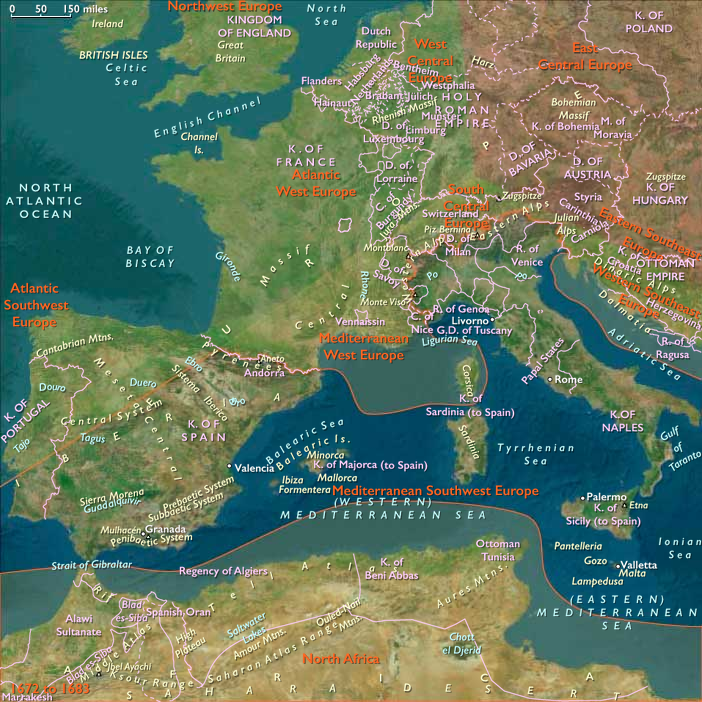
Mediterranean Southwest Europe spans Italy (with Sardinia and Sicily), Malta, and southeastern Spain—including Andalusia, Murcia, Valencia, Catalonia’s southern coast, and the Balearic Islands. Anchors included the volcanic peaks of Etna and Vesuvius, the Po Valley, the Apennine spine, the Bay of Naples, the Ebro delta, and the Mediterranean archipelagos linking Iberia to Italy.
The Little Ice Age brought alternating droughts and torrential winters, particularly across Andalusia and southern Italy. Erratic rains affected wheat and olive harvests, while extended cool seasons reduced grape yields in uplands. Yet the region’s maritime orientation, diversified crops, and enduring irrigation networks sustained dense populations and vibrant coastal cities.
Political Landscapes & Imperial Tides
Spanish and Italian Worlds under Habsburg Rule
By the mid-16th century, Habsburg Spain presided over a trans-Mediterranean empire linking Andalusia, Naples, Sicily, Milan, and the Balearics into a single imperial framework. From Seville, treasure fleets departed for the Americas; from Naples and Messina, fleets supplied the garrisons of Tunis and Oran. The Spanish Crown maintained tight control through viceroys in Naples, Sicily, and Milan, whose palaces and arsenals symbolized both imperial reach and bureaucratic weight.
Habsburg Italy bore the dual imprint of Spanish absolutism and local autonomy: the Republics of Venice and Genoaremained formally independent but economically bound to the empire’s trade and credit systems.
The Papal and Ducal States
In central Italy, the Papal States reasserted ecclesiastical sovereignty under the Counter-Reformation. Popes like Paul III and Urban VIII fused religious zeal with Baroque patronage—rebuilding St. Peter’s Basilica, commissioning Bernini’s colonnades, and sponsoring the Jesuit missions that radiated outward through Malta, Goa, and the New World.
Elsewhere, ducal courts—Florence, Ferrara, Modena, Parma, Mantua—balanced Habsburg oversight with artistic grandeur, cultivating painters, architects, and philosophers whose work defined European taste.
Malta and the Great Siege (1565)
The Order of Saint John transformed Malta into a fortified bastion of Christendom. The Great Siege of 1565, when Ottoman fleets besieged the island for months, became a defining episode: the Knights’ victory resonated across Europe as a triumph of faith and endurance. Valletta, rebuilt after the siege, embodied Renaissance geometry fused with military modernity—a city of bastions, domes, and arsenals facing east toward perpetual vigilance.
Ottoman–Habsburg Maritime Conflict
The Battle of Lepanto (1571)—fought off western Greece—marked the climax of Mediterranean naval rivalry. A Holy League fleet led by Don John of Austria shattered Ottoman naval supremacy, though piracy and privateering persisted from Barbary corsairs to Calabrian coasts. Coastal watchtowers, signal fires, and galleys patrolling from Messina to Alicante embodied the militarization of the sea.
Economy & Material Life
Agrarian Systems and Maritime Exchange
Across Italy and Spain’s southern provinces, irrigation channels, terraces, and communal cisterns preserved the legacy of Moorish and Roman water management. Andalusian latifundia produced olives, citrus, and wine for export through Cádiz and Valencia. Sicily and Apulia fed the empire with grain; Malta and the Balearics served as provisioning depots. Sardinia’s salt pans and cork forests entered Mediterranean trade, while silk from Naples and Valencia graced European markets.
Maritime commerce thrived despite warfare: Genoese financiers bankrolled the Spanish Crown; Neapolitan shipyards armed the fleets; and Italian artisans dominated luxury production in glass, lace, and ceramics.
Urban Economies and Guild Networks
Cities flourished as centers of both art and manufacture. Florence and Naples were theaters of opulence, their streets lined with new palaces and churches under Jesuit influence. Palermo, Messina, Seville, and Barcelona pulsed with the wealth of trade and bureaucracy. Guilds of silk-weavers, metalworkers, and printers maintained civic identity amid imperial centralization, while ports such as Livorno and Cádiz emerged as entrepôts for northern European merchants seeking Mediterranean wares.
Culture, Faith, and Expression
Counter-Reformation and the Baroque Imagination
No region embodied the Baroque Age more vividly than southern Europe. Following the Council of Trent (1545–1563), Catholic renewal found physical form in art, architecture, and ritual. Painters—Caravaggio, Zurbarán, Guido Reni, Ribera—filled churches with chiaroscuro devotion, dramatizing saints and martyrdoms.
Jesuit missions, schools, and printing presses spread reformed Catholic orthodoxy. Religious festivals combined processions, fireworks, and theater; mystery plays and pilgrimages reaffirmed sacred geography from Santiago de Compostela to Loreto.
Humanism and Science
Italian universities and academies bridged Renaissance inquiry and early modern science. Galileo Galilei’s telescopes in Florence and Pisa redefined astronomy even as the Inquisition curtailed intellectual freedom. In Spain, writers like Cervantes and Lope de Vega turned chivalric decline into modern literature. Across Naples, Rome, and Madrid, patrons fused scholarship with spectacle, blending theology, natural philosophy, and performance into a single continuum of learning and faith.
Music and Theater
Opera was born in Florence around 1600, merging classical drama with courtly spectacle; by mid-century, it spread to Naples and Rome. Polyphonic sacred music flourished in Spanish and Italian cathedrals—Palestrina’s harmonies at St. Peter’s epitomized the new ideal of clarity and devotion. In Spain, Lope de Vega, Calderón de la Barca, and Tirso de Molina filled public theaters with moral and political allegories reflecting the tensions of empire and conscience.
Environmental Adaptation & Resilience
Farmers adapted to climatic variability through intercropping olives, vines, and grains, rotating fallows, and expanding irrigation. Mountain communities relied on chestnuts, wool, and transhumant flocks; coastal peasants planted citrus and maintained cisterns against drought. Urban granaries, monastic charities, and confraternities distributed food in famine years. Shipwrights and salt-makers rebuilt quickly after storms; the rhythms of harvest, pilgrimage, and festival intertwined survival with faith.
Conflict, Decline, and Renewal
From the Dutch Revolt to the Thirty Years’ War, Spain’s imperial burdens drained southern Europe’s resources. Taxation, plague (notably the Neapolitan outbreak of 1656), and warfare bred discontent and revolt—Masaniello’s uprising in Naples (1647) symbolized urban desperation. Yet even amid decline, the region’s artistic vitality and maritime skill endured. The Spanish Road through Lombardy carried troops north; Genoese bankers continued to fund empire; and Malta’s bastions stood firm against the Ottoman frontier.
By the 1670s, French influence under Louis XIV encroached on Catalonia and northern Italy, presaging new rivalries that would reshape Mediterranean geopolitics.
Transition (to 1683 CE)
By 1683, Mediterranean Southwest Europe remained the visual and spiritual heart of Catholic Europe. From Seville’s cathedrals to Rome’s domes and Valletta’s bastions, faith, art, and empire were inseparable. Habsburg power was ebbing, yet the Baroque imagination reached its zenith—its frescoes, sonatas, and marble colonnades echoing both triumph and fatigue.
As cooler climates, fiscal exhaustion, and northern rivals eroded its dominance, the region nonetheless retained its role as Europe’s sacred theater: a world of processions and harbors, saints and sailors, whose enduring blend of devotion and splendor would continue to define the Mediterranean soul for centuries to come.
People
- Charles III of Spain
- Charles IV of Spain
- Ferdinand VII of Spain
- Jacques-Louis David
- Joachim Murat
- Joseph Bonaparte
- Manuel de Godoy, Prince of the Peace
- Napoleon
- Rafael del Riego
Groups
- Andorra, Principality of
- Austria, Archduchy of
- Sardinia, Kingdom of
- Spanish Empire
- Naples, Kingdom of
- Puerto Rico (Spanish Colony)
- Cuba (Spanish Colony)
- Spain, Habsburg Kingdom of
- Savoy, Duchy of
- Spain, Bourbon Kingdom of
- Sardinia, Kingdom of (Savoy)
- Naples and Sicily, Bourbon Kingdom of
- Piedmontese Republic
- Sardinia, Kingdom of
- Austrian Empire
- Naples, Bonapartist Kingdom of
- Spain, Bonapartist Kingdom of
- Spain, Bourbon Kingdom (first restoration) of
- Sardinia, Kingdom of
- Savoy, (restored) Duchy of
Topics
- Colonization of the Americas, Spanish
- Enlightenment, Age of
- Spanish Succession, War of the
- Spanish American wars of independence
- Trienio Liberal (Spanish Civil War of 1820-23)
- Franco-Spanish War of 1823
Subjects
Regions
Subregions
Related Events
Showing 10 events out of 37475 total
Years: 1540 - 1683
People
- Charles III of Spain
- Charles IV of Spain
- Ferdinand VII of Spain
- Jacques-Louis David
- Joachim Murat
- Joseph Bonaparte
- Manuel de Godoy, Prince of the Peace
- Napoleon
- Rafael del Riego
Groups
- Andorra, Principality of
- Austria, Archduchy of
- Sardinia, Kingdom of
- Spanish Empire
- Naples, Kingdom of
- Puerto Rico (Spanish Colony)
- Cuba (Spanish Colony)
- Spain, Habsburg Kingdom of
- Savoy, Duchy of
- Spain, Bourbon Kingdom of
- Sardinia, Kingdom of (Savoy)
- Naples and Sicily, Bourbon Kingdom of
- Piedmontese Republic
- Sardinia, Kingdom of
- Austrian Empire
- Naples, Bonapartist Kingdom of
- Spain, Bonapartist Kingdom of
- Spain, Bourbon Kingdom (first restoration) of
- Sardinia, Kingdom of
- Savoy, (restored) Duchy of
Topics
- Colonization of the Americas, Spanish
- Enlightenment, Age of
- Spanish Succession, War of the
- Spanish American wars of independence
- Trienio Liberal (Spanish Civil War of 1820-23)
- Franco-Spanish War of 1823
Subjects
Regions
Subregions