
Southwest Europe (1684 – 1827 CE) …
Years: 1684 - 1827
Southwest Europe (1684 – 1827 CE)
Enlightenment, Revolution, and Imperial Decline
Geography & Environmental Context
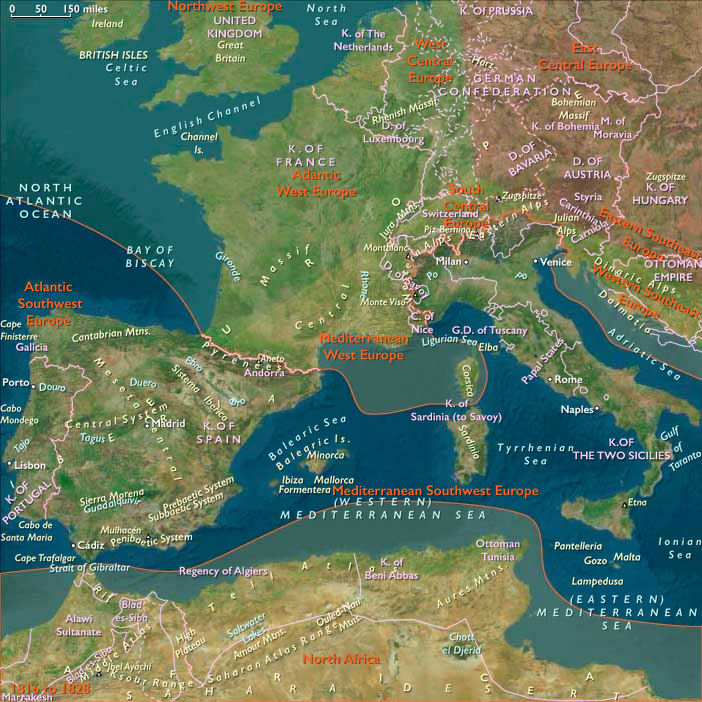
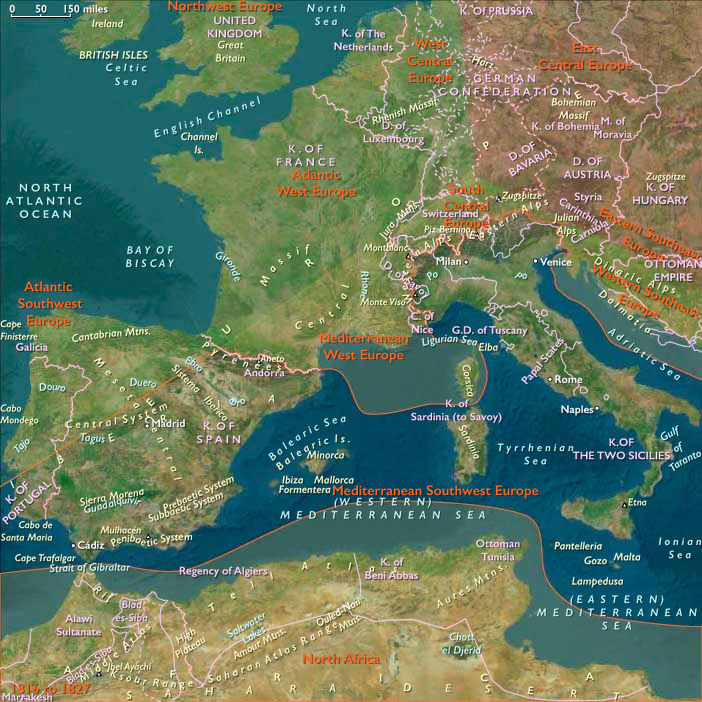
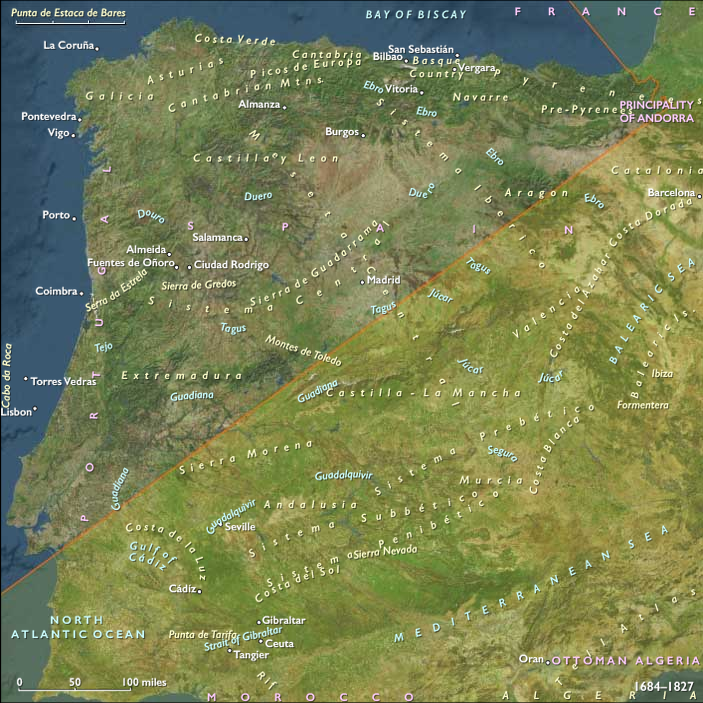
Southwest Europe united two complementary subregions: Mediterranean Southwest Europe—southern and eastern Spain and Italy (from Catalonia and Valencia through Naples, Sicily, Sardinia, and Malta, including Andorra and Monaco)—and Atlantic Southwest Europe—northern Spain (Galicia, Asturias, Cantabria, León) and central–northern Portugal, including Lisbon and the Douro Valley. The region encompassed contrasting worlds: Mediterranean coasts and olive-clad uplands, Atlantic-facing rías and mountain pastures, and the global imperial hubs of Madrid, Lisbon, and Naples.
Climate & Environmental Shifts
The Little Ice Age’s final pulses brought cooler winters, erratic rains, and droughts punctuated by floods. The Tambora eruption (1815) caused the “Year Without a Summer” (1816–1817), producing harvest failures and famine across Iberia and Italy. In the Mediterranean, drought and locusts struck Sicily and Valencia; Atlantic coasts endured storms and failed fisheries. Yet maize, introduced earlier, spread widely and improved subsistence resilience, while the Douro and Ebro valleys sustained wine and olive production even in lean years.
Subsistence & Settlement
-
Agriculture & trade: Wheat, rye, and maize anchored highland diets; olives, vines, and citrus defined Mediterranean valleys; the Douro terraces produced port wine for export; Andalusian and Neapolitan estates exported olive oil and citrus; inland herders raised sheep and goats across the Meseta and Apennines.
-
Fisheries & maritime life: Sardines, cod, and tuna sustained Atlantic coasts; coral and sponge fishing remained profitable in the Mediterranean.
-
Urban networks: Madrid, Lisbon, Barcelona, Valencia, Naples, Palermo, Porto, Bilbao, A Coruña, and Genoa served as hubs of administration and commerce; Lisbon rebuilt after its 1755 earthquake with wide boulevards and Pombaline architecture; Monaco and Andorra survived as enclaved principalities amid continental warfare.
Technology & Material Culture
-
Agrarian reform: The Enlightenment era promoted new crops, irrigation, and land surveys; Charles III’s Spain (1759–1788) fostered rational agronomy and economic societies.
-
Urban reconstruction: Post-1755 Lisbon embodied neoclassical town planning; Naples, Turin, and Barcelonaadopted Enlightenment grids and academies.
-
Industrial stirrings: Mining, silk weaving (Valencia, Lyon–Turin), shipyards on the Tagus and Bay of Biscay, and Lisbon’s arsenals foreshadowed later industrialization.
-
Material life: Mix of peasant implements, maritime tools, and luxury imports from the Americas—Brazilian gold, sugar, coffee, and tobacco funded rococo palaces and religious art.
Movement & Interaction Corridors
-
Imperial arteries:
-
Lisbon remained Europe’s bridge to Brazil, channeling sugar, gold, diamonds, and coffee.
-
Seville–Cadiz shifted to Atlantic trade after 1717; Barcelona–Valencia retained Mediterranean shipping to Italy and the Levant.
-
The Douro–Porto corridor tied vineyards to Britain under the Methuen Treaty (1703), fostering Anglo-Portuguese mercantile ties.
-
-
War and diplomacy:
-
War of the Spanish Succession (1702–1714): Reshaped European alliances; Austria gained Italian territories, Savoy took Sardinia.
-
Peninsular War (1808–1814): French occupation of Spain and Portugal brought devastation but also nationalist mobilization and guerrilla warfare; Lisbon survived under British naval protection.
-
Congress of Vienna (1815): Reinstated monarchies—Bourbon Spain, Sardinian Savoy, Naples/Bourbon Two Sicilies—yet could not erase revolutionary legacies.
-
Cultural & Symbolic Expressions
-
Religion & reform: Catholic devotion persisted but came under scrutiny; Enlightened monarchs curbed monastic orders and seized church lands; the Jesuit expulsion (1767) marked a decisive shift toward state control.
-
Intellectual ferment: Universities in Coimbra, Madrid, Naples, Barcelona, and Bologna hosted reformist thinkers; Spanish and Italian Enlightenments circulated through learned societies and journals.
-
Art & literature: Neoclassicism flourished in Rome and Madrid; Goya’s paintings captured both Enlightenment optimism and Napoleonic horror; Jacques-Louis David’s Roman studies influenced European art.
-
Popular culture: Pilgrimages to Santiago de Compostela, Galician bagpipes (gaita), Portuguese fado, and Neapolitan song embodied enduring vernacular identities.
Environmental Adaptation & Resilience
Diversified economies—grain, vines, olives, livestock, and fisheries—softened climatic shocks. Parish relief and monastic charity mitigated famine. Terracing and irrigation expanded arable land; maize and potatoes became famine crops. Coastal shipping distributed grain between famine and surplus ports.
Political & Military Shocks
-
Spanish decline: After Charles III’s reforms, misrule under Charles IV and Manuel de Godoy drew Spain into Napoleonic wars; the Peninsular War wrecked the economy and precipitated loss of nearly all American colonies by 1825, leaving only Cuba and Puerto Rico.
-
Revolutionary upheavals: The Constitution of Cádiz (1812) heralded liberalism; Riego’s revolt (1820)reinstated it briefly before French intervention (1823) restored absolutism.
-
Italian and Sardinian reorganization: Austrian dominance over Lombardy–Venetia and Savoyard expansion into Piedmont–Sardinia laid foundations for 19th-century nationalism.
-
Portuguese transition: The royal family’s flight to Brazil (1807) and return (1821) transformed Lisbon’s empire; Brazilian independence (1822) ended Portugal’s golden age.
Transition
Between 1684 and 1827 CE, Southwest Europe evolved from Baroque monarchy to a crucible of Enlightenment reform, revolution, and imperial loss. Lisbon and Madrid, once capitals of world empires, faced contraction as Brazil and Spanish America broke free. Napoleonic invasion, liberal constitutions, and restorations alternated in dizzying succession. Yet from Porto’s terraces to Naples’ quays and Andorra’s valleys, resilient agrarian and maritime communities sustained cultural continuity. The age ended with monarchies restored but Enlightenment ideals—and Atlantic winds of change—irreversibly reshaping the destiny of Southern Europe.
People
- Charles III of Spain
- Charles IV of Spain
- Ferdinand VII of Spain
- Jacques-Louis David
- Joachim Murat
- Joseph Bonaparte
- Manuel de Godoy, Prince of the Peace
- Napoleon
- Rafael del Riego
Groups
- Andorra, Principality of
- Austria, Archduchy of
- Sardinia, Kingdom of
- Spanish Empire
- Naples, Kingdom of
- Puerto Rico (Spanish Colony)
- Cuba (Spanish Colony)
- Spain, Habsburg Kingdom of
- Savoy, Duchy of
- Spain, Bourbon Kingdom of
- Sardinia, Kingdom of (Savoy)
- Naples and Sicily, Bourbon Kingdom of
- Piedmontese Republic
- Sardinia, Kingdom of
- Austrian Empire
- Naples, Bonapartist Kingdom of
- Spain, Bonapartist Kingdom of
- Spain, Bourbon Kingdom (first restoration) of
- Sardinia, Kingdom of
- Savoy, (restored) Duchy of
Topics
- Colonization of the Americas, Spanish
- Enlightenment, Age of
- Spanish Succession, War of the
- Spanish American wars of independence
- Trienio Liberal (Spanish Civil War of 1820-23)
- Franco-Spanish War of 1823
Subjects
Regions
Subregions
Years: 1684 - 1827
People
- Charles III of Spain
- Charles IV of Spain
- Ferdinand VII of Spain
- Jacques-Louis David
- Joachim Murat
- Joseph Bonaparte
- Manuel de Godoy, Prince of the Peace
- Napoleon
- Rafael del Riego
Groups
- Andorra, Principality of
- Austria, Archduchy of
- Sardinia, Kingdom of
- Spanish Empire
- Naples, Kingdom of
- Puerto Rico (Spanish Colony)
- Cuba (Spanish Colony)
- Spain, Habsburg Kingdom of
- Savoy, Duchy of
- Spain, Bourbon Kingdom of
- Sardinia, Kingdom of (Savoy)
- Naples and Sicily, Bourbon Kingdom of
- Piedmontese Republic
- Sardinia, Kingdom of
- Austrian Empire
- Naples, Bonapartist Kingdom of
- Spain, Bonapartist Kingdom of
- Spain, Bourbon Kingdom (first restoration) of
- Sardinia, Kingdom of
- Savoy, (restored) Duchy of
Topics
- Colonization of the Americas, Spanish
- Enlightenment, Age of
- Spanish Succession, War of the
- Spanish American wars of independence
- Trienio Liberal (Spanish Civil War of 1820-23)
- Franco-Spanish War of 1823
Subjects
Regions
Subregions