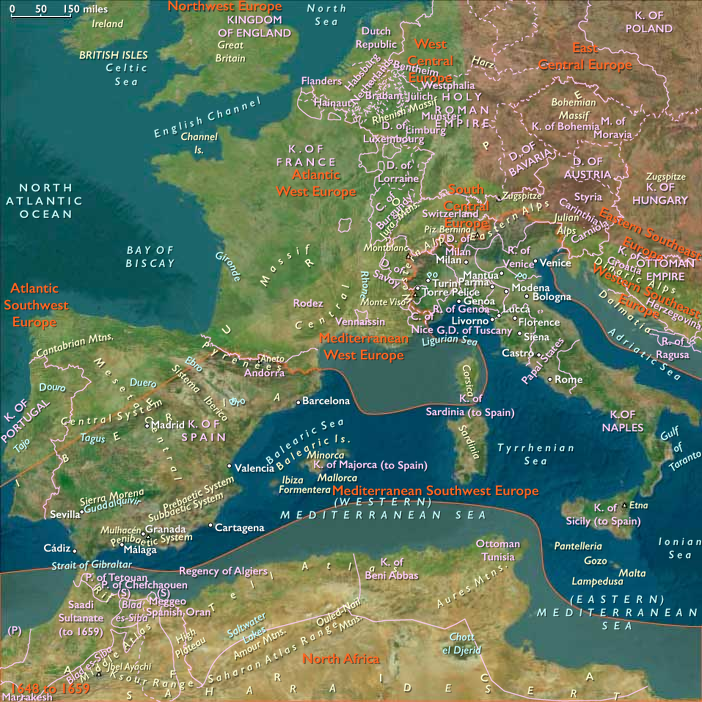
Mediterranean Southwest Europe (1648–1659 CE): Epidemic Devastation …
Years: 1648 - 1659
Mediterranean Southwest Europe (1648–1659 CE): Epidemic Devastation and Cultural Endurance
The period 1648–1659 CE in Mediterranean Southwest Europe is profoundly shaped by severe epidemic crises, most notably the devastating Great Plague of Seville, alongside continued resilience in cultural and political spheres. This era underscores the region's capacity to endure calamity while maintaining significant cultural vitality and political restructuring.
Spain: The Great Plague of Seville
The Great Plague of Seville (1647–1652), one of the most catastrophic epidemics in Spain's history, dominates this era. Initially emerging from North Africa—likely Algeria—the plague first strikes the Mediterranean coastal city of Valencia, resulting in approximately thirty thousand deaths. Rapidly spreading throughout the Mediterranean coast, the plague severely impacts the coastal city of Málaga, causing more than fifty thousand fatalities. In Seville, the devastation is profound, with the city and its surrounding rural areas losing an estimated one hundred and fifty thousand inhabitants out of an initial population of six hundred thousand.
The epidemic also ravages Catalonia and Aragon in the north, exacerbating regional vulnerabilities amid ongoing political and economic strains. Overall, Spain suffers the loss of nearly five hundred thousand individuals—nearly five percent of its total population of just under ten million—marking this as the most severe plague of the century. The epidemic sharply impacts Spain's economic strength, contributing significantly to demographic decline and intensifying the kingdom's longstanding fiscal challenges.
Italy: Artistic and Intellectual Resilience
Despite ongoing repercussions from previous epidemics, Italy experiences sustained cultural and intellectual vigor. Baroque artistry continues to thrive, particularly in Rome and Venice, with Gian Lorenzo Bernini producing enduring masterpieces that further cement his reputation. Italy remains an intellectual hub, with scholars and scientists engaging actively in European academic exchanges despite restrictions imposed by religious authorities, notably around Galileo's legacy.
The Italian peninsula also sees intensified diplomatic and political activity following the conclusion of the Thirty Years' War (1618–1648), navigating a complex landscape shaped by emerging European balance-of-power dynamics.
Malta: Strengthened Defenses and Cultural Influence
Malta, governed by the Knights Hospitaller, continues enhancing its strategic defenses in response to persistent Ottoman threats, fortifying coastal installations and improving internal infrastructure. The island’s cultural prestige remains prominent, with Valletta continuing as a celebrated center for medical advancement and intellectual exchange. Malta's Sacra Infermeria remains a leading European institution, celebrated for its pioneering healthcare services and innovative medical practices.
Venice: Economic Challenges and Cultural Flourishing
Venice faces persistent economic challenges exacerbated by plague outbreaks and shifting trade routes, diminishing its traditional dominance. Nevertheless, the city retains its cultural vibrancy, continuing to serve as an influential center for Baroque music and the arts. Venetian composers and musicians remain influential, sustaining the city’s reputation for sophisticated musical innovation and cultural influence despite economic decline.
Cultural and Social Impacts
Throughout Mediterranean Southwest Europe, the severity of epidemic outbreaks reshapes societal dynamics, amplifying economic disparities, and reshaping urban populations. The significant loss of life prompts substantial changes in social organization, labor distribution, and community structures, laying groundwork for transformations that extend into subsequent decades.
Legacy of the Era
The years 1648–1659 CE vividly illustrate Mediterranean Southwest Europe's dual narrative of epidemic devastation and enduring cultural resilience. Spain's demographic crisis highlights the vulnerabilities of early modern societies, while Italy’s continued cultural productivity underscores the region’s enduring contributions to European intellectual and artistic traditions. Malta and Venice exemplify resilience through adaptive responses, maintaining cultural and strategic significance despite ongoing challenges. This era, marked by profound adversity and adaptive strength, significantly shapes the trajectory of Mediterranean Southwest Europe, influencing its path toward future recovery and transformation.
Years: 1648 - 1659
People
Groups
- Papal States (Republic of St. Peter)
- Malta
- Italy, Kingdom of (Holy Roman Empire)
- Christians, Roman Catholic
- Venice, (Most Serene) Republic of
- Holy Roman Empire
- Spain, Habsburg Kingdom of
- Knights of Malta, Sovereign and Military Order of the
Topics
Subjects
Regions
Subregions