
Mediterranean Southwest Europe (1588–1599 CE): Conflicts, Cultural …
Years: 1588 - 1599
Mediterranean Southwest Europe (1588–1599 CE): Conflicts, Cultural Innovation, and Maritime Influence
The era 1588–1599 CE in Mediterranean Southwest Europe is characterized by significant geopolitical tensions, cultural innovation, and maritime influence. The Iberian Peninsula sees notable conflicts, particularly involving Spain's naval ambitions, while Italy continues to be a vibrant hub of cultural and artistic developments. Concurrently, Malta, under the Knights Hospitaller, solidifies its role as a critical Mediterranean stronghold.
Iberian Geopolitical Tensions and Maritime Conflicts
This period begins dramatically with the Spanish Armada (1588), a fleet dispatched by King Philip II of Spain against England, which ends disastrously, severely impacting Spain’s maritime supremacy. Despite this setback, Spain remains an influential power, deeply involved in European politics and maintaining control over its Mediterranean territories, including Sicily, Sardinia, and the Balearic Islands. The failed Armada expedition reshapes naval strategies and alliances across Europe, prompting greater attention to maritime defenses throughout the Mediterranean region.
Cultural Flourishing and Literary Golden Age in Spain
In Spain, despite political and military setbacks, the cultural environment remains vibrant. This era sees the continued rise of the Spanish Golden Age, with significant literary contributions by prominent authors like Miguel de Cervantes, whose early literary works set the stage for his masterpiece, Don Quixote, in subsequent years. Spanish theater flourishes under playwrights such as Lope de Vega, who becomes known for his prolific output and innovations in dramatic form and character complexity, further enriching the Spanish cultural landscape.
Artistic and Scientific Advancements in Italy
In Italy, cultural innovation continues unabated, particularly in the arts and sciences. This era sees notable advancements in both visual arts and music, with developments influenced by the late Renaissance and early Baroque transitions. Artists like Caravaggio begin to rise in prominence with their innovative use of chiaroscuro and realistic portrayal of human figures. In music, Italian composers continue to refine vocal and instrumental forms, laying foundations that will soon blossom into the Baroque style.
The scientific community, inspired by Renaissance humanism, sees continued growth. The University of Padua remains a leading institution for scientific inquiry, notably in medicine and anatomy, attracting scholars from across Europe and reinforcing Italy’s central role in the European scientific community.
Malta’s Strategic Importance and Fortification Efforts
Malta under the Knights Hospitaller continues to strengthen its strategic importance in the Mediterranean. The fortified city of Valletta, completed earlier in 1571, now fully operational, becomes increasingly vital for maritime defense. The Knights significantly enhance the island’s military capabilities, constructing additional fortifications and watchtowers along the coastline. Malta’s reputation as a cultural and scientific center grows, particularly with the expansion of the Sacra Infermeria, renowned across Europe for its medical advancements and sophisticated healthcare.
Trans-Mediterranean Cultural and Commercial Exchanges
Venice maintains its role as a critical commercial and cultural hub, sustaining vibrant trade links with the Ottoman Empire and North Africa. This trade continues to introduce new goods and ideas into Europe, influencing tastes and habits, particularly through the spread of coffee and other exotic commodities. Such exchanges further entrench Venice’s position as a center for cultural fusion, diplomacy, and commerce in the Mediterranean.
Legacy of the Era
The period 1588–1599 CE encapsulates a dynamic era of political tensions, cultural vibrancy, and maritime strategy. Despite setbacks like the failure of the Spanish Armada, Iberia’s cultural influence grows, while Italy and Malta continue to innovate and solidify their significance within the broader European context. These developments profoundly influence the Mediterranean’s cultural and geopolitical landscape, setting the stage for the complexities of the seventeenth century.
People
Groups
- Malta
- Italy, Kingdom of (Holy Roman Empire)
- Christians, Roman Catholic
- Venice, (Most Serene) Republic of
- Holy Roman Empire
- Ottoman Empire
- England, (Tudor) Kingdom of
- Spain, Habsburg Kingdom of
- Knights of Malta, Sovereign and Military Order of the
Topics
- Humanism, Renaissance
- Renaissance, Italian
- Spanish Golden Age
- Counter-Reformation (also Catholic Reformation or Catholic Revival)
- Spanish Armada, Defeat of the
Commodoties
Subjects
Regions
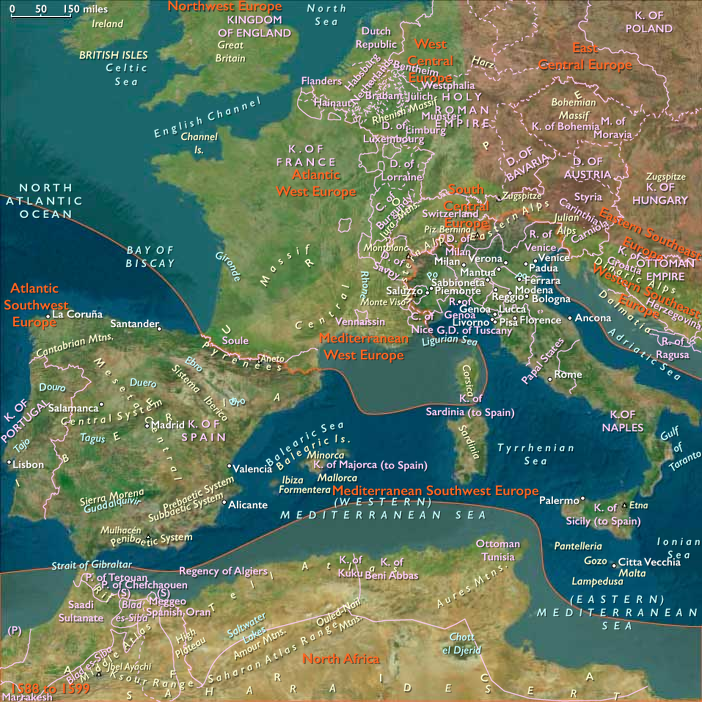
Subregions
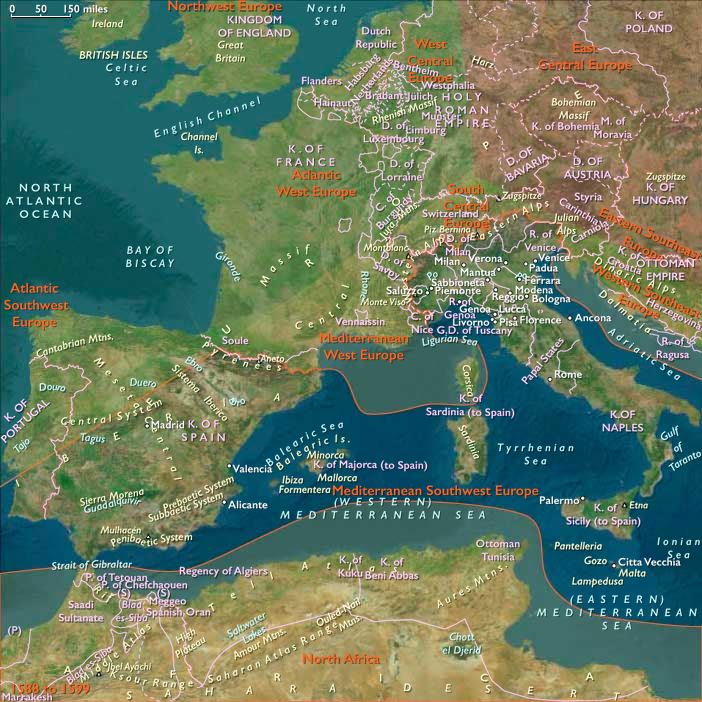
Years: 1588 - 1599
People
Groups
- Malta
- Italy, Kingdom of (Holy Roman Empire)
- Christians, Roman Catholic
- Venice, (Most Serene) Republic of
- Holy Roman Empire
- Ottoman Empire
- England, (Tudor) Kingdom of
- Spain, Habsburg Kingdom of
- Knights of Malta, Sovereign and Military Order of the
Topics
- Humanism, Renaissance
- Renaissance, Italian
- Spanish Golden Age
- Counter-Reformation (also Catholic Reformation or Catholic Revival)
- Spanish Armada, Defeat of the
Commodoties
Subjects
Regions
Subregions