
Mediterranean Southwest Europe (1396–1539 CE): Aragonese Sea …
Years: 1396 - 1539
Mediterranean Southwest Europe (1396–1539 CE): Aragonese Sea Lanes, Italian Renaissance, and Habsburg–Valois Wars
Geographic & Environmental Context
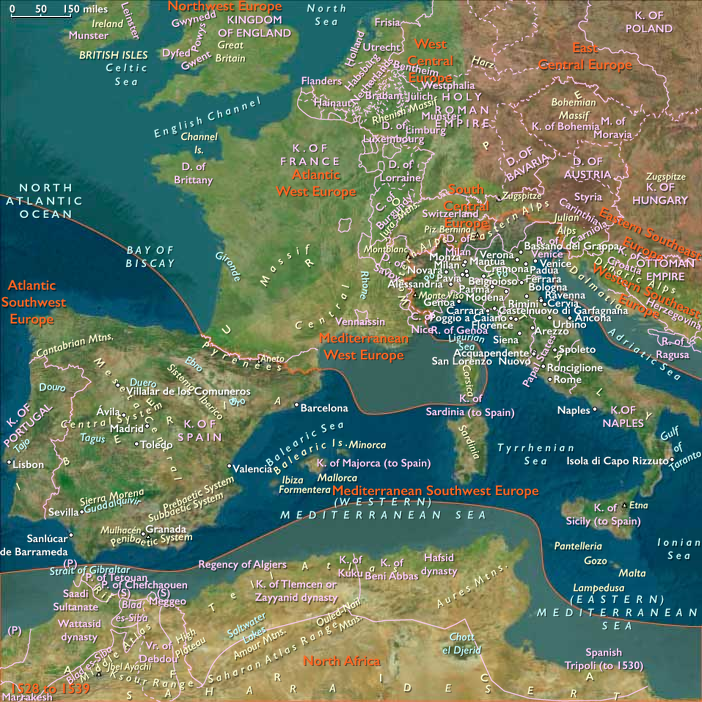
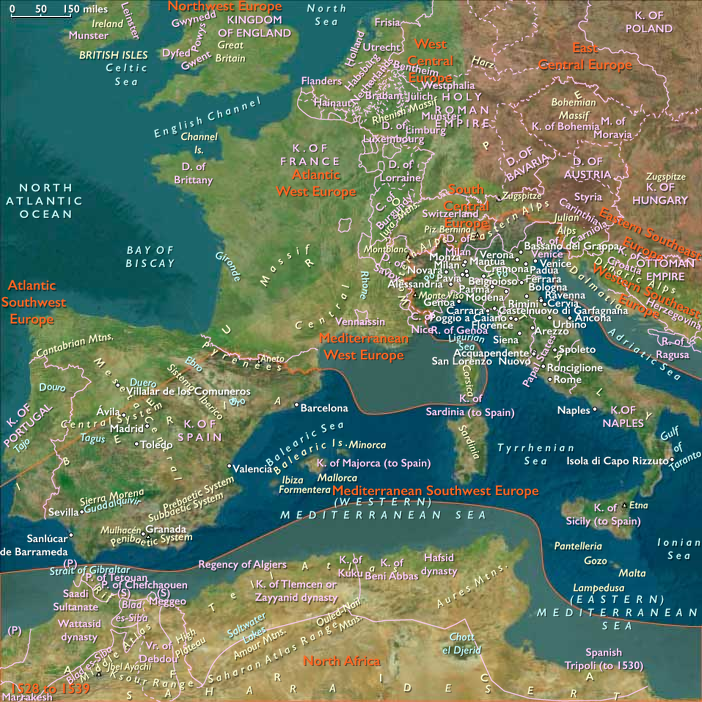
The subregion of Mediterranean Southwest Europe includes Italy (including Sardinia and Sicily), Malta, southern and eastern Spain (Andalusia, Murcia, Valencia, Catalonia), and the Balearic Islands. Anchors span the Po Valley and Venetian–Adriatic gateways, the Apennine spine with Tyrrhenian and Adriatic littorals, the grain and volcanic uplands of Sicily, the rugged Sardinian interior, Malta’s limestone plateau astride central sea-lanes, and Spain’s irrigated huertas and ports from Seville–Cádiz (Atlantic–Mediterranean hinge) through Valencia–Barcelonato the Balearics. Together, these corridors fed and armed Europe’s busiest inland sea.
Climate & Environmental Shifts
Under the Little Ice Age, winters were cooler and variability sharper:
-
Po Valley & northern Italy: alternating droughts and Po floods unsettled wheat/rice rotations; foggy winters extended.
-
Sicily, Sardinia, southern Spain: periodic droughts dented wheat and olive yields; citrus and pastoralism buffered shortfalls.
-
Valencian/Murcian huertas: canal and acequia irrigation moderated dry spells; occasional torrential floods (riadas) damaged terraces.
-
Balearics & Malta: thin soils and rainfall swings drove reliance on cisterns, terracing, and imported grain in lean years.
Subsistence & Settlement
-
Italy: Wheat, barley, vines, and olives dominated; rice spread in Lombardy; urban gardens ringed city-states.
-
Sicily & Sardinia: Grain, olives, vines, citrus, pastoral flocks; granaries supplied Italian and Iberian ports.
-
Southern & eastern Spain: Andalusian cereals, olives, vines; Valencia/Murcia grew rice, sugarcane, mulberry–silk; Catalan uplands raised sheep for wool.
-
Balearics & Malta: Mixed grain, olives, vines, goats; fisheries vital; harbors provisioned passing fleets.
Port cities—Venice, Genoa, Naples, Palermo, Barcelona, Valencia, Seville, Palma, Cagliari—functioned as collection and redistribution hubs for Mediterranean and, increasingly, Atlantic trade.
Technology & Material Culture
-
Irrigation & terracing: acequias, qanat-derived galleries, pozzos/cisterns, stone-walled benches stabilized yields on coasts and islands.
-
Maritime technology: galleys remained the workhorse; Italian and Iberian yards developed round-hulled naos and early caravels; bronze cannon transformed siege and naval warfare.
-
Manufactures: Florentine wool and silk; Venetian glass and print (Aldine press); Valencian silk and sugar; Catalan and Neapolitan shipyards.
-
Architecture & arts: Gothic to Renaissance transitions—Brunelleschi’s dome, Alberti’s façades, Venetian palazzi; Spanish Mudéjar and early Plateresque; island watchtowers and coastal walls.
Movement & Interaction Corridors
-
Aragonese thalassocracy: Barcelona–Valencia–Balearics–Sardinia–Sicily–Naples stitched a western Mediterranean network later inherited by Habsburg Spain.
-
Italian sea-lanes: Venice and Genoa collected Levantine and North African wares; peninsular roads (Via Emilia, Apennine passes) bound inland cities to ports.
-
Iberian hinge: Seville–Cádiz bridged Atlantic and Mediterranean circuits after 1492; Atlantic silver would later amplify these flows.
-
Island waypoints: Malta, Sardinia, and the Balearics provisioned convoys and guarded straits against corsairs.
Cultural & Symbolic Expressions
-
Renaissance humanism: Florence, Rome, and Venice fostered painting, sculpture, architecture, philology; courts of Naples, Ferrara, and Urbino radiated styles into Iberia and the islands.
-
Catholic Christendom: Papal Rome remained a pilgrimage and patronage center; confraternities, processions, and mendicant orders structured urban piety.
-
Iberian transformations: The Fall of Granada (1492) ended Nasrid rule; the Inquisition and expulsion/forced conversion reshaped Andalusian society; Valencian and Catalan towns mixed mercantile pragmatism with reforming currents.
-
Island identities: Genoese, Aragonese, and local elites fused on Corsica/Sardinia; Malta blended Sicilian, Catalan, and Arabic legacies—until 1530, when it became the fief of the Knights Hospitaller.
Environmental Adaptation & Resilience
-
Risk-spreading agriculture: cereal–legume rotations, vine–olive intercropping, and chestnut economies in uplands; rice paddies where water allowed.
-
Water management: canal dredging (Po/Adige), huerta maintenance (Valencia), terrace/cistern upkeep (Malta, Balearics, Ligurian and Amalfi coasts).
-
Urban buffers: state granaries, grain imports, and charitable confraternities mitigated dearth; fisheries and salted staples bridged bad harvests.
Technology & Power Shifts (Conflict Dynamics)
-
Hundred Years’ War (to 1453): peripheral raids reached Languedoc and Catalonia, nudging Aragonese naval policy.
-
Conquest of Naples (1442): Alfonso V of Aragon knit Naples to the Crown of Aragon’s sea empire.
-
Italian Wars (1494–1559): France, Spain, and the Empire fought over Italian hegemony—
-
Battle of Fornovo (1495) checked Charles VIII’s withdrawal;
-
Battle of Cerignola (1503) (Apulia) showcased gunpowder infantry, securing Spanish control in southern Italy;
-
Battle of Agnadello (1509) humbled Venice on the terraferma;
-
Battle of Pavia (1525) delivered a decisive Habsburg victory and Francis I’s capture;
-
the Sack of Rome (1527) shattered papal prestige and artists’ security.
-
-
Western Mediterranean contest: Barbary and Ottoman corsairs raided Sicily, Sardinia, Balearics, and Valencia; Rhodes (1522) fell to the Ottomans, redirecting the Hospitallers to Malta (1530); Preveza (1538) cemented Ottoman naval dominance in the eastern basin with echoes westward.
-
Iberian unification: The crowns of Aragon and Castile united (1479), projecting Spanish power across the peninsula, Italy, and the sea.
Transition
By 1539 CE, Mediterranean Southwest Europe was a crucible of power and culture. Habsburg Spain controlled Naples, Sicily, and Sardinia; Venice and Genoa mediated eastern and western trades under growing Habsburg and Ottoman pressure; Malta stood newly under the Knights as a central bastion; Valencia–Barcelona and Italian ports thrummed with commerce and shipbuilding. Despite climatic swings, terracing, irrigation, and maritime provisioning sustained populations. Renaissance patronage glowed even as Italian Wars and corsair/Ottoman threats remade the political seascape—setting up a long sixteenth century of Spanish predominance and Mediterranean contest.
People
- Charles V, Holy Roman Emperor
- Christopher Columbus
- Donatello
- Ferdinand II of Aragon
- Ferdinand Magellan
- Filippo Brunelleschi
- Francisco Pizarro
- Henry the Navigator
- Hernán Cortés
- Isabella I of Castile
- Joanna of Castile
- Leonardo Bruni
- Leonardo da Vinci
- Michelangelo Buonarroti
- Pope Clement VII
- Raphael
- Sandro Botticelli
- Titian
- Tomás de Torquemada
- Vasco Núñez de Balboa
Groups
- Italy, Kingdom of (Holy Roman Empire)
- Habsburg, House of
- Aragon, Crown of
- Mantua, Lordship of
- Castile, Crown of
- Ottoman Empire
- Ferrara, Modena and Reggio, Marquisate of
- Portugal, Avizan (Joannine) Kingdom of
- Milan, Duchy of
- Ottoman Empire
- Portuguese Empire
- Holy Roman Empire
- Milan, Duchy of
- Ottoman Empire
- Ferrara, Duchy of
- Inquisition, Spanish
- Spanish Empire
- Moriscos
- Florence, Medici-ruled
- Spain, Habsburg Kingdom of
- Florence, Republic of
- Mantua, Duchy of
Topics
- Reconquista, the
- Humanism, Renaissance
- Renaissance, Italian
- Granada War
- Granada, Fall of
- Italian War of Charles VIII
- Italian War of Louis XII
- League of Cognac, War of the
Subjects
Regions
Subregions
Years: 1396 - 1539
People
- Charles V, Holy Roman Emperor
- Christopher Columbus
- Donatello
- Ferdinand II of Aragon
- Ferdinand Magellan
- Filippo Brunelleschi
- Francisco Pizarro
- Henry the Navigator
- Hernán Cortés
- Isabella I of Castile
- Joanna of Castile
- Leonardo Bruni
- Leonardo da Vinci
- Michelangelo Buonarroti
- Pope Clement VII
- Raphael
- Sandro Botticelli
- Titian
- Tomás de Torquemada
- Vasco Núñez de Balboa
Groups
- Italy, Kingdom of (Holy Roman Empire)
- Habsburg, House of
- Aragon, Crown of
- Mantua, Lordship of
- Castile, Crown of
- Ottoman Empire
- Ferrara, Modena and Reggio, Marquisate of
- Portugal, Avizan (Joannine) Kingdom of
- Milan, Duchy of
- Ottoman Empire
- Portuguese Empire
- Holy Roman Empire
- Milan, Duchy of
- Ottoman Empire
- Ferrara, Duchy of
- Inquisition, Spanish
- Spanish Empire
- Moriscos
- Florence, Medici-ruled
- Spain, Habsburg Kingdom of
- Florence, Republic of
- Mantua, Duchy of
Topics
- Reconquista, the
- Humanism, Renaissance
- Renaissance, Italian
- Granada War
- Granada, Fall of
- Italian War of Charles VIII
- Italian War of Louis XII
- League of Cognac, War of the
Subjects
Regions
Subregions