
Mediterranean Southwest Europe (1516–1527 CE): Cultural Crisis, …
Years: 1516 - 1527
Mediterranean Southwest Europe (1516–1527 CE): Cultural Crisis, Mannerism, and Jewish Flourishing
The era 1516–1527 CE in Mediterranean Southwest Europe witnesses a significant cultural shift marked by the emergence of Mannerism, a crisis of artistic confidence, and the thriving of Jewish communities in central Italy.
Artistic Crisis and the Rise of Mannerism
By the early 16th century, young artists face a profound crisis, perceiving that Renaissance art had already reached a pinnacle of technical perfection. With anatomical precision, refined expressions of emotion, and mastery of perspective seemingly exhausted by masters such as Michelangelo, Raphael, and Andrea del Sarto, artists begin seeking new forms of expression.
Mannerism emerges in response to this artistic saturation. Characterized by exaggerated proportions, heightened emotionality, and intentional complexity, Mannerist artworks diverge from classical ideals. The term derives from the Italian maniera, denoting a sophisticated or artificial style, and is embraced by Giorgio Vasari, who later describes this phase as la maniera moderna ("the modern style").
Flourishing Jewish Communities
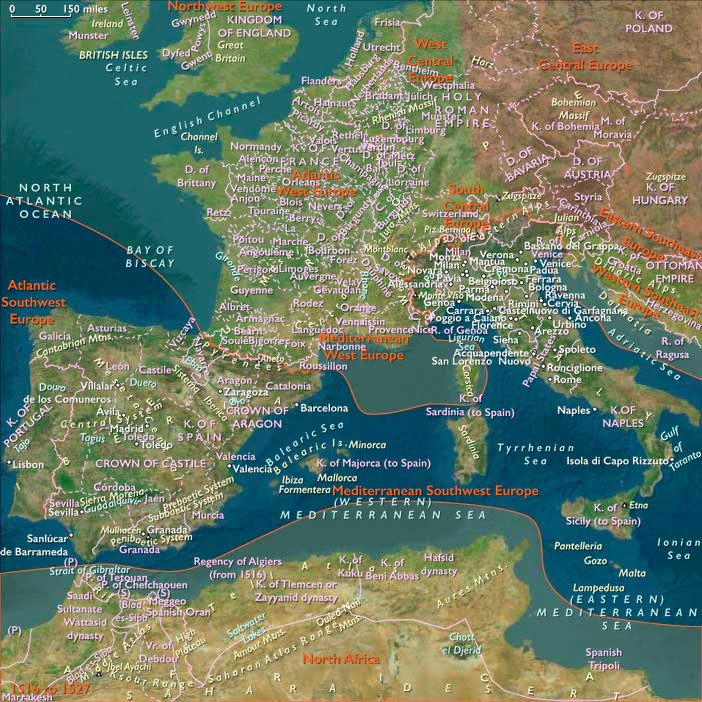
Despite continued persecutions elsewhere, Jewish life flourishes in central Italy during this period, particularly in Mantua, which boasts Italy’s second-largest Jewish community after Venice. Other vibrant centers include Urbino, Ferrara, Florence, Spoleto, Siena, and Ancona. These communities become significant cultural and intellectual hubs, providing sanctuary and fostering scholarship, religious study, and artistic contributions.
Intellectual and Cultural Legacy
This period symbolizes a critical turning point, reflecting a broader European shift from classical Renaissance ideals to more complex and self-conscious cultural expressions. The contrast between artistic anxiety and cultural flourishing within specific communities encapsulates the multifaceted character of this transformative era, setting the stage for further intellectual and artistic evolution in Mediterranean Southwest Europe.
People
Groups
- Italy, Kingdom of (Holy Roman Empire)
- Siena, Republic of
- Venice, (Most Serene) Republic of
- Mantua, Lordship of
- Ancona, Republic of
- Holy Roman Empire
- Urbino, Duchy of
- Ferrara, Duchy of
- Florence, Medici-ruled
Topics
Subjects
Regions
Subregions

Years: 1516 - 1527
People
Groups
- Italy, Kingdom of (Holy Roman Empire)
- Siena, Republic of
- Venice, (Most Serene) Republic of
- Mantua, Lordship of
- Ancona, Republic of
- Holy Roman Empire
- Urbino, Duchy of
- Ferrara, Duchy of
- Florence, Medici-ruled
Topics
Subjects
Regions
Subregions