
Southwest Europe (1396–1539 CE) Aragonese Sea …
Years: 1396 - 1539
Southwest Europe (1396–1539 CE)
Aragonese Sea Lanes, Italian Renaissance, and Habsburg–Valois Wars
Geography & Environmental Context
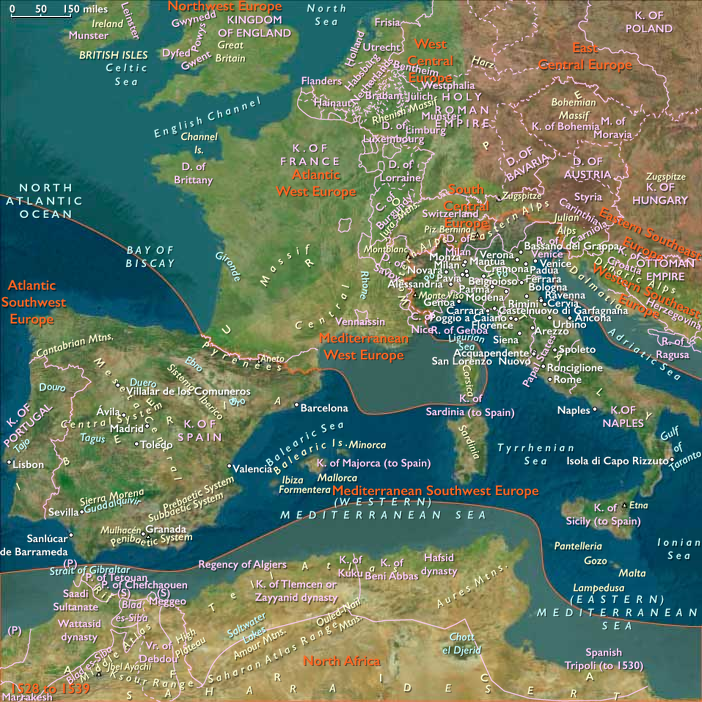
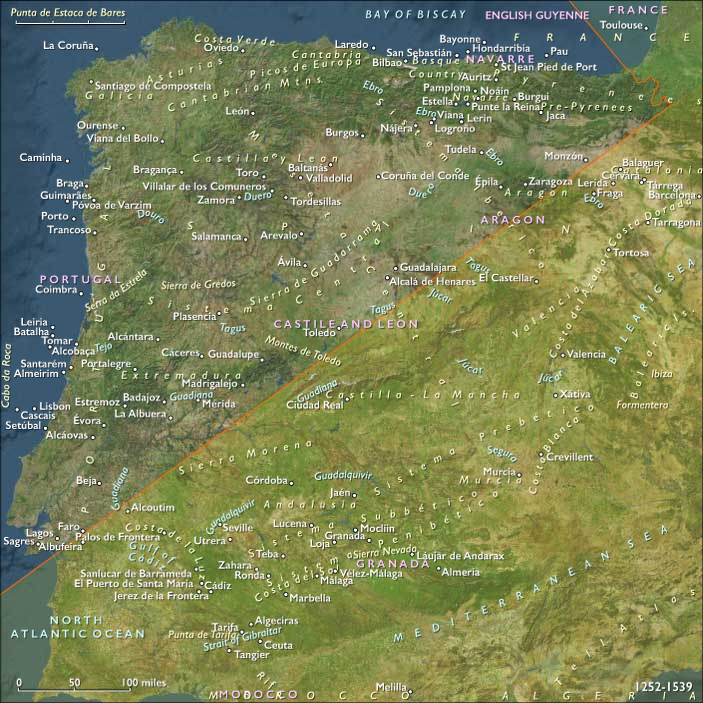
Southwest Europe encompassed Italy (including Sardinia and Sicily), Malta, southern and eastern Spain (Andalusia, Murcia, Valencia, Catalonia), and the Balearic Islands. Anchors spanned the Po Valley and Venetian–Adriatic gateways, the Apennine spine with Tyrrhenian and Adriatic littorals, the grain and volcanic uplands of Sicily, the rugged Sardinian interior, Malta’s limestone plateau astride central sea-lanes, and Spain’s irrigated huertas and ports from Seville–Cádiz (Atlantic–Mediterranean hinge) through Valencia–Barcelona to the Balearics.
Together these corridors provisioned, armed, and cultured Europe’s busiest inland sea.
Climate & Environmental Shifts
Under the Little Ice Age, winters cooled and variability intensified:
-
Po Valley & Lombardy: alternating droughts and Po floods unsettled rice and wheat rotations.
-
Sicily, Sardinia, southern Spain: recurrent droughts reduced grain and olive yields; citrus and pastoralism buffered loss.
-
Valencia–Murcia huertas: Acequia irrigation offset dry years, but torrential riadas periodically destroyed terraces.
-
Balearics & Malta: thin soils and rainfall swings required cisterns, terracing, and imported grain.
Subsistence & Settlement
-
Italy: Wheat, barley, vines, olives, and, in Lombardy, irrigated rice; urban gardens surrounded the city-states.
-
Sicily & Sardinia: Grain, olives, vines, citrus, and livestock; granaries provisioned Italian and Iberian ports.
-
Southern & eastern Spain: Andalusian cereals, olives, and vines; Valencian and Murcian sugarcane and mulberry–silk; Catalan wool flocks.
-
Islands: Grain, olives, vines, goats, and fisheries sustained mixed economies; harbors provisioned passing fleets.
Major ports—Venice, Genoa, Naples, Palermo, Barcelona, Valencia, Seville, Palma, Cagliari—served as collection hubs for Mediterranean and emerging Atlantic commerce.
Technology & Material Culture
-
Irrigation & terracing: Acequias, qanat-derived galleries, pozzos and cisterns, and stone-bench terraces stabilized yields on coasts and islands.
-
Maritime innovation: Galleys remained indispensable; Italian and Iberian shipyards developed round-hulled naos and early caravels; bronze cannon revolutionized siege and naval warfare.
-
Manufactures: Florentine wool and silk, Venetian glass and books (the Aldine Press), Valencian silk and sugar, Catalan and Neapolitan shipbuilding.
-
Architecture & arts: Gothic–Renaissance transitions—Brunelleschi’s dome, Alberti’s façades, Venetian palazzi; Spanish Mudéjar and early Plateresque; island watchtowers and coastal walls.
Movement & Interaction Corridors
-
Aragonese thalassocracy: The Barcelona–Valencia–Balearics–Sardinia–Sicily–Naples chain formed a western Mediterranean empire later absorbed by Habsburg Spain.
-
Italian sea-lanes: Venice and Genoa dominated Levantine and North African trade; Apennine passes linked inland production to ports.
-
Iberian hinge: Seville–Cádiz bridged Atlantic and Mediterranean routes after 1492, prefiguring global circuits of silver and spice.
-
Islands: Malta, Sardinia, and the Balearics provisioned convoys and guarded corsair-prone straits.
Cultural & Symbolic Expressions
-
Renaissance humanism: Florence, Rome, and Venice led Europe’s artistic renewal; courts of Naples, Ferrara, and Urbino radiated taste into Iberia and the islands.
-
Catholic Christendom: Rome remained pilgrimage center and patron of arts; confraternities and mendicant orders structured devotion.
-
Iberian transformations: The Fall of Granada (1492) ended Nasrid rule; the Inquisition and expulsions reshaped Andalusian society; Valencian and Catalan towns mixed mercantile realism with reformist thought.
-
Islands: Malta, blending Sicilian, Catalan, and Arabic legacies, was granted in 1530 to the Knights Hospitaller as a new crusading bastion.
Environmental Adaptation & Resilience
Cereal–legume rotations, vine–olive intercropping, chestnut economies in uplands, and rice paddies in irrigated lowlands spread risk.
Huerta canals and terrace systems were continuously maintained; state granaries and charitable confraternities mitigated dearth; fisheries and salted staples balanced harvest failures.
Technology & Power Shifts (Conflict Dynamics)
-
Aragonese expansion: Alfonso V (1442) united Naples with Aragon’s sea empire.
-
Italian Wars (1494–1559): France, Spain, and the Empire contested Italy—Fornovo (1495), Cerignola (1503), Agnadello (1509), Pavia (1525), and the Sack of Rome (1527) redefined European warfare and diplomacy.
-
Corsair & Ottoman pressure: Raids struck Sicily, Sardinia, Valencia, and the Balearics; Preveza (1538) confirmed Ottoman naval mastery in the east.
-
Iberian union: The crowns of Aragon and Castile (1479) created a Spanish monarchy projecting power across the peninsula and into the Mediterranean.
Transition
By 1539 CE, Southwest Europe was a crucible of power and culture. Habsburg Spain controlled Naples, Sicily, and Sardinia; Venice and Genoa mediated East–West trades under Ottoman pressure; Malta under the Knights became a bulwark; Valencia–Barcelona and Italian ports thrived on commerce and shipbuilding. Terracing, irrigation, and maritime provisioning sustained populations amid climatic volatility. Renaissance brilliance endured even as corsairs and cannon ushered in a new Mediterranean order.
People
- Charles V, Holy Roman Emperor
- Christopher Columbus
- Donatello
- Ferdinand II of Aragon
- Ferdinand Magellan
- Filippo Brunelleschi
- Francisco Pizarro
- Henry the Navigator
- Hernán Cortés
- Isabella I of Castile
- Joanna of Castile
- Leonardo Bruni
- Leonardo da Vinci
- Michelangelo Buonarroti
- Pope Clement VII
- Raphael
- Sandro Botticelli
- Titian
- Tomás de Torquemada
- Vasco Núñez de Balboa
Groups
- Italy, Kingdom of (Holy Roman Empire)
- Habsburg, House of
- Aragon, Crown of
- Mantua, Lordship of
- Castile, Crown of
- Ottoman Empire
- Ferrara, Modena and Reggio, Marquisate of
- Portugal, Avizan (Joannine) Kingdom of
- Milan, Duchy of
- Ottoman Empire
- Portuguese Empire
- Holy Roman Empire
- Milan, Duchy of
- Ottoman Empire
- Ferrara, Duchy of
- Inquisition, Spanish
- Spanish Empire
- Moriscos
- Florence, Medici-ruled
- Spain, Habsburg Kingdom of
- Florence, Republic of
- Mantua, Duchy of
Topics
- Reconquista, the
- Humanism, Renaissance
- Renaissance, Italian
- Granada War
- Granada, Fall of
- Italian War of Charles VIII
- Italian War of Louis XII
- League of Cognac, War of the
Subjects
Regions
Subregions
Years: 1396 - 1539
People
- Charles V, Holy Roman Emperor
- Christopher Columbus
- Donatello
- Ferdinand II of Aragon
- Ferdinand Magellan
- Filippo Brunelleschi
- Francisco Pizarro
- Henry the Navigator
- Hernán Cortés
- Isabella I of Castile
- Joanna of Castile
- Leonardo Bruni
- Leonardo da Vinci
- Michelangelo Buonarroti
- Pope Clement VII
- Raphael
- Sandro Botticelli
- Titian
- Tomás de Torquemada
- Vasco Núñez de Balboa
Groups
- Italy, Kingdom of (Holy Roman Empire)
- Habsburg, House of
- Aragon, Crown of
- Mantua, Lordship of
- Castile, Crown of
- Ottoman Empire
- Ferrara, Modena and Reggio, Marquisate of
- Portugal, Avizan (Joannine) Kingdom of
- Milan, Duchy of
- Ottoman Empire
- Portuguese Empire
- Holy Roman Empire
- Milan, Duchy of
- Ottoman Empire
- Ferrara, Duchy of
- Inquisition, Spanish
- Spanish Empire
- Moriscos
- Florence, Medici-ruled
- Spain, Habsburg Kingdom of
- Florence, Republic of
- Mantua, Duchy of
Topics
- Reconquista, the
- Humanism, Renaissance
- Renaissance, Italian
- Granada War
- Granada, Fall of
- Italian War of Charles VIII
- Italian War of Louis XII
- League of Cognac, War of the
Subjects
Regions
Subregions