
Mediterranean Southwest Europe (1276–1287 CE): Sicilian Vespers, …
Years: 1276 - 1287
Mediterranean Southwest Europe (1276–1287 CE): Sicilian Vespers, Papal-Aragonese Conflict, and Intellectual Developments in Iberia
The era 1276–1287 CE in Mediterranean Southwest Europe is marked by significant political upheaval in Sicily, papal conflict with the Kingdom of Aragon, increased persecution of Jews in Castile, and important mystical and intellectual developments among Iberian Jewish communities.
The Sicilian Vespers and the Aragonese Crusade
The period sees the outbreak of the War of the Sicilian Vespers in 1282, triggered by an insurrection of the Sicilian populace against Charles of Anjou's rule. The rebellion rapidly escalates into an international conflict, leading Pope Martin IV to declare the Aragonese Crusade (1284–1285) against Peter III the Great of Aragon, who had recently seized Sicily. The Pope justifies this crusade by asserting papal overlordship of Sicily, officially deposing Peter III and dramatically intensifying regional hostilities.
Persecution and Exclusion in Castile
In Iberia, persecution against Jewish communities intensifies significantly under the reign of Alfonso X of Castile. In his influential legal code, Las Siete Partidas (“Seven Sets”), Alfonso X formalizes church doctrines that systematically marginalize Jews, explicitly excluding them from public offices and reinforcing their subordinate status. These measures heighten tensions, marking a significant escalation in the persecution of Iberian Jews, setting the stage for later expulsions and repressions.
Mystical Innovations: Sefer HaTemunah
Amidst this turbulent era, the Jewish mystical text Sefer HaTemunah (“Book of the Image”) emerges in Spain, composed anonymously around the 1270s. The work introduces innovative concepts, such as the existence of cosmic cycles, each governed by distinct divine attributes—namely “grace,” “judgment,” and “mercy.” Each eon, the text argues, possesses its unique Torah, rendering Judaism adaptable to cosmic epochs rather than presenting immutable truths. The book imbues Hebrew letters with profound mystical significance, suggesting hidden, esoteric dimensions of the Torah. This influential mystical tradition significantly enriches Kabbalistic thought and spirituality throughout the Jewish diaspora.
Continued Maritime Rivalries and Economic Strength
Mediterranean maritime republics, especially Genoa and Venice, maintain fierce competition for naval dominance and trade supremacy. Their conflicts influence broader geopolitical dynamics and economic conditions in the Mediterranean, contributing to ongoing regional rivalries and economic vitality.
Architectural Continuity and Urban Development
The region continues its ambitious Gothic architectural projects, particularly in Italy and Iberia, where cathedrals, palaces, and public buildings remain enduring symbols of civic pride, religious devotion, and cultural identity.
Legacy of the Era
The era 1276–1287 CE significantly shapes Mediterranean Southwest Europe through the profound political shifts initiated by the Sicilian Vespers, papal conflicts with Aragon, intensified persecution of Jewish communities, and significant intellectual and mystical contributions in Iberia. Collectively, these events influence the region’s religious, political, cultural, and intellectual trajectory, deeply affecting subsequent European historical developments.
People
Groups
- Jews
- Genoa, (Most Serene) Republic of
- Christians, Roman Catholic
- Florence, Republic of
- Aragón, Kingdom of
- Siena, Republic of
- Venice, (Most Serene) Republic of
- Castile, Crown of
Topics
Subjects
- Commerce
- Writing
- Architecture
- Painting and Drawing
- Conflict
- Faith
- Government
- Custom and Law
- Arcanum
- Cosmography
Regions
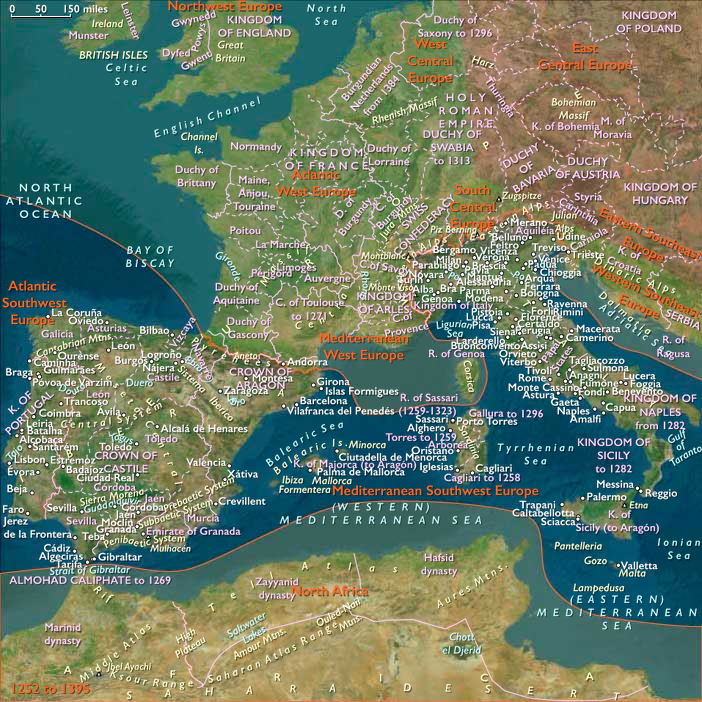
Subregions
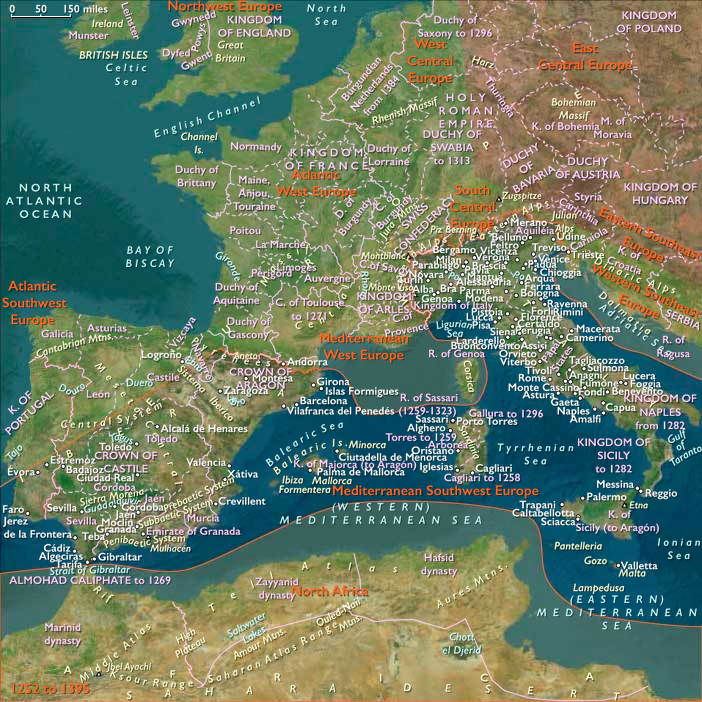
Years: 1276 - 1287
People
Groups
- Jews
- Genoa, (Most Serene) Republic of
- Christians, Roman Catholic
- Florence, Republic of
- Aragón, Kingdom of
- Siena, Republic of
- Venice, (Most Serene) Republic of
- Castile, Crown of
Topics
Subjects
- Commerce
- Writing
- Architecture
- Painting and Drawing
- Conflict
- Faith
- Government
- Custom and Law
- Arcanum
- Cosmography
Regions
Subregions