
Southwest Europe (1252 – 1395 CE): Mediterranean …
Years: 1252 - 1395
Southwest Europe (1252 – 1395 CE): Mediterranean Thalassocracies and the Atlantic Turn
From the lagoons of Venice to the harbors of Lisbon, the southwest rim of Europe entered the Late Middle Ages as one of the world’s most dynamic maritime zones. The period between 1252 and 1395 witnessed the zenith of the Crown of Aragon’s thalassocracy, the consolidation of Castile and Portugal, and the financial and naval dominance of the Italian city-republics. Across the Mediterranean and Atlantic, fleets, fairs, and fortresses bound Europe’s southern peninsulas into an interlinked economy whose rhythms were set by wind, grain, and gold.
Geography and Climate
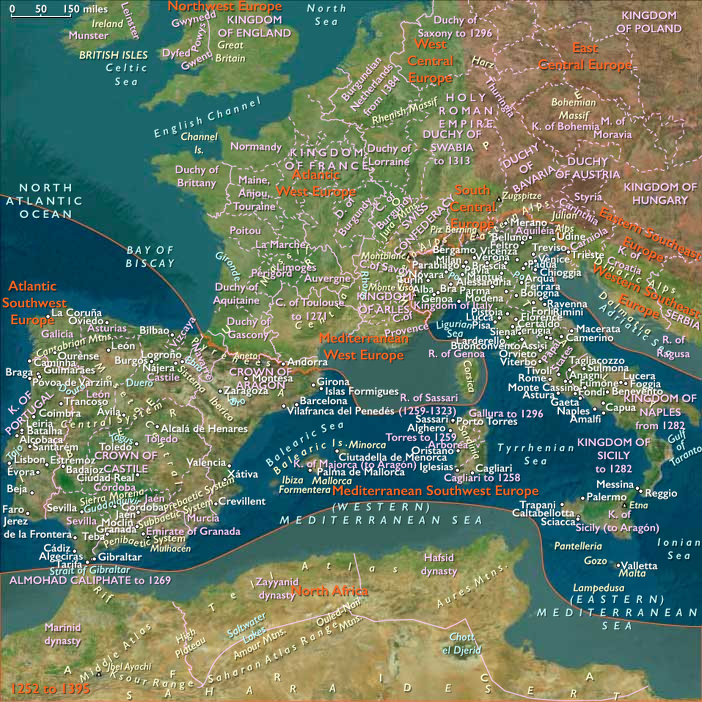
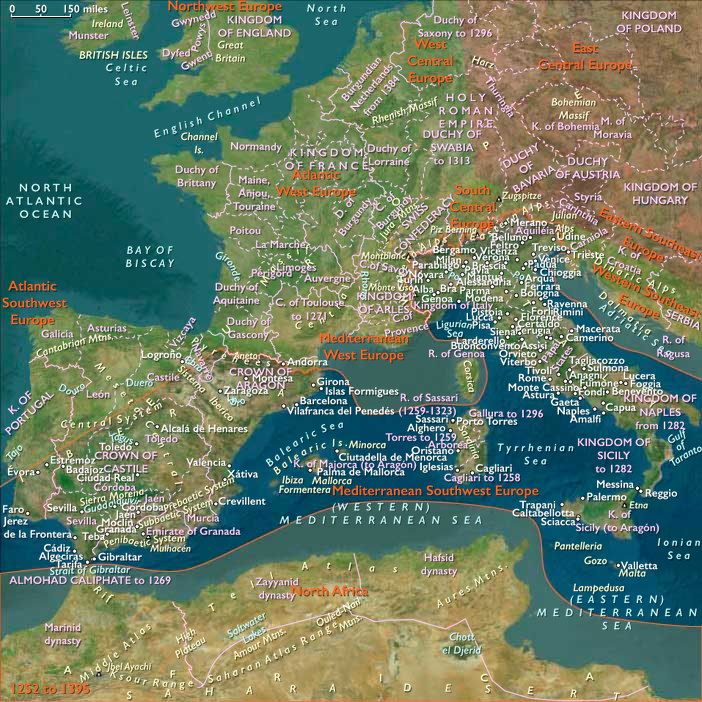
The subregion encompassed the Iberian Peninsula, the Italian peninsula and islands, and the surrounding seas—from the Guadalquivir and Tagus basins to the Venetian Adriatic and the Tyrrhenian and Balearic waters.
The onset of the Little Ice Age after 1300 brought cooler, wetter variability: Andalusian and Sicilian irrigation maintained productivity, while drier cycles in La Mancha and Alentejo encouraged sheep and transhumant herding. Maritime provisioning stabilized populations through famine years, even as the Black Death (1348–1352) devastated the great ports—Barcelona, Valencia, Genoa, Venice, and Naples—with partial demographic recovery by the century’s end.
Mediterranean Crowns and City-Republics
The Crown of Aragon, forged by the thirteenth-century conquests of James I, reached its maritime zenith. Catalan and Valencian fleets dominated the western Mediterranean; Sardinia was taken in the 1320s, and Sicily, freed from Angevin control after the Sicilian Vespers (1282), entered Aragon’s orbit. Barcelona’s merchants financed convoys to Tunis, Alexandria, and Constantinople, while Majorcan cartographers drew the most precise sea charts of the age.
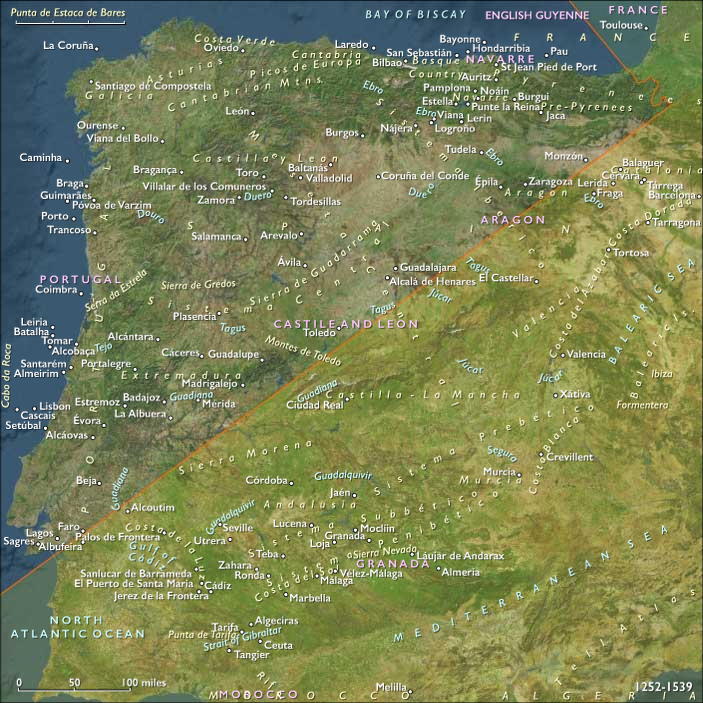
To the west, Castile completed the reconquest of Andalusia, leaving Granada as the last Muslim emirate. The Guadalquivir valley’s cereals and Seville’s shipyards enriched the Castilian crown, while Madrid and La Mancha evolved into the agrarian-sheep core of the realm. Portugal, meanwhile, under Afonso III and Dinis I, stabilized its southern frontier in the Algarve and built the maritime forests of Leiria for ship timber. After dynastic crisis (1383–1385), João I’s victory at Aljubarrota and the Treaty of Windsor (1386) with England secured independence and inaugurated the Anglo-Portuguese alliance that would anchor the next century’s explorations.
Across the sea, Italy’s mercantile powers contested every horizon. Venice, from its lagoon capital, extended a maritime empire through the Adriatic and Aegean; its Arsenal mass-produced galleys and its patriciate ruled an empire of grain and spice. Genoa, facing west, financed expeditions and monopolized Tyrrhenian trade from Corsica to Tunis. In Florence, textile wealth and banking consolidated under the merchant guilds, while the Angevin kingdom of Naples and the Aragonese Sicily contended for southern Italy. Malta, Sardinia, and the Balearics served as naval stepping-stones, their harbors echoing with the languages of sailors from every sea.
Economy and Trade
Southwest Europe functioned as a dual maritime engine—Aragonese–Italian in the Mediterranean and Castilian–Portuguese in the Atlantic.
-
Mediterranean circuits: Venetian and Genoese fleets carried Levantine spices, silks, and sugar; in return, they exported grain from Sicily and Apulia, wine and oil from Iberia, and salt from Ibiza and Trapani.
-
Western basins: Barcelona, Valencia, and Majorca knit the western Mediterranean to Atlantic routes through Gibraltar.
-
Atlantic façade: Castilian and Portuguese merchants exported wool, iron, wine, and salted fish; Castile’s Mesta(chartered 1273) organized transhumant flocks whose wool fed Flemish and Italian looms. Basque forgessupplied anchors, nails, and artillery; shipyards at Bilbao, Lisbon, and Porto produced cogs and caravels.
-
Banking and cartography: Genoese and Venetian financiers underwrote commerce, while Catalan and Majorcan mapmakers synthesized Mediterranean and Atlantic knowledge into the new portolan charts.
Mixed agriculture—grains, vines, olives—and irrigation in the Valencia and Murcia huertas sustained populations; the Algarve, Sicily, and Crete pioneered sugar cultivation, a foretaste of the colonial plantations to come.
Movement and Interaction Corridors
Sea routes defined the region’s geography.
The Strait of Gibraltar linked Lisbon, Seville, and Barcelona to Tunis and Alexandria; the Messina and Otranto Straits funneled Sicilian and Adriatic convoys; the Venetian–Aegean corridor joined Constantinople to the Po valley.
Overland arteries—Ebro–Pyrenees, Tagus–Guadiana, Po–Alps—fed the ports, while the Douro road connected the Castilian plateau to Porto’s wine markets. The pilgrim routes to Santiago de Compostela continued to channel people and goods across northern Iberia, even amid war and plague.
Belief and Symbolism
Faith framed identity in a region of plural crowns.
The mendicant orders—Franciscans and Dominicans—flourished in Barcelona, Valencia, Venice, and Naples, preaching reform and mercy during plague years.
Cathedrals such as Seville’s, Valencia’s, and Florence’s Duomo, and civic loggias in Italian and Catalan cities expressed both religious devotion and urban pride.
The lingering influence of the Avignon Papacy tied Provençal, Aragonese, and Italian politics to papal diplomacy, while the Reconquista and frontier crusades gave Iberian warfare a sanctified rhetoric that foreshadowed later overseas expansion.
Adaptation and Resilience
Despite climatic uncertainty and epidemic loss, Southwest Europe remained remarkably adaptive.
-
Irrigation, terrace agriculture, and maritime provisioning cushioned drought.
-
Polycentric power—Venice, Genoa, Aragon, Castile, Portugal—allowed commerce to shift ports and flags as crises arose.
-
Guild statutes and municipal charters stabilized labor and credit after the Black Death.
-
The recovery of the 1380s–1390s re-energized trade, strengthened dynasties, and renewed shipbuilding, positioning the region for its fifteenth-century ascent.
Long-Term Significance
By 1395 CE, Southwest Europe stood as the beating heart of the late-medieval maritime world.
In the Mediterranean, Venice ruled the Adriatic lanes, Genoa and Florence financed the wider economy, and Aragon’s Catalan fleets mastered the western sea.
Across the Iberian Peninsula, Castile and Portugal unified their realms and turned outward to the Atlantic, where Lisbon’s and Bilbao’s shipwrights were already experimenting with ocean-going hulls.
From the Rialto to Lisbon, from Barcelona to Seville, merchants, mapmakers, and mariners laid the logistical and intellectual foundations of Europe’s global age.
The dual maritime systems of the Mediterranean thalassocracies and the Atlantic wool-iron networks formed a single economic engine—one that would propel Iberia and Italy beyond their seas and into the wider world of the fifteenth century.
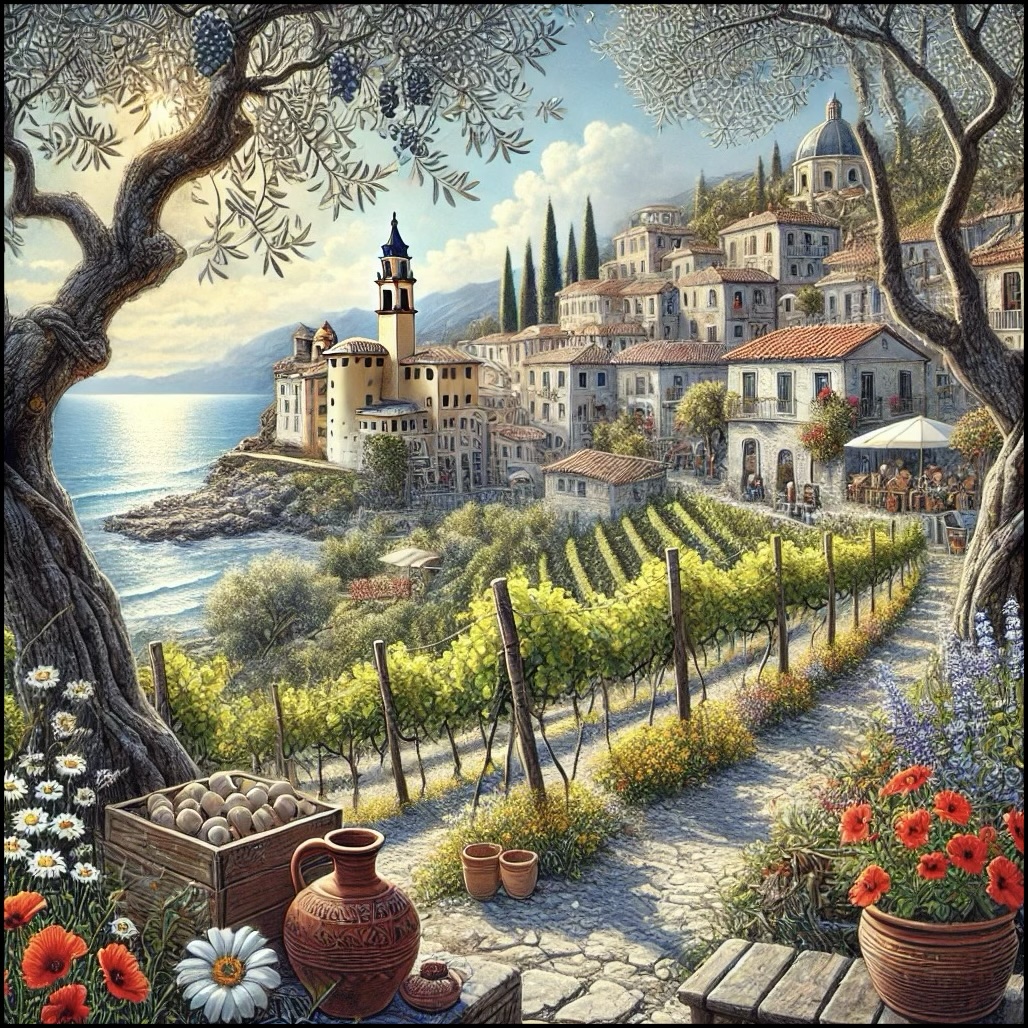
Mediterranean Southwest Europe (with civilization) ©2024-25 Electric Prism, Inc. All rights reserved.
People
Groups
- Malta
- Hanseatic league (informally organized)
- France, (Capetian) Kingdom of
- Genoa, (Most Serene) Republic of
- Florence, Republic of
- Aragón, Kingdom of
- Portugal, Burgundian (Alfonsine) Kingdom of
- Siena, Republic of
- Venice, (Most Serene) Republic of
- England, (Plantagenet, Angevin) Kingdom of
- Aragon, Crown of
- Sicily, Hohenstaufen Kingdom of
- Castile, Crown of
- Portugal, Burgundian (Alfonsine) Kingdom of
- Naples, Angevin Kingdom of
- Sicily, Angevin Kingdom of
- Sicily, Aragonese Kingdom of
- Catalonia, Principality of
- France, (Valois) Kingdom of
- Hanseatic League
- Portugal, Kingdom of
- Netherlands, Burgundian
- Portugal, Avizan (Joannine) Kingdom of
Topics
- Sicilian Vespers
- Little Ice Age, Warm Phase I
- Little Ice Age (LIA)
- Black Death, or Great Plague
- 1383–1385 Portuguese interregnum
- Aljubarrota, Battle of
Commodoties
- Domestic animals
- Oils, gums, resins, and waxes
- Grains and produce
- Fibers
- Textiles
- Salt
- Sweeteners
- Beer, wine, and spirits
- Lumber
- Naval stores
- Spices
Subjects
- Commerce
- Watercraft
- Painting and Drawing
- Public health
- Conflict
- Mayhem
- Government
- Custom and Law
- Catastrophe
- Finance
- Cartography
Regions
Subregions
Related Events
Showing 10 events out of 46611 total
Years: 1252 - 1395
Mediterranean Southwest Europe (with civilization) ©2024-25 Electric Prism, Inc. All rights reserved.
People
Groups
- Malta
- Hanseatic league (informally organized)
- France, (Capetian) Kingdom of
- Genoa, (Most Serene) Republic of
- Florence, Republic of
- Aragón, Kingdom of
- Portugal, Burgundian (Alfonsine) Kingdom of
- Siena, Republic of
- Venice, (Most Serene) Republic of
- England, (Plantagenet, Angevin) Kingdom of
- Aragon, Crown of
- Sicily, Hohenstaufen Kingdom of
- Castile, Crown of
- Portugal, Burgundian (Alfonsine) Kingdom of
- Naples, Angevin Kingdom of
- Sicily, Angevin Kingdom of
- Sicily, Aragonese Kingdom of
- Catalonia, Principality of
- France, (Valois) Kingdom of
- Hanseatic League
- Portugal, Kingdom of
- Netherlands, Burgundian
- Portugal, Avizan (Joannine) Kingdom of
Topics
- Sicilian Vespers
- Little Ice Age, Warm Phase I
- Little Ice Age (LIA)
- Black Death, or Great Plague
- 1383–1385 Portuguese interregnum
- Aljubarrota, Battle of
Commodoties
- Domestic animals
- Oils, gums, resins, and waxes
- Grains and produce
- Fibers
- Textiles
- Salt
- Sweeteners
- Beer, wine, and spirits
- Lumber
- Naval stores
- Spices
Subjects
- Commerce
- Watercraft
- Painting and Drawing
- Public health
- Conflict
- Mayhem
- Government
- Custom and Law
- Catastrophe
- Finance
- Cartography
Regions
Subregions