
Mediterranean Southwest Europe (1240–1251 CE): Reconquista Successes, …
Years: 1240 - 1251
Mediterranean Southwest Europe (1240–1251 CE): Reconquista Successes, Imperial Decline, and Mendicant Influence
The era 1240–1251 CE in Mediterranean Southwest Europe is characterized by decisive Reconquista victories in Iberia, deepening political conflicts in northern Italy, and continued growth of mendicant religious orders.
Decisive Reconquista Advances in Iberia
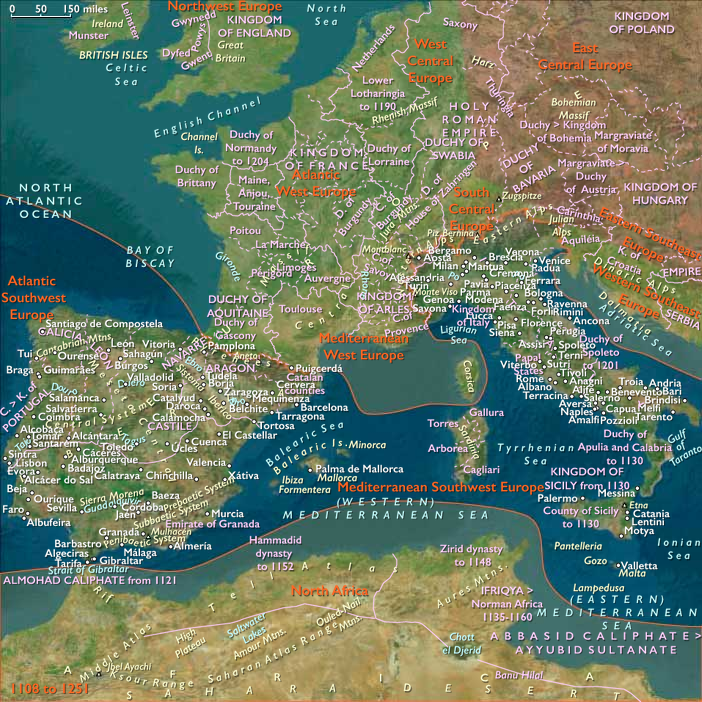
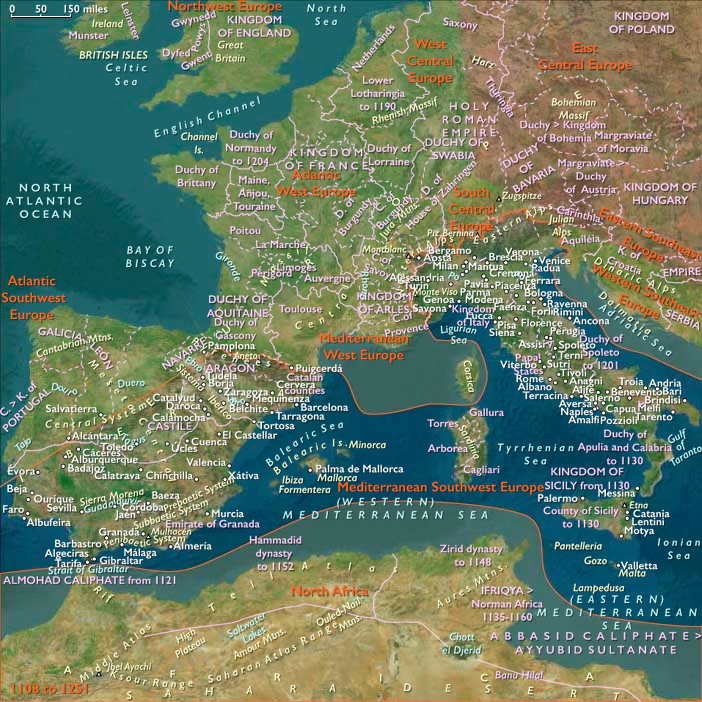
The Christian kingdoms of Castile, León, and Aragon achieve substantial territorial gains against the weakened Almohad Caliphate. Under the leadership of Ferdinand III of Castile and León and James I of Aragon, Christian forces capture crucial cities, including Córdoba in 1236 (fully consolidated by the 1240s) and Seville in 1248. These successes dramatically reduce Almohad territories and establish firm Christian dominance over large areas of southern Iberia, setting the stage for the near-total reconquest of the peninsula.
Imperial Decline and Communal Ascendancy in Italy
Northern Italy witnesses escalating conflicts between Emperor Frederick II and the independent city-states of the Lombard League. Persistent communal resistance, coupled with Frederick’s political and military difficulties, notably weakens imperial authority. Cities such as Milan, Alessandria, and Florence reinforce their autonomy, establishing powerful precedents for urban self-governance and communal liberty that shape future political developments.
Influence and Expansion of Mendicant Orders
The Dominican and Franciscan Orders continue their rapid expansion throughout Europe, further solidifying their roles as pivotal spiritual, intellectual, and social institutions. They significantly influence education by establishing important theological schools and universities, including contributions to the rise of the University of Paris as a major intellectual center. Their presence deeply affects religious practices, social attitudes, and intellectual traditions across the region.
Scholarly Activity and Cultural Exchange
Scholarly activities flourish, with ongoing translation efforts and intellectual exchanges, particularly in Toledo and emerging universities in Italy. Arabic and Greek scientific and philosophical texts continue to be translated into Latin, greatly enriching Western intellectual culture and laying crucial groundwork for the later European Renaissance.
Economic Strength of Maritime Republics
The maritime republics of Venice and Genoa maintain robust commercial prosperity and naval power. Their extensive trading networks support continued economic growth, cultural exchanges, and urban expansion throughout the Mediterranean.
Legacy of the Era
The era 1240–1251 CE significantly influences Mediterranean Southwest Europe through critical Reconquista victories, the weakening of imperial control in Italy, and the enduring cultural and intellectual influence of the mendicant orders. Together, these developments substantially shape the region’s subsequent medieval and early modern historical trajectories.
People
Groups
- Al-Garb Al-Andalus
- al-Andalus (Andalusia), Muslim-ruled
- León, Kingdom of
- Genoa, (Most Serene) Republic of
- Christians, Roman Catholic
- Castile, Kingdom of
- Aragón, Kingdom of
- Almohad Caliphate
- Venice, (Most Serene) Republic of
- Lombard League
- Franciscans, or Order of St. Francis
- Dominicans, or Order of St. Dominic
- Castile, Crown of
Topics
Subjects
Regions
Subregions
Years: 1240 - 1251
People
Groups
- Al-Garb Al-Andalus
- al-Andalus (Andalusia), Muslim-ruled
- León, Kingdom of
- Genoa, (Most Serene) Republic of
- Christians, Roman Catholic
- Castile, Kingdom of
- Aragón, Kingdom of
- Almohad Caliphate
- Venice, (Most Serene) Republic of
- Lombard League
- Franciscans, or Order of St. Francis
- Dominicans, or Order of St. Dominic
- Castile, Crown of
Topics
Subjects
Regions
Subregions