
Mediterranean Southwest Europe (1168–1179 CE): Sicilian Earthquake, …
Years: 1168 - 1179
Mediterranean Southwest Europe (1168–1179 CE): Sicilian Earthquake, Almohad Conquest, and Communal Resistance in Italy
The era 1168–1179 CE in Mediterranean Southwest Europe is marked by a catastrophic natural disaster in Sicily, the rapid expansion and consolidation of the Almohad Caliphate in Iberia, and notable communal resistance in northern Italy against imperial forces.
The 1169 Sicily Earthquake and Tsunami
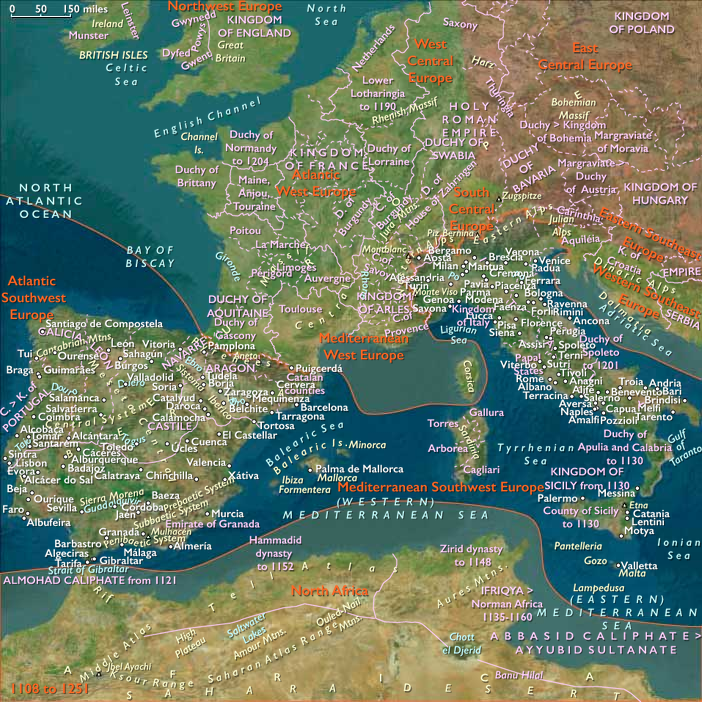
On February 4, 1169, southern Italy and Sicily suffer a devastating earthquake with an estimated magnitude between 6.4 and 7.3, reaching a maximum intensity of X (Intense) on the Mercalli scale. Severely damaging cities such as Catania, Lentini, and Modica, the earthquake triggers a tsunami, leading to approximately fifteen thousand fatalities and widespread destruction, profoundly impacting the region’s urban infrastructure and economy.
Almohad Conquest and Expansion in Al-Andalus
During this era, the North African Berber Almohad dynasty decisively expands its control into Iberia, overpowering the fragmented taifa kingdoms and rapidly transforming the political and religious landscape of Muslim Spain. By the late 1160s and early 1170s, major cities such as Seville, Córdoba, and Granada fall under Almohad dominance. The Almohads impose a stricter, more orthodox interpretation of Islam, resulting in intensified pressure on Christian Mozarab and Jewish communities, many of whom migrate northward toward Christian kingdoms.
Founding and Resistance of Alessandria
In northern Italy, the city of Alessandria—founded initially as Civitas Nova in 1168 CE—emerges as a stronghold of communal resistance within the Lombard League, formed to defend traditional liberties against Holy Roman Emperor Frederick Barbarossa. In 1174–1175, Alessandria successfully withstands an intense Imperial siege. According to local legend, the city's resistance is famously aided by a clever peasant named Gagliaudo, whose cunning convinces Barbarossa to abandon the siege prematurely, although malaria likely contributes significantly to the Emperor's withdrawal.
Cultural and Economic Continuity
Despite significant political and natural upheavals, Mediterranean Southwest Europe maintains its cultural and economic vitality. The Norman kingdom of Sicily continues to flourish culturally under the Hauteville dynasty, particularly through architectural innovations in the Arab-Norman style.
Legacy of the Era
The era 1168–1179 CE significantly influences Mediterranean Southwest Europe through the destructive Sicilian earthquake, the politically transformative Almohad conquest in Iberia, and the successful communal resistance exemplified by Alessandria in northern Italy. Collectively, these events profoundly shape the region’s political alignments, cultural dynamics, and societal resilience moving into subsequent periods.
People
Groups
- Arab people
- Jews
- Moors
- Greeks, Medieval (Byzantines)
- Islam
- Al-Garb Al-Andalus
- al-Andalus (Andalusia), Muslim-ruled
- Mozarabs
- Venice, Duchy of
- Papal States (Republic of St. Peter)
- Normans
- Holy Roman Empire
- Pisa, (first) Republic of
- Genoa, (Most Serene) Republic of
- Christians, Roman Catholic
- Almoravid dynasty
- Sicily, County of
- Florence, Republic of
- Almohad Caliphate
- Sicily, Kingdom of
- Lombard League
Topics
Subjects
Regions
Subregions
Years: 1168 - 1179
People
Groups
- Arab people
- Jews
- Moors
- Greeks, Medieval (Byzantines)
- Islam
- Al-Garb Al-Andalus
- al-Andalus (Andalusia), Muslim-ruled
- Mozarabs
- Venice, Duchy of
- Papal States (Republic of St. Peter)
- Normans
- Holy Roman Empire
- Pisa, (first) Republic of
- Genoa, (Most Serene) Republic of
- Christians, Roman Catholic
- Almoravid dynasty
- Sicily, County of
- Florence, Republic of
- Almohad Caliphate
- Sicily, Kingdom of
- Lombard League
Topics
Subjects
Regions
Subregions