
Mediterranean Southwest Europe (1120–1131 CE): Norman Sicily’s …
Years: 1120 - 1131
Mediterranean Southwest Europe (1120–1131 CE): Norman Sicily’s Golden Age, Rise of Maritime Commerce, and Intellectual Exchange
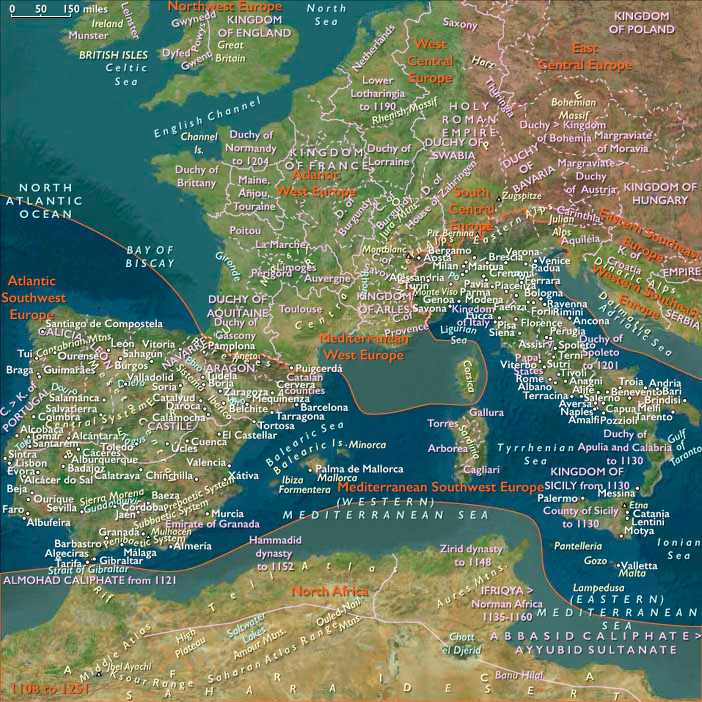
The era 1120–1131 CE in Mediterranean Southwest Europe sees the peak of Norman cultural synthesis in Sicily, continued expansion and prosperity of Italian maritime republics, and intensified intellectual exchanges across the Mediterranean region.
Norman Sicily’s Golden Age under Roger II
Under Roger II, who officially becomes King of Sicily in 1130 CE, Norman Sicily reaches a cultural and political zenith. Roger’s court in Palermo becomes a flourishing center of multicultural integration, drawing scholars, scientists, artists, and intellectuals from across the Mediterranean world. Reflecting influences from Muslim, Byzantine, and Western European traditions, Sicily under Roger II experiences significant advancements in science, art, architecture, and law. The island maintains a uniquely tolerant society, where Muslims, Jews, Eastern Orthodox Greeks, Lombards, and Normans coexist harmoniously under a robust legal framework.
Expansion of Maritime Commerce: Venice and Genoa
Italian maritime republics, particularly Venice and Genoa, continue their economic ascent as dominant maritime and commercial powers. Venice solidifies its strategic position, significantly expanding trade networks linking Western Europe, the Byzantine Empire, and the Islamic world. Concurrently, Genoa strengthens its maritime influence and trade capabilities, rivaling Venice and establishing itself as a major competitor for control of Mediterranean commerce.
Autonomous Communes and Urban Prosperity
Autonomous communes in northern Italy, notably Florence, continue their economic and political evolution. The urban-based communal governments gradually eclipse older feudal structures, fostering conditions favorable to commercial expansion, financial innovation, and civic autonomy. This transformation significantly reshapes the socioeconomic landscape of northern Italy.
Continued Multicultural and Intellectual Exchange in Toledo
Toledo, now firmly under Christian control, remains a critical intellectual crossroads, facilitating ongoing translation efforts of classical Greek and Arabic texts into Latin. The city's scholars—including Mozarabic Christians, Jews, and visiting European intellectuals—sustain and enhance its pivotal role in transmitting ancient knowledge to Western Europe.
Economic Prosperity and Technological Advancements
Technological innovations and maritime advancements underpin continued economic prosperity throughout the region. The enhanced shipbuilding techniques, improved navigation, and increased trade volume contribute significantly to regional growth, urban development, and economic stability.
Legacy of the Era
The era 1120–1131 CE represents a cultural and political high point in Norman Sicily under Roger II, witnesses the steady rise of Italian maritime republics, and sustains robust intellectual exchanges across the Mediterranean. These developments significantly influence Mediterranean Southwest Europe's medieval trajectory, setting foundations for future transformations in culture, commerce, and governance.
People
Groups
- Berber people (also called Amazigh people or Imazighen, "free men", singular Amazigh)
- Jews
- Lombards (West Germanic tribe)
- Moors
- Greeks, Medieval (Byzantines)
- Islam
- Al-Garb Al-Andalus
- al-Andalus (Andalusia), Muslim-ruled
- Mozarabs
- Venice, Duchy of
- Papal States (Republic of St. Peter)
- Normans
- Holy Roman Empire
- Genoa, (Most Serene) Republic of
- Christians, Roman Catholic
- Almoravid dynasty
- Sicily, County of
- Florence, Republic of
- Sicily, Kingdom of
Subjects
Regions
Subregions
Years: 1120 - 1131
People
Groups
- Berber people (also called Amazigh people or Imazighen, "free men", singular Amazigh)
- Jews
- Lombards (West Germanic tribe)
- Moors
- Greeks, Medieval (Byzantines)
- Islam
- Al-Garb Al-Andalus
- al-Andalus (Andalusia), Muslim-ruled
- Mozarabs
- Venice, Duchy of
- Papal States (Republic of St. Peter)
- Normans
- Holy Roman Empire
- Genoa, (Most Serene) Republic of
- Christians, Roman Catholic
- Almoravid dynasty
- Sicily, County of
- Florence, Republic of
- Sicily, Kingdom of
Subjects
Regions
Subregions