
Mediterranean Southwest Europe (1096–1107 CE): The First …
Years: 1096 - 1107
Mediterranean Southwest Europe (1096–1107 CE): The First Crusade, Almoravid Expansion, and Cultural Crossroads
The era 1096–1107 CE in Mediterranean Southwest Europe is marked by significant religious and military upheaval due to the First Crusade, Almoravid expansion into Iberia, and continued cultural exchange and scholarly vitality.
The First Crusade and Its Impact
In 1096 CE, the First Crusade is formally launched by Pope Urban II, profoundly reshaping Europe's religious, military, and political landscapes. Though primarily focused on the Holy Land, the mobilization has significant repercussions throughout Mediterranean Southwest Europe. Ports and cities, particularly in Italy, experience increased economic activity, logistical preparations, and cultural interactions prompted by the passage of Crusader armies toward the Eastern Mediterranean.
Almoravid Expansion into Iberia
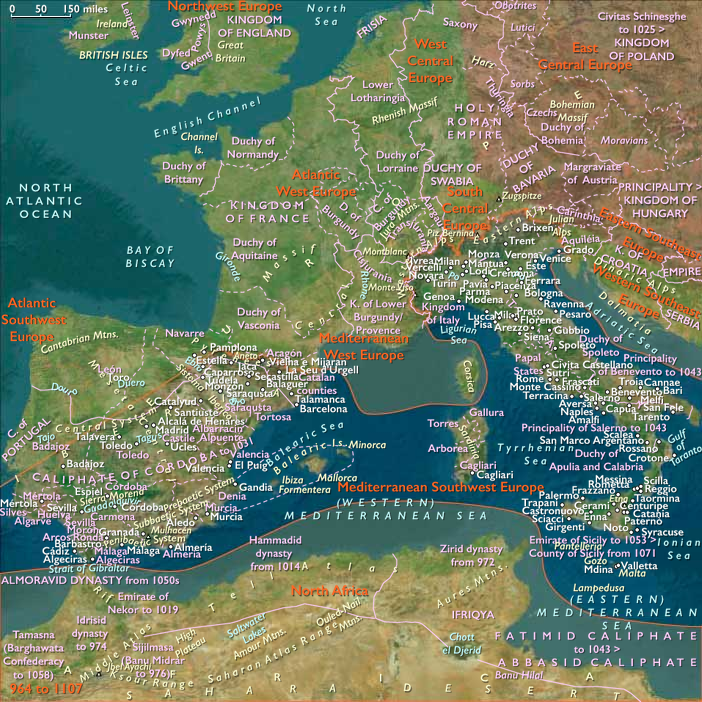
In Iberia, the Almoravids, a Berber Muslim dynasty originating from North Africa, intensify their presence and military campaigns, decisively intervening in the fractured political landscape of the taifa kingdoms. By 1099 CE, the Almoravids capture key cities including Valencia, significantly reshaping political alliances and restoring stronger Muslim unity across southern Iberia, countering the advances of the Christian kingdoms.
Continued Cultural Synthesis in Toledo
Toledo, under Christian rule since 1085 CE, continues thriving as a critical center of cultural and scholarly synthesis. Arab, Jewish, and Christian traditions interact dynamically within the city, leading to significant scholarly achievements. Toledo’s active translation efforts, especially from Arabic and Greek into Latin, persist in transmitting classical knowledge and fostering intellectual revival across Western Europe.
Norman Strength in Southern Italy and Sicily
Norman authority remains robust in southern Italy and Sicily, fostering relative political stability and promoting economic growth in these regions. Under Norman rule, Sicily becomes a pivotal crossroads for cultural interaction, trade, and scholarship between the Islamic Mediterranean, Latin Europe, and the Byzantine East.
Scholarly and Cultural Vitality
Throughout the period, Jewish and Mozarab communities remain central to the intellectual and cultural vitality of Mediterranean Southwest Europe. Scholarly centers, such as Lucena, sustain vibrant intercultural dialogue and academic excellence, reinforcing the region’s reputation as a dynamic hub of medieval learning.
Economic Prosperity and Technological Continuity
Economic stability continues, underpinned by sustained technological advancements like the Catalan forge, boosting iron production and enhancing agricultural productivity, urban expansion, and military readiness. The region's economic foundations remain strong despite broader political and military upheavals.
Legacy of the Era
The era 1096–1107 CE profoundly influences Mediterranean Southwest Europe through the dramatic impacts of the First Crusade, Almoravid expansions, and the ongoing scholarly and cultural synthesis in Toledo. These developments significantly shape regional dynamics, laying essential groundwork for transformative medieval and early-modern transitions.
People
Groups
- Berber people (also called Amazigh people or Imazighen, "free men", singular Amazigh)
- Jews
- Moors
- Islam
- Al-Garb Al-Andalus
- al-Andalus (Andalusia), Muslim-ruled
- Mozarabs
- Papal States (Republic of St. Peter)
- Holy Roman Empire
- Toledo, (Muslim statelet, or taifa, of)
- Sevilla, (Abbadid) Muslim statelet, or taifa, of
- Christians, Roman Catholic
- Almoravid dynasty
- Sicily, County of
Topics
Commodoties
Subjects
Regions

Subregions
Related Events
Showing 10 events out of 50218 total
Years: 1096 - 1107
People
Groups
- Berber people (also called Amazigh people or Imazighen, "free men", singular Amazigh)
- Jews
- Moors
- Islam
- Al-Garb Al-Andalus
- al-Andalus (Andalusia), Muslim-ruled
- Mozarabs
- Papal States (Republic of St. Peter)
- Holy Roman Empire
- Toledo, (Muslim statelet, or taifa, of)
- Sevilla, (Abbadid) Muslim statelet, or taifa, of
- Christians, Roman Catholic
- Almoravid dynasty
- Sicily, County of
Topics
Commodoties
Subjects
Regions
Subregions