
Mediterranean Southwest Europe (93–82 BCE): Social War …
Years: 93BCE - 81BCE
Mediterranean Southwest Europe (93–82 BCE): Social War and Civil Conflict
The era 93–82 BCE witnesses a turbulent period within the Roman Republic, characterized by internal conflicts, profound social upheaval, and significant constitutional crises, leading to the destructive Social War and subsequent civil wars between rival political factions.
The Social War: Allies Rebel (90–88 BCE)
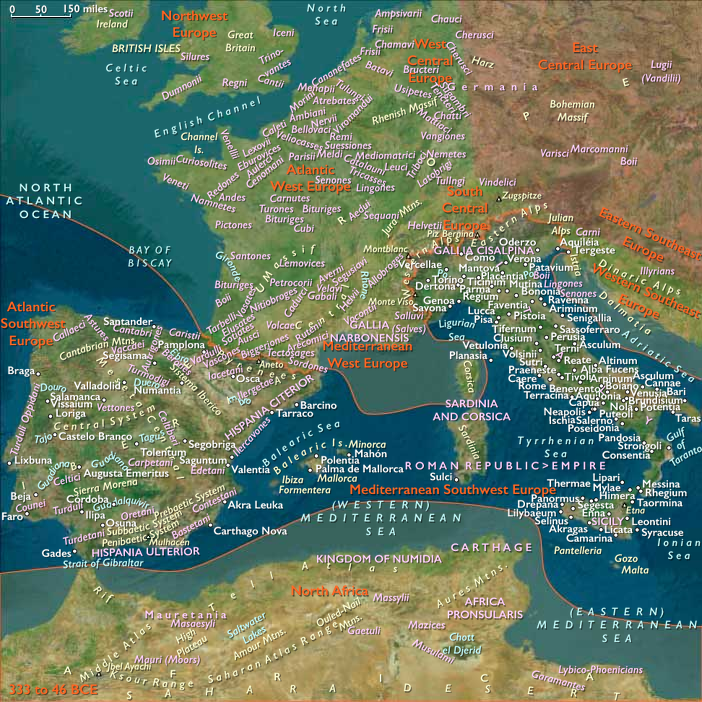
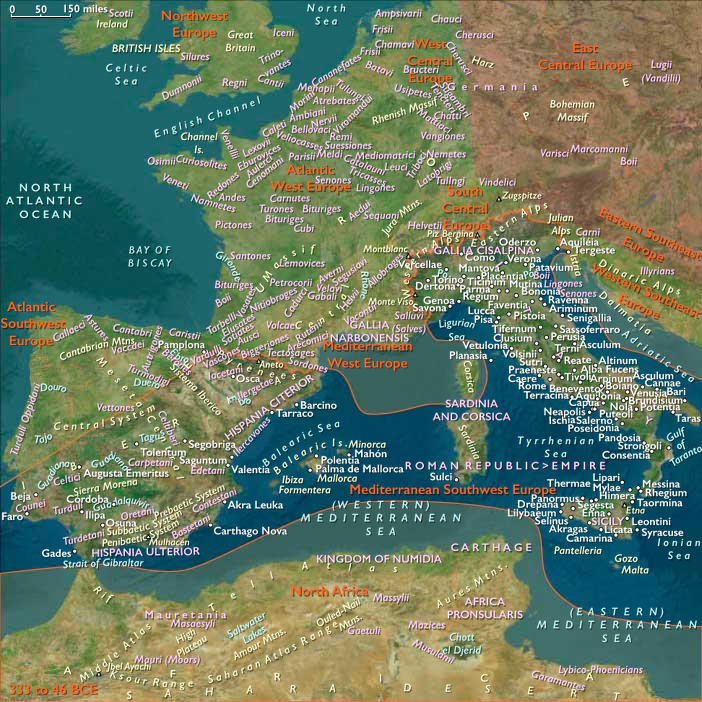
The Social War (also known as the Italian War or Marsic War) erupts in 90 BCE, fueled by longstanding grievances of Rome’s Italian allies (socii) over citizenship and political rights. The Italian allies, including the Marsi, Samnites, and other central and southern Italian peoples, form a federation and revolt against Roman domination, presenting one of the most severe internal threats Rome has faced.
Rome initially suffers severe defeats as the well-trained and highly motivated Italian forces challenge Roman supremacy, threatening the cohesion of the Republic itself. In response, Rome hastily grants citizenship to loyal communities, undermining rebel unity. By 88 BCE, Roman forces, under commanders such as Lucius Cornelius Sulla and Gnaeus Pompeius Strabo, successfully suppress the rebellion. Although militarily victorious, Rome is forced to concede citizenship to nearly all Italian allies, fundamentally transforming Roman society and politics.
Sulla's First Civil War (88–87 BCE)
In the immediate aftermath of the Social War, Rome plunges into further conflict. The political rivalry between Gaius Marius, the champion of popular causes and military reform, and Lucius Cornelius Sulla, representing conservative senatorial interests, escalates dramatically. When Sulla is granted command of the lucrative and prestigious war against Mithridates VI of Pontus, Marius successfully manipulates political channels to transfer this command to himself.
Refusing to relinquish power, Sulla responds by an unprecedented march on Rome in 88 BCE, capturing the city and purging his opponents. This dramatic action triggers Sulla's first civil war against Marius and his supporters. After consolidating control, Sulla departs for the East to engage Mithridates, allowing Marius and his ally Lucius Cornelius Cinna to retake Rome and instigate brutal reprisals against Sullan supporters.
Sulla's Second Civil War (83–82 BCE)
Upon concluding his campaign in the East, Sulla returns to Italy in 83 BCE, initiating the second civil war. Fierce battles unfold throughout Italy, Sicily, and parts of Africa as Sulla confronts Marius’s faction, now led by Gaius Marius the Younger following his father's death. The decisive conflict occurs at the Battle of the Colline Gate in 82 BCE, where Sulla achieves a bloody victory, securing absolute control over Rome.
Sulla's Dictatorship and Constitutional Reforms
With victory secured, Sulla assumes the extraordinary office of dictator without term limits, initiating a series of conservative constitutional reforms aimed at strengthening the Senate and curbing popular power. He institutes proscriptions—a policy of legalized mass executions and property confiscations—to eliminate political enemies and replenish depleted state funds.
Cultural Developments: The Second Style of Roman Wall Painting
Parallel to the political upheavals, Roman art flourishes, exemplified by advancements in wall painting. Early in the first century BCE, Roman artists perfect the Second Style, also known as the architectural style, characterized by sophisticated painted illusions of marble paneling, columns, and expansive landscapes or cityscapes, often integrating mythological narratives.
Legacy and Implications
The era 93–82 BCE profoundly reshapes the Roman Republic, with the Social War permanently altering the relationship between Rome and its Italian allies, extending citizenship and altering political dynamics. The civil wars, driven by the rivalry between Marius and Sulla, demonstrate the Republic’s susceptibility to charismatic military leaders wielding personal armies, further undermining the traditional republican system and setting a dangerous precedent toward autocratic governance.
People
- Gaius Marius
- Gaius Marius the Younger
- Gnaeus Pompeius Strabo
- Lucius Cornelius Sulla
- Mithridates VI of Pontus
Groups
Topics
- Roman Republic, Crisis of the
- Social War (91–88 BCE)
- Sulla's first civil war
- Sulla's second civil war
- Colline Gate, Battle of the
Subjects
Regions
Subregions
Years: 93BCE - 81BCE
People
- Gaius Marius
- Gaius Marius the Younger
- Gnaeus Pompeius Strabo
- Lucius Cornelius Sulla
- Mithridates VI of Pontus
Groups
Topics
- Roman Republic, Crisis of the
- Social War (91–88 BCE)
- Sulla's first civil war
- Sulla's second civil war
- Colline Gate, Battle of the
Subjects
Regions
Subregions