
…Mediolanum (modern Milan) and …
Years: 538 - 538
March
…Mediolanum (modern Milan) and …
Locations
People
Groups
- Goths (East Germanic tribe)
- East, or Oriens, Praetorian prefecture of
- Italy, Praetorian prefecture of
- Ostrogoths, Italian Kingdom of the
- Roman Empire, Eastern: Justinian dynasty
Topics
Commodoties
Subjects
- Commerce
- Engineering
- Environment
- Labor and Service
- Conflict
- Mayhem
- Faith
- Government
- Technology
- Movements
Regions
Subregions
Related Events
Filter results
Showing 10 events out of 57770 total
Buddhism reaches Japan from Korea by 538, and will coexist harmoniously (as it continues to do today) with the ancient Shinto religion.
The reign of Emperor Kimmei, said to have spanned the years from 539 through 571, is the first for which contemporary historiography are able to assign verifiable dates.
His contemporary title would not have been tennō, as most historians believe this title was not introduced until the reigns of Emperor Tenmu and Empress Jitō.
Rather, it was presumably Sumeramikoto or Amenoshita Shiroshimesu Ōkimi, meaning "the great king who rules all under heaven."
Alternatively, Kimmei might have been referred to as the "Great King of Yamato."
Although Japan’s imperial court will not be moved to the Asuka region until 592, Emperor Kimmei's reign is considered by some to be the beginning of the Asuka period of Yamato Japan, particularly by those who associate the Asuka period primarily with the introduction of Buddhism.
With the introduction of a new religion to the court, a deep rift will develop between the Mononobe clan, who support the worship of Japan's traditional deities, and the Soga clan, who support the adoption of Buddhism.
A branch of the royal Armenian Arsacid line is recognized as autonomous local princes in the eastern fringes of the Eastern Roman Empire.
Artabanes is a member of this lineage: His father is named John, and he has a brother also named John.
Artabanes, apparently still a young man in 538/539, takes part in the Armenian conspiracy against Acacius, the proconsul of First Armenia, whose heavy taxes and cruel behavior are greatly resented.
Artabanes himself kills Acacius.
Sittas, an imperial general who had received the honorific title of patrician in 535, is credited with a victory against the Bulgars in Moesia, by the Iatrus (Yantra) in the same year, and had been named an honorary consul in 536.
In 538/539, Sittas is sent back to Armenia to face the revolt led by Artabanes.
Failing to negotiate peace, Sittas starts active fighting.
In the Battle of Oenochalcon, the nature of the terrain forces both armies to fight in scattered groups rather than in unified forces.
Procopius records that Sittas was killed by either Artabanes or Solomon, an otherwise obscure rebel.
The Frankish Church Councils and the Strengthening of Church-State Relations (511–538 CE)
The Merovingian kings closely aligned themselves with the Catholic Church, using church councils to establish legal and religious frameworks that applied to both the Frankish ruling class and the Romanized population. These councils helped consolidate royal authority, reinforce Christian orthodoxy, and regulate social and religious life within the kingdom.
1. The First Council of Orléans (511 CE): The Foundation of Frankish Church-State Relations
- Convoked by Clovis I, this was the first national church council held under Frankish rule.
- The decrees were equally applicable to Franks and Romans, establishing legal equality between the conquerors and the conquered.
- This council is regarded as the first treaty between the Frankish State and the Church, marking the beginning of the Frankish monarchy’s role as a protector and enforcer of Catholic Christianity.
2. The Second National Council (533 CE): Religious Purity and Anti-Jewish Measures
Held under Childebert I, this council focused on:
- Banning interfaith marriages – The marriage of Christians and Jews was explicitly forbidden.
- Enforcing religious purity – Excommunication was declared against those who partook in flesh sacrificed to idols, reinforcing anti-pagan measures.
- These decrees further marginalized Jewish communities, signaling an increasing fusion of Catholic and royal authority in Frankish society.
3. The Third National Council (538 CE): Clerical Discipline and Church Governance
Held in May 538, this council addressed:
- Marriage Impediments – Determining the canonical obstacles to marriage, reinforcing Christian moral law.
- Clerical Discipline – Excommunication was declared against high-ranking ecclesiastics who lived incontinently (engaged in sexual misconduct).
- Election of Bishops and Archbishops
- Archbishops were to be elected by the bishops of the province, with the consent of clergy and citizens.
- Bishops were to be elected by the archbishop, clergy, and people of the city.
- This reinforced a structured system of Church leadership, reducing secular interference while ensuring royal oversight.
Anti-Jewish Legislation: Social Restrictions
- In a measure approved by Childebert I, the council prohibited Jews from appearing in the streets during Easter, stating that “their appearance is an insult to Christianity.”
- This further reflects growing intolerance and segregationist policies, reinforcing Jewish exclusion from public and civic life.
Impact of the Frankish Church Councils
- These councils strengthened the partnership between the Frankish monarchy and the Church, making the Franks the foremost defenders of Catholic Christianity in Western Europe.
- They formalized legal and social structures, merging Roman and Frankish traditions into a unified Christian state.
- The increasing marginalization of Jews and pagans demonstrates the consolidation of Christian hegemony in Merovingian society.
By the sixth century, the Franks had successfully woven religious authority into the fabric of their expanding kingdom, setting the stage for later Carolingian reforms and the emergence of a deeply Catholic medieval Europe.
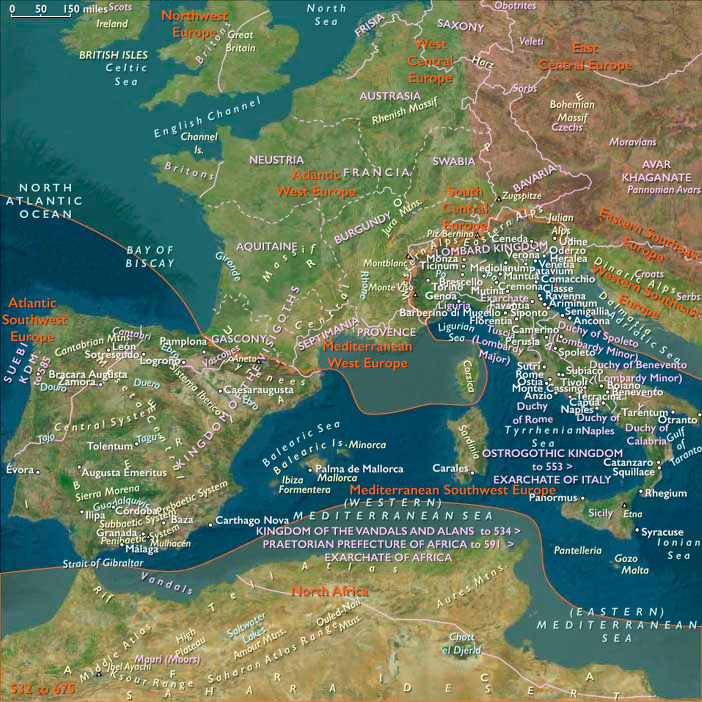
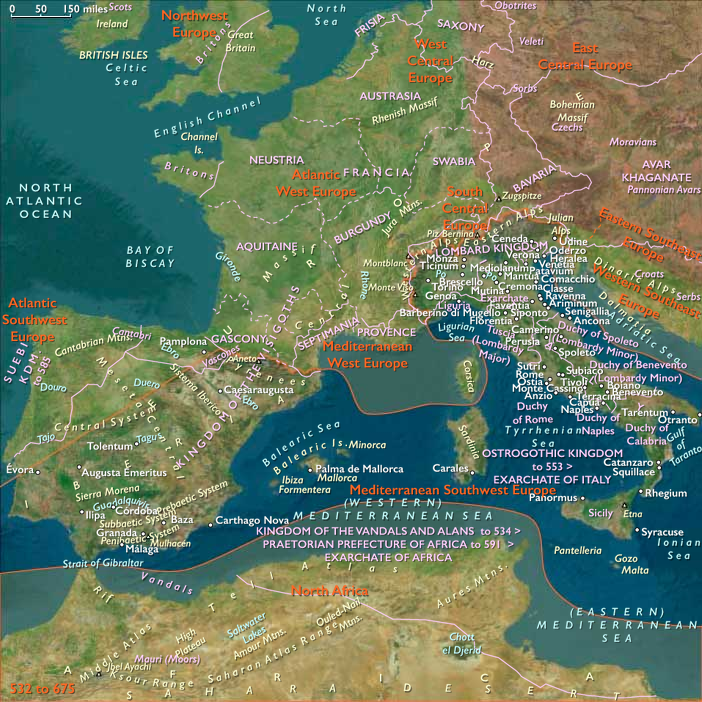
Belisarius’s forces have successfully withstood the three hundred and seventy-four day-siege, which Vitiges ends on March 12.
Abandoning Rome, he retreats with his Gothic army northeast along the Via Flaminia.
Belisarius attacks the Goths after they have crossed the Milvian Bridge.
After fierce resistance, Vitiges routs in panic, and many of his men are slain or drown in the Tiber River.
Belisarius moves north in pursuit, but Gothic attacks hinder the advance of the undersupplied, unreinforced imperial army.
Vitiges strengthens the garrisons of various towns and besieges Ariminum.
Imperial forces under the Armenian general Narses arrive at Picenum.
Belisarius secures Liguria, …
…Ariminum, but disagreements, especially with Narses, lead to disunity in the imperial army.
Theudebert I had found himself embroiled in the Gothic War after relations between the Frankish kings had settled down.
Justinian sees Theudebert as an ideal ally: Austrasian lands flank the Ostrogoths in northern Italy.
The emperor has paid Theudebert handsomely for his assistance, but Theudebert proves an untrustworthy ally.
The Frankish armies see the Italian conflict as an opportunity for plunder and a chance to exert their own claims to northern Italy.
In summer 538, King Theudebert I sends a small Frankish force across the Alps, and separately defeats both the Goths and imperial forces at the River Po.
Belisarius retreats to Tuscany.
The Lombards, one of the Germanic tribes that formed the Suebi, had by the end of the fifth century moved from their home in northwestern Germany into the area roughly coinciding with modern Austria north of the Danube River.
Their ruler for the past three decades has been Wacho, who had assassinated his uncle Tato and usurped the throne about 510.
Tato's son and grandson had taken refuge with the king of a neighboring Germanic people, the Gepidae, making several fruitless attempts to recover rule over the Lombards.
Shortly after 536, Waccho had made a treaty with Justinian against the Gepids.
Vitiges, King of the Ostrogoths in Italy, hard-pressed by Justinian's general Belisarius, sends ambassadors to Wacho in 539, offering him money in exchange for military aid.
Wacho refuses, preferring to remain on good terms with Constantinople.
Having also good relations with the Franks, Wacho has married off his daughter, Waldrada, to the Frankish prince Theudebald, son of Theudebert of Metz.
Their granddaughter is Theodelinda, who will later become queen of the Lombards.
He his second marriage was to a Gepid princess, Austrigusa, called "Ostrogotha" (perhaps due to her maternal descent from Ostrogothic rulers).
Austrigusa was the mother of two daughters: Wisigarda (who married Theudebert I of Austrasia) and Waldrada (who married firstly Theudebald of Austrasia, secondly Chlothar I, King of the Franks, and thirdly Garibald I of Bavaria).
Wacho's third marriage was to Silinga, a Heruli, and the mother of his son Walhtari.
At the death of Wacho in 539, Walthari rules as an infant king, and his government is administered by Audoin as regent.
Years: 538 - 538
March
Locations
People
Groups
- Goths (East Germanic tribe)
- East, or Oriens, Praetorian prefecture of
- Italy, Praetorian prefecture of
- Ostrogoths, Italian Kingdom of the
- Roman Empire, Eastern: Justinian dynasty
Topics
Commodoties
Subjects
- Commerce
- Engineering
- Environment
- Labor and Service
- Conflict
- Mayhem
- Faith
- Government
- Technology
- Movements
