
Medieval and obsolescent forms of government have …
Years: 1722 - 1722
Medieval and obsolescent forms of government have given place to effective autocracy in the course of Peter's reign.
He had in 1711 abolished the boyarskaya duma, or boyar council, and established by decree of the Senate as the supreme organ of state—to coordinate the action of the various central and local organs, to supervise the collection and expenditure of revenue, and to draft legislation in accordance with his edicts.
Martial discipline is extended to civil institutions, and an officer of the guards is always on duty in the Senate.
From 1722, moreover, there is a procurator general keeping watch over the daily work of the Senate and its chancellery and acting as “the eye of the sovereign.” When Peter had come to power, the central departments of state had been the prikazy, or offices, of which there were about eighty, functioning in a confused and fragmented way.
To replace most of this outmoded system, Peter in 1718 had instituted nine “colleges” (kollegy), or boards, the number of which is by 1722 expanded to thirteen.
Their activities are controlled, on the one hand, by the General Regulation and, on the other, by particular regulations for individual colleges, and indeed there are strict regulations for every branch of the state administration.
Crimes against the state come under the jurisdiction of the Preobrazhensky Office, responsible immediately to the tsar.
In 1722 also, Peter creates a new order of precedence, known as the Table of Ranks.
Formerly, precedence had been determined by birth.
In order to deprive the boyars of their high positions, Peter directs that precedence should be determined by merit and service to the Emperor.
This replaces the old system of promotion in the state services, which had been according to ancestry, by one of promotion according to services actually rendered.
It classifies all functionaries—military, naval, and civilian alike—in fourteen categories, the fourtenth being the lowest and the firsst the highest; and admission to the eighth category confers hereditary nobility. (The Table of Ranks will continue to remain in effect until the Russian monarchy is overthrown in 1917.)
Peter also introduces new taxes to fund improvements in Saint Petersburg.
He abolishes the land tax and household tax, and replaces them with a capitation.
The taxes on land on households are payable only by individuals who own property or maintain families; the new head taxes, however, are payable by serfs and paupers.
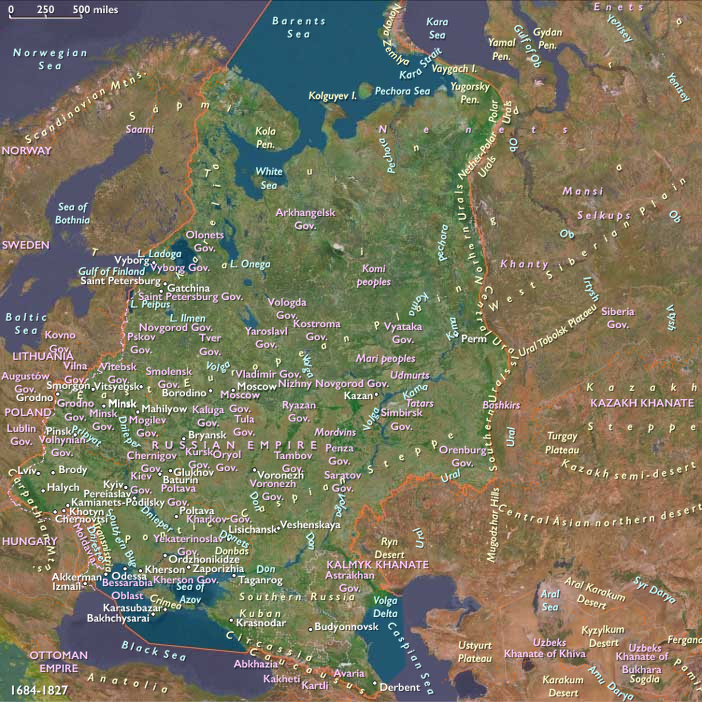
Despite Russia’s exhaustion after the Second or Great Northern War, Peter, who has long contemplated establishing a trade route to India via the countries east of the Caspian Sea, is apprehensive over the Turkish push toward the region.
Even during the second half of the Northern War, Peter had sent exploratory missions to the East—to the Central Asian steppes in 1714, to the Caspian region in 1715, and to Khiva in 1717.
The end of the war leaves him free to resume a more active policy on his southeastern frontier.
Losses suffered by some Russian merchants during one of the many tribal uprisings in the Persian realms, ongoing since 1709, provide Peter with the pretext for launching a war against a Persia weakened by the Afghan rebellions.
Locations
People
Groups
Topics
Commodoties
Subjects
Regions
Subregions
Years: 1722 - 1722
Locations
People
Groups
Topics
Commodoties
Subjects
Regions
Subregions