The alliance of Hungary, Serbia and Bulgaria …
Years: 1366 - 1366
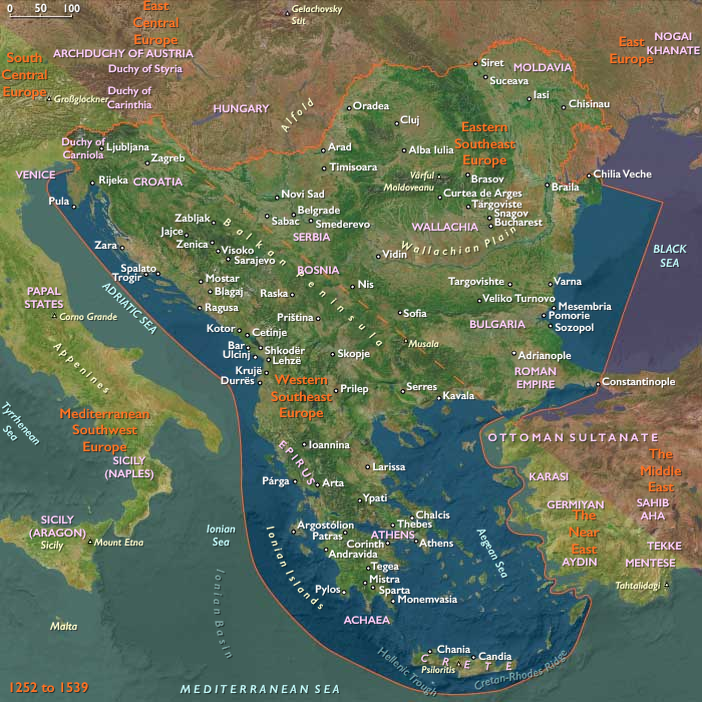
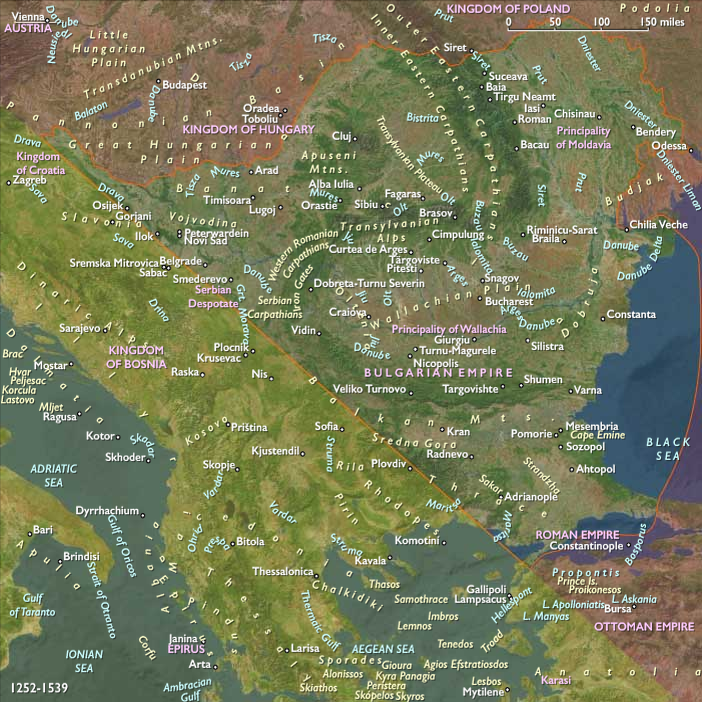
The alliance of Hungary, Serbia and Bulgaria against the Ottomans ends in defeat, and the Bulgarians are compelled to become vassals of the sultan in 1366.
Locations
Groups
- Bulgarian Empire (Second), or Empire of Vlachs and Bulgars
- Serbia, Kingdom of
- Hungary, Kingdom of
- Ottoman Empire
- Zeta, semi-independent chiefdom of
Commodoties
Subjects
Regions
Subregions
Related Events
Filter results
Showing 10 events out of 43935 total
The paintings of Wang Meng, a leading Chinese landscape master, reflect a distinctively individual approach to the problems of space, form, and tactile quality in compositions of astonishing density, as exemplified in his masterful landscape Dwelling in the Qingbian Mountains, executed in 1366.
Wang Meng is considered to be one of the Four Masters of the Yuan Dynasty, along with Huang Gongwang, Wu Zhen, and Ni Zan.
They had famously refused to serve the Mongolian rulers of their country.
In contrast to many renowned painters in previous history, these artists mostly work on paper instead of silk, an indication of the importance they give to the calligraphic touch of the brush on paper.
They exclusively paint landscapes, which they believe to be the visible key to the invisible reality.
They restrict their acquaintanceship to each other, and like-minded "wen ren" (gentleman-scholars).
Wang Meng is the youngest of the group, and the least famous in his own time.
Nevertheless, his style will greatly influence later Chinese painting.
In contrast to the relatively spare style of his compatriots, his ropy brushstrokes pile one on the other to produce masses of texture combined in dense and involved patterns.
Many artists will be influenced by the works of Wang Meng centuries after his death, most notably Dong Qichang.
His most famous works are the Ge Zhichuan Relocating, Forest Grotto at Juqu, Writing Books under the Pine Trees, The Simple Retreat, and Dwelling in the Qingbian Mountains.
Most of his masterpieces are now located in notable museums around the world, such as the Palace Museum, National Palace Museum, Shanghai Museum, Cleveland Museum of Art and the Metropolitan Museum of Art In 2011, a lesser known work of his from a private collection, titled Zhichuan Resettlement, will be sold for 402.5 million yuan (US$62.1 million) at art auction.

Emperor John V Palaiologos has appealed to the West for help, proposing to end the schism between the Greek and Latin churches by submitting to the supremacy of the Roman Church.
He visits Hungary in 1366 to beg for help, but in vain.
Amadeus VI of Savoy initiates a minor crusade (with fifteen ships and seventeen hundred men) in 1366 against Murad I of the Ottoman Empire to aid his cousin, the Emperor John V Palaiologos, son of the Dowager Empress, Anne of Savoy.
On this campaign, Amadeus joins forces with Francesco I of Lesbos, and Hungarian king Louis the Great, and they drive the Turks from Gallipoli. (This victory will be short-lived, though, for they will lose Gallipoli to the Turkish Sultan Murad I when, after three years of civil war between John V and his son, Andronikos IV, it will handed over to the Ottomans by the latter as payment for their support.)
Peter continues his crusade, this time aiming to attack Beirut.
However his military operations end after intervention of the Venetians willing to offer Peter high compensations for his military preparations, in order to not attack against Damascus.
Peter raids Tripoli in 1366, before the terms of service of his European reinforcements can expire.
Pierre's unruly crusaders return to Cyprus with immense booty as reprisals follow against Christian merchants in Syria and Egypt.
Pierre has sent Mézières to Venice, the princes of western Europe, and to Avignon to obtain help against the Saracens, who now threaten the kingdom of Cyprus.
His efforts are in vain; even Pope Urban V advises peace with the sultan.
Mézières remains for some time at Avignon, seeking recruits for his order, and writing his Vita S. Petri Thomasii (Antwerp, 1659), which is invaluable for the history of the Alexandrian expedition.
The Prefacio and Epistola, which form the first draft of his work on the projected order of the Passion, are written at this time.
King Peter I of Castile—Peter the Cruel, as he is called by his subjects—abandons and imprisons his wife, arousing the opposition of the nobility led by his illegitimate half brother, Count Henry of Trastamara, who, with Aragonese backing, challenges Peter’s right to rule.
Charles V of France also sends troops into Spain in support of Trastamara, who overthrows Peter.
Peter then turns to English king Edward III, who dispatches an expeditionary force led by his son Edward, the Black Prince.
Edward defeats the Franco-Aragonese-Castilian forces at Nájera in 1367, then departs for England; Trastamara promptly starts a new round of civil war.
André Beauneveu: Royal Sculptor and Artist of Fourteenth-Century France
André Beauneveu, a sculptor, painter, and architect from Valenciennes, was one of the most highly esteemed artists of the French royal family in the second half of the fourteenth century. Despite the scarcity of biographical records, his impressive commissions and lasting artistic influence attest to his renown in both France and England.
Early Career and Work in England (Before 1364)
- Beauneveu worked under the patronage of Philippa of Hainault, the Queen of England and wife of Edward III.
- The earliest documentary reference to "Master Andrew the Painter" (presumed to be Beauneveu) appears in 1359, when he worked for Duchess Yolande de Bar, decorating a chapel in her castle at Nieppe (now destroyed).
Royal Patronage in France Under Charles V (1364–1366)
- By 1364, Beauneveu had moved to Paris, becoming part of King Charles V’s artistic workshop.
- The king referred to him as “our esteemed Andreu Bauneveu, our sculptor,” signaling his prominence at the royal court.
- In 1365, Charles V commissioned Beauneveu to create four monumental tomb sculptures for the royal crypt at Saint-Denis, the dynastic burial site of French kings.
The Saint-Denis Royal Tomb Project
- Charles V aimed to legitimize and reinforce the authority of the new Valois dynasty by creating spectacular tombs for himself and his immediate ancestors, placing them in the Capetian necropolis at Saint-Denis.
- Beauneveu designed the tombs in the latest artistic style, featuring:
- Brilliant white marble gisants (recumbent effigies of the deceased).
- Polished black marble slabs, creating a striking contrast.
- These effigies, particularly that of Charles V, were crafted in the representacion au vif style (representation from life), displaying highly personalized and lifelike features, distinguishing them from earlier, more stylized medieval tomb sculptures.
Completion by Other Artists and Legacy
- Beauneveu was paid 4,700 gold francs for his work, demonstrating his high status and the importance of the project.
- Records of payments to Beauneveu cease in 1366, suggesting that he left the project, which was then completed by Jean de Liège and other sculptors.
- Although the tombs were destroyed in 1793 during the French Revolution, their form is preserved in late seventeenth-century drawings commissioned by Roger de Gaignières.
- The surviving gisants (effigies) of Charles V and his family are still at Saint-Denis, though now mounted on plain bases.
Beauneveu’s Influence and Later Recognition
- His work set a new standard for royal tomb sculpture, influencing future commissions, including the Burgundian necropolis at Champmol a decade later.
- His realistic approach to portraiture and refined use of marble established him as one of the most innovative artists of the period.
André Beauneveu’s masterful sculptures at Saint-Denis and his prominent role in Charles V’s court cemented his reputation as one of the leading artists of fourteenth-century France, bridging the artistic traditions of France, England, and the Low Countries.
The English colony in Ireland had reached its greatest extent in the early fourteenth century, but by mid-century Gaelic society had enjoyedconsiderable resurgence, partly by winning territories back from the colonists but mainly through the transformation of the Anglo-Normans into an "Anglo-Irish" aristocracy.
As the Anglo-Normans intermarry with the Gaelic population and adopt the Gaelic language and customs, they gradually become "more Irish than the Irish."
The English government, in 1366, issues the Statutes of Kilkenny, an unsuccessful attempt to halt this process and to define the area of English control.
Amadeus is in Savoy assembling his army in early 1366.
More than half of the army consists of the hereditary vassals of the count of Savoy, and almost no family in his dominions is unrepresented.
His half-brother Ogier and his nephew Humbert, son of his half-brother Humbert, both join.
Aymon, younger brother of James of Piedmont, and Amadeus's two illegitimate sons, both named Antoine, participate.
Among crusaders are the English knight Richard Musard, the count's cousin Guillaume de Grandson, Aymond, heir of Amadeus III of Geneva, who is too ill to fulfill his vow, and Louis de Beaujeu, sire d'Alloignet, who is taking the place of Antoine de Beaujeu.
By the time it reaches Venice, this army will have been been organized into three batailles under the oversight of the marshal Gaspard de Montmayeur: the first to be led by Amadeus, Gaspard, Aymard de Clermont, and the brothers Guy and Jean de Vienne; the second by Étienne de la Baume, the sire de Basset, and the sire de Saint-Amour; the third and largest, the grosse bataille, is to be commanded by Guillaume de Grandson, Antelme d'Urtières, and Florimont de Lesparre, and includes the count's relatives.
Seeing that the Alexandrian Crusade had harmed its commercial relations with the Islamic powers, the Republic of Venice is disinclined to participate in the projected crusade or to provide it transportation east.
A letter from Pope Urban in March 1365 had not convinced them otherwise, but an embassy from Amadeus had procured a promise of two galleys in light of the count's request for five (and two fustes).
Urban, the architect of the crusade, has negotiated with Genoa and Marseille to procure ships, but the promise of transportation from the Holy Roman Emperor Charles IV will never be fulfilled.
Years: 1366 - 1366
Locations
Groups
- Bulgarian Empire (Second), or Empire of Vlachs and Bulgars
- Serbia, Kingdom of
- Hungary, Kingdom of
- Ottoman Empire
- Zeta, semi-independent chiefdom of