Mazarin returns to France with a small …
Years: 1651 - 1651
December
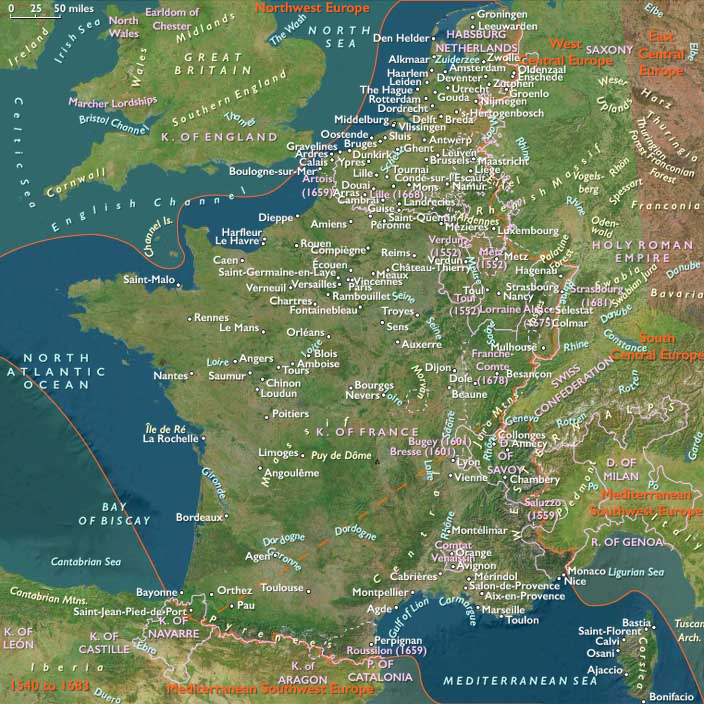
Mazarin returns to France with a small army in December 1651.
The war begins anew, and this time Turenne and Condé are pitted against one another.
Locations
People
Groups
Topics
Commodoties
Subjects
Regions
Subregions
Related Events
Filter results
Showing 10 events out of 31714 total
The twenty-one-year-old Prince of Gui, the seventh son of the Wanli Emperor, had in November 1646 ascended the throne of the vanquished Southern Ming dynasty and assumed the reign name of Yongli.
He had initially established himself in Guangzhou, the capital of Guangdong, but as the Ming troops were unable to fend off the stronger Qing troops who were continuously sending reinforcements south towards Guangzhou, the Yongli emperor, in order to save his life, had had no choice but to flee in 1650 from Guangzhou towards Nanning with a motley court and hastily assembled army.
Koxinga, a Ming loyalist and military leader during the Southern Ming Dynasty who now establishes himself as the head of the Zheng family, opposes the Manchu-ruled Qing Dynasty, and has pledged allegiance to the only remaining claimant to the throne of the Ming Dynasty, the Yongli Emperor.
Despite one fruitless attempt, Koxinga is unable to do anything to aid the emperor, who is to be the last of the Ming Dynasty.
He decides instead to concentrate on securing his own position on the southeast coast.
Aurangzeb is the third son of the fifth Mughal emperor Shah Jahan and Mumtaz Mahal (Arjumand Bānū Begum).
After a rebellion by his father, part of Aurangzeb's childhood had been spent as a virtual hostage at the court of his grandfather Jahangir.
Muhammad Saleh Kamboh Salafi, a noted calligraphist and official biographer of Emperor Shah Jahan, had been one of his childhood teachers.
Aurangzeb had returned to live with his parents after Jahangir's death in 1627.
Shah Jahan, following the Mughal practice of assigning authority to his sons, had in 1634 put Aurangzeb in charge of the Deccan campaign.
Following his success in 1636, Aurangzeb had became Subahdar (governor) of the Deccan.
At this time, he had begun building a new city near the former capital of Khirki which he named Aurangabad after himself.
He had married Rabia Durrani in 1637.
During this period the Deccan was relatively peaceful.
In the Mughal court, however, Shah Jahan had begun to increasingly favor his eldest son Dara Shikoh.
Aurangzeb's sister Jahanara Begum had been accidentally burned in Agra in 1644, an event that precipitated a family crisis which is to have political consequences.
Aurangzeb had suffered his father's displeasure when he returned to Agra three weeks after the event, instead of immediately.
Shah Jahan dismissed him as the governor of the Deccan.
He had been barred from the court in 1645 for seven months, but Shah Jahan later appointed him governor of Gujarat, where he performed well and had been rewarded.
Shah Jahan had in 1647 made him governor of Balkh and Badakhshan (in modern Afghanistan and Tajikistan), replacing Aurangzeb's ineffective brother Murad Baksh.
These areas at the time were under attack from various forces and Aurangzeb's military skill proved successful.
After Aurangzeb was appointed governor of Multan and Sindh, he began a protracted military struggle against the Safavid army in an effort to capture the city of Kandahar.
He failed, and fell again into his father's disfavor.
The Rokeby Venus (also known as The Toilet of Venus, Venus at her Mirror, Venus and Cupid, or La Venus del espejo) is a painting by Velázquez.
Completed between 1647 and 1651, and probably painted during the artist's visit to Italy, the work depicts the goddess Venus in a sensual pose, lying on a bed and looking into a mirror held by the Roman god of physical love, her son Cupid.
The painting is in the National Gallery, London.
Numerous works, from the ancient to the baroque, have been cited as sources of inspiration for Velázquez.
The nude Venuses of the Italian painters, such as Giorgione's Sleeping Venus (circa 1510) and Titian's Venus of Urbino (1538), are the main precedents.
In this work, Velázquez combines two established poses for Venus: recumbent on a couch or a bed, and gazing at a mirror.
She is often described as looking at herself on the mirror, although this is physically impossible since viewers can see her face reflected in their direction.
In a number of ways the painting represents a pictorial departure, through its central use of a mirror, and because it shows the body of Venus turned away from the observer of the painting.
The Rokeby Venus is the only surviving female nude by Velázquez.
Nudes are extremely rare in seventeenth-century Spanish art, which is policed actively by members of the Spanish Inquisition.
Despite this, nudes by foreign artists are keenly collected by the court circle, and this painting is toe be hung in the houses of Spanish courtiers until 1813, when it is brought to England to hang in Rokeby Park, Yorkshire.
The painting will be purchased in 1906 by National Art Collections Fund for the National Gallery, London.
Although attacked and badly damaged in 1914 by the suffragette Mary Richardson, it would soon be fully restored and returned to display.
Innocent X, whose palace fronts the Piazza Navona in Rome, had commissioned Gianlorenzo Bernini to design the Fontana dei Quattro Fiumi or "Fountain of the Four Rivers" for the center of the piazza.
Constructed at public expense during the intense famine of 1646-48, the city had murmured and talk of riot was in the air.
Pasquinade writers had protested the construction of the fountain in September 1648 by attaching handwritten invectives on the stone blocks used to make the obelisk.
The Pamphili pope, believing the street vendors of the market detracted from the magnificence of the square, had ordered their expulsion from the piazza.
The vendors had refused to move, and the papal police had had to chase them from the piazza.
Roman Jews, in particular, lament the closing of the Navona, since they had been allowed to sell used articles of clothing there at the Wednesday market.
According to a report from the time, an event had been organized to draw people to the Piazza Navona for the fountain’s unveiling to the populace on June 12, 1651.
Wooden scaffolding, overlaid with curtains, has hidden the fountain, though probably not the obelisk, which would have given people an idea that something was being built, but the precise details were unknown.
Once unveiled, the full majesty of the fountain would be apparent, which the celebrations were designed to advertise.
The festival is paid for by the Pamphili family, to be specific, Innocent X.
The most conspicuous item on the Pamphili crest, an olive branch, is brandished by the performers who take part in the event.
Erected in front of the church of Sant'Agnese in Agone, and yards from the Pamphil palace, the Fontana dei Quattro Fiumi is emblematic of the dynamic and dramatic effects sought by High Baroque artists.
The four gods on the corners of the fountain represent the four major rivers of the world known at the time: the Nile, Danube, Ganges, and Plate.
The design of each god figure has symbolic importance.

On October 9, the Navigation Acts are passed to ensure that trade enriches only Britain, barring trade with other nations.
Some will argue that the economic impact is minimal on the colonists, but the political friction that the acts trigger is more serious, as the merchants most directly affected are most politically active.
Four witch trials and three executions for witchcraft occur in the town of Wethersfield in the seventeenth century.
Mary Johnson had been convicted of witchcraft and executed in 1648, Joan and John Carrington in 1651.
Landowner Katherine Harrison had been convicted as well: although her conviction is reversed, she is banished and her property seized by her neighbors.
The Iroquois have completely driven the Neutrals from traditional territory, having killed and assimilated thousands by the end of 1651.
The Mohawks attack to the south and overwhelm Algonquians in the coastal areas, taking between five hundred and six hundred captives in the winter of 1651.
The remaining Huron, along with the surviving remnants of the Petun, an Iroquoian group living at the base of the Niagara Escarpment near present-day Collingwood, leave the island in 1651.
The Petun had suffered serious losses in Iroquois raids in late 1649 and 1650.
Their descendants will eventually settle in the Detroit-Windsor area.
The surviving Huron have fled their territory to seek assistance from the Anishinaabeg Confederacy in the northern Great Lakes region.
The Odaawaa Nation (Ottawa) temporarily halts Iroquois expansion further northwest.
With the Hurons' withdrawal, the Iroquois control a fur-rich region and have no more native tribes blocking them from the French settlements in Canada.