Maximinus, having secured the German frontier, at …
Years: 236 - 236
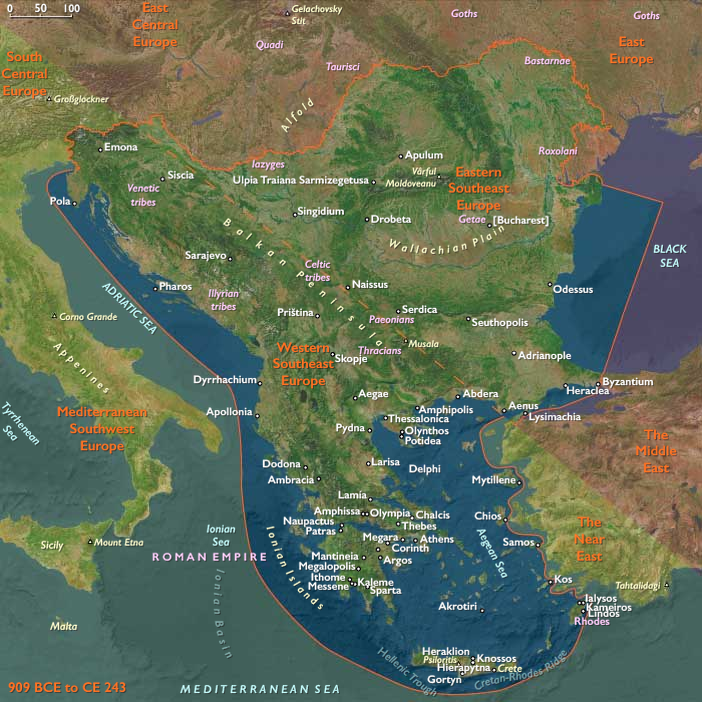
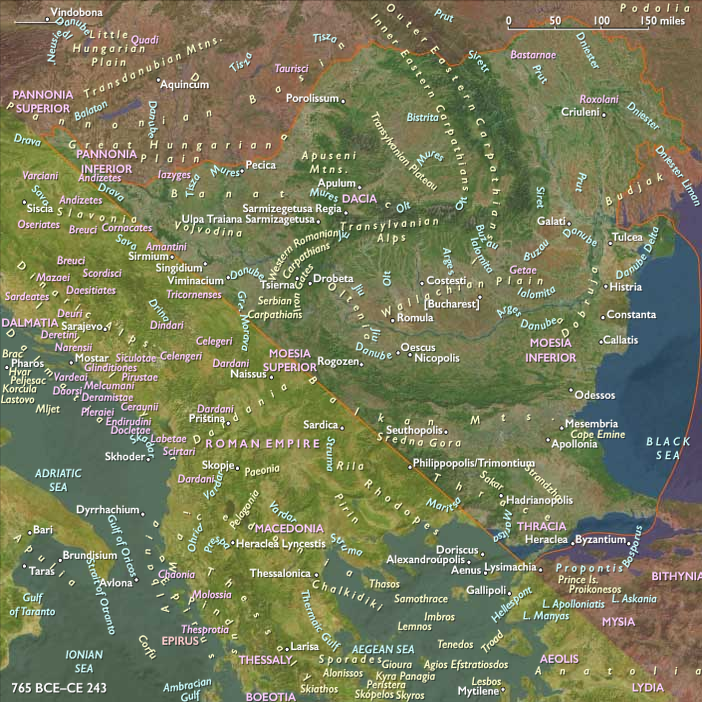
Maximinus, having secured the German frontier, at least for a while, sets up a winter encampment at Sirmium in Pannonia, and from that supply base fights the Dacians and the Sarmatians during the winter of 235–236.
Locations
People
Groups
- Dacians, or Getae, or Geto-Dacians
- Sarmatians
- Germans
- Dacia, Roman
- Pannonia Inferior (Roman province)
- Persian Empire, Sassanid, or Sasanid
Topics
- Classical antiquity
- Portraits, Classical
- Roman Age Optimum
- Crisis of the Third Century (Roman Civil “War” of 235-84)
Commodoties
Subjects
Regions
Subregions
Related Events
Filter results
Showing 10 events out of 60553 total
Germanic tribes had crossed the Rhine and devastated the Roman countryside in 233.
In 235, Maximinus Thrax had led the revenge campaign into Germania, which had been prepared by his predecessor Severus Alexander, defeating a Germanic tribe beyond the Weser in the Battle at the Harzhorn.
The archaeologists responsible for the excavation of the battle site believe that the roughly fifteen hundred artifacts found at the battle site are associated with Roman legionaries.
Since Germanic tribes of the time were also sometimes equipped with Roman weaponry, one early assumption was that this could have been an inter-Germanic battle.
Other Germanic excavations of the time reveal that many such conflicts were fought during the third century.
The finding of many bolts associated with the Scorpio or Cheiroballistra, which were exclusively used by Roman legions, prove, according to the scientists involved, that this battle involved a larger number of Roman troops.
The working hypothesis of the scientists is that the Roman troops were on their way back from the North German Plain.
They found the Harzhorn pass blocked by a large number of Germans, and had to fight their way through, using their superior Roman artillery.
The finds indicate a Roman success, due to their superior military technology.
Pope Anterus is thought to have been of Greek origin, but the name could indicate that he was a freed slave.
He is succeeded in 236 by Fabian.
Eusebius of Caesarea (Church History, VI.
29) relates how the Christians, having assembled in Rome to elect a new bishop, saw a dove alight upon the head of Fabian, a layman and stranger to the city, who was thus marked out for this dignity and was at once proclaimed bishop by acclamation, although there were several famous men among the candidates for the vacant position.
It is very probable that Hippolytus, before his death in Sardinia, he was reconciled to the other party at Rome, for, under Pope Fabian, his body and that of Pontian are brought to Rome.
Maximinus' first campaign is against the Alamanni, whom Maximinus defeats despite heavy Roman casualties in a swamp in the Agri Decumates.
After the victory, Maximinus takes the title Germanicus Maximus, raises his son Maximus to the rank of Caesar and Prince of Youths, and deifies his late wife Paulina.
Cao Rui had commenced large-scale palace and temple-building projects almost immediately after ascending the throne.
Part of it was to be expected—the Luoyang palaces had been remnants of the ones not destroyed by Dong Zhuo, and the temples were needed for the cults of his ancestors.
However, he has gone beyond the minimally required constructions, and continues to build temples and palaces throughout his reign, severely draining the imperial treasury.
While he occasionally halts projects at the officials' behest, the projects restart after brief breaks.
He not only builds palaces in Luoyang, but also builds a palace in Xuchang.
In 237, he further moves many of the magnificent statues and monuments that had been commissioned by Emperor Wu of Han from Chang'an to Luoyang, at great expenses and the cost of many lives.
He further builds gigantic bronze statues of his own and places them on a man-made hill inside his palace, surrounded by rare trees and plants and populated by rare animals.
Cao Rui is also increasing his collection of women, as his concubines and ladies-in-waiting number in the thousands.
His palace-building projects might have been with intent to house them.
In 237, he even orders that beautiful married women all be formally seized unless their husbands are able to ransom them, and that they will be married to soldiers instead—but that the most beautiful among them will become his concubines.
Despite some officials' protestations, this decree is apparently carried out, much to the distress of his people.
Despite his harem, however, Cao Rui is without any son who survives infancy.
He had adopted two sons to be his own—Cao Fang and Cao Xun, whom he had created princes in 235.
(It is usually accepted that they were sons of his cousins, although the exact parentage is not clear.)
In 237, Cao Rui takes the unprecedented (and unrepeated in Chinese history) action of setting his own temple name of Liezu and ordering that his temple never be torn down in the future.
(Based on Confucian regulations, except for the founder of the dynasty, rulers' temples are destroyed after six generations.)
He carries out these actions apparently in apprehension that he will be given an unflattering temple name (or none at all) and that his temple will eventually be destroyed, due to his lack of biological issue and unclear origin.
By 237, Cao Rui's favorite is no longer Empress Mao, but Consort Guo.
In this year, when Cao Rui is attending a feast hosted by Consort Guo, Consort Guo requests that Empress Mao be invited to join as well, but Cao Rui refuses and further orders that no news about the feast be given to Empress Mao.
However, the news leaks, and Empress Mao talks about the feast with him anyway.
He becomes exceedingly angry, and kills a number of his attendants whom he suspected of leaking the news to Empress Mao, and, inexplicably, orders Empress Mao to commit suicide, even though she is still buried with honors due an empress, and her family remains honored.

Cao Rui, angered in 237 by reports that Gongsun has repeatedly defamed him, once again considers attacking Liaodong.
He commissions Guanqiu Jian to prepare for an attack, then orders Gongsun to come to Luoyang for an official visit.
Gongsun refuses and instead declares independence.
Guanqiu attacks him, but is stopped by torrential rains.
Gongsun then declares himself the Prince of Yan and enters into alliances with the Xianbei tribes to harass Cao Wei's borders.
Cao Rui sends Sima Yi with forty thousand men to attack Liaodong the following year.
Upon hearing this, Gongsun again requests aid from Eastern Wu.
Sun, angry at Gongsun's previous betrayal, pretends to agree, but does not send Gongsun any actual help.
Although Sima's expeditionary force is also initially halted by torrential rains as had been that of Guanqiu, Sima waits out the rains and eventually surrounds Gongsun's capital of Xiangping (in modern Liaoyang, Liaoning), starving Gongsun's troops.
Xiangping falls after nearly three months of siege; Gongsun flees, but is captured and executed by Sima.
Liaodong becomes part of Cao Wei's domain.
…Carrhae.
The shock this causes in Rome leads the emperor to revive the Roman client-state of Osroene.
Ardashir—along with his son and successor Shapur I—again invades Mesopotamia in 237.
The successful assaults on Nisibis and …
The oldest accounts of Yamatai are found in the official Chinese dynastic Twenty-Four Histories for the Eastern Han Dynasty (25-220 CE), the Cao Wei Kingdom (220-265 CE), and the Sui Dynasty (581-618 CE).
The Wei Zhi ("Records of Wei") from about 297 CE, which is part of the San Guo Zhi (Records of the Three Kingdoms"), first mentions the country Yamatai written as Yamaichi.
This history describes ancient Wa (Japan) based upon detailed reports of third-century Chinese envoys who traveled throughout the Japanese Archipelago.
Going south by water for twenty days, one comes to the country of Toma, where the official is called mimi and his lieutenant, miminari.
Here there are about fifty thousand households.
Then going toward the south, one arrives at the country of Yamadai, where a Queen holds her court.
[This journey] takes ten days by water and one month by land.
Among the officials there are the ikima and, next in rank, the mimasho; then the mimagushi, then the nakato.
There are probably more than seventy thousand households. (115, tr. Tsunoda 1951:9)
The Wei Zhi also records that in 238 CE, Queen Himiko sent an envoy to the court of Wei emperor Cao Rui, who responded favorably.
Gongsun Yuan is under attack by Wei's general Sima Yi in 238.
Sun Quan, despite his prior rage against Gongsun, correctly judges the situation as one where he might be able to take advantage if Sima Yi were initially unsuccessful, and does not immediately refuse Gongsun's request for help.
However, as Sima Yi is able to conquer Gongsun Yuan quickly, Sun Quan never launches the major attack that he had considered were Sima to have gotten stuck in a stalemate with Gongsun.
In this year, he also recognizes the manner in which his head secretary Lü Yi had been falsely accusing his officials, and has Lü executed; he then further confirms his trust in the high level officials by personally writing an emotional letter to Zhuge Jin, Bu Zhi, Zhu Ran, and Lü Dai, blaming himself for the recent problems with his administration while urging them to speak out honestly whenever they see faults in him.
Years: 236 - 236
Locations
People
Groups
- Dacians, or Getae, or Geto-Dacians
- Sarmatians
- Germans
- Dacia, Roman
- Pannonia Inferior (Roman province)
- Persian Empire, Sassanid, or Sasanid
Topics
- Classical antiquity
- Portraits, Classical
- Roman Age Optimum
- Crisis of the Third Century (Roman Civil “War” of 235-84)