
Maxentius recovers Africa in 311, but in …
Years: 312 - 312
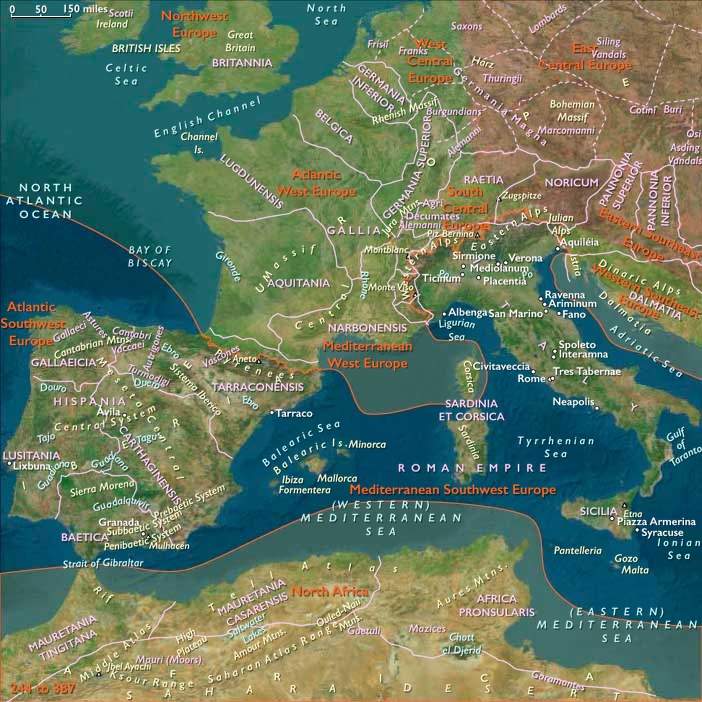
Maxentius recovers Africa in 311, but in the following year must face the invasion of Italy by his brother-in-law Constantine at the head of a forty thousand-man army.
Constantine, scoring victories at Milan and Turin against superior numbers, wins two more victories at Brescia and Verona, and then marches south on Rome, reinforcing his army along the way.
Before the beginning of his final battle with Maxentius, Constantine reportedly sees a flaming cross in the sky.
Adopting the cross as a symbol for the fight, he supposedly vows to become a Christian if he emerges victorious.
On October 28, 312, Constantine’s forces, now about fifty thousand strong, defeat Maxentius and his seventy-five thousand-man army outside Rome at the Milvian Bridge over the Tiber River, in which Maxentius drowns while attempting to escape.
Constantine thus removes a dangerous rival and secures his share in the new government organized by Licinius.
Constantine's adherence to Christianity is closely associated with his rise to power.
He had fought the Battle of the Milvian Bridge in the name of the Christian God, having received instructions in a dream to paint the Christian monogram on his troops' shields.
This, at least, is the account given by the Christian apologist Lucius Caecilius Firmianus Lactantius; a somewhat different version, offered by Eusebius of Caesarea, tells of a vision seen by Constantine during the campaign against Maxentius, in which the Christian sign appeared in the sky with the legend “In this sign, conquer.” Despite the Emperor's own authority for the account, given late in life to Eusebius, it is in general more problematic than the other; but a religious experience on the march from Gaul is suggested also by a pagan orator, who in a speech of 310 referred to a vision of Apollo received by Constantine at a shrine in Gaul.
Locations
People
Groups
Topics
- Portraits, Classical
- Roman art
- Roman Age Optimum
- Late Antiquity
- Diocletianic Persecution
- Civil wars of the Tetrarchy
- Roman Civil War of 311-12
- Milvian Bridge, Battle of the
Commodoties
Subjects
- Commerce
- Symbols
- Sculpture
- Environment
- Labor and Service
- Conflict
- Mayhem
- Faith
- Government
- Technology
- Theology
Regions
Subregions
Related Events
Showing 10 events out of 59970 total
Years: 312 - 312
Locations
People
Groups
Topics
- Portraits, Classical
- Roman art
- Roman Age Optimum
- Late Antiquity
- Diocletianic Persecution
- Civil wars of the Tetrarchy
- Roman Civil War of 311-12
- Milvian Bridge, Battle of the
Commodoties
Subjects
- Commerce
- Symbols
- Sculpture
- Environment
- Labor and Service
- Conflict
- Mayhem
- Faith
- Government
- Technology
- Theology
Regions
Subregions