
Matthias Grünewald and the Isenheim Altarpiece (circa …
Years: 1515 - 1515
Matthias Grünewald and the Isenheim Altarpiece (circa 1501–1515)
Matthias Grünewald, originally known as Mathis Gothart Nithart (or Neithardt), emerged as one of the most compelling and enigmatic artists in early-sixteenth-century Germany. Born between 1480 and 1483, Grünewald grew up near Würzburg, close to Nuremberg. By 1501, around age twenty-six, he had established a successful painting workshop in Seligenstadt, demonstrating early professional recognition.
Early Life and Artistic Formation
Details about Grünewald's personal life are notably scarce for an artist of his stature. The first significant biographical reference comes from seventeenth-century art historian Joachim von Sandrart, who described Grünewald working around 1505 in Frankfurt, painting the external decorations of an altarpiece designed by Albrecht Dürer. Such tasks were generally reserved for younger artists, suggesting Grünewald’s relatively young age at the time.
According to Sandrart, Grünewald later took on the painter Hans Grimmer as an apprentice. Sandrart’s account characterizes Grünewald as a solitary, introspective figure leading a withdrawn and unhappy domestic life.
Court Artist and Personal Struggles (1511–1512)
In 1511, Grünewald was appointed court painter to Uriel von Gemmingen, Archbishop of Mainz, and subsequently served his successor, Archbishop Albert of Brandenburg. The following year, he settled in Frankfurt, purchasing a house and marrying an eighteen-year-old converted Jew named Anna. Their marriage would prove troubled, culminating in Anna’s institutionalization in 1523 due to what contemporary sources ambiguously described as mental illness or demonic possession.
The Isenheim Altarpiece (1512–1515)
Grünewald's enduring artistic legacy rests upon his masterpiece, the Isenheim Altarpiece (created between 1512 and 1515), commissioned for the Monastery of St. Anthony at Isenheim, near Colmar. This monastery specialized in treating plague victims and sufferers of skin diseases like ergotism (St. Anthony’s Fire). The altarpiece thus uniquely and poignantly addresses themes of suffering, redemption, and divine compassion, explicitly aimed at the patients cared for by the Antonine monks.
The altarpiece, a multi-panel work executed in collaboration with another painter identified as Mathis Nithart, Neithart von Würzburg, or Gothardt, is renowned for its extraordinary emotional intensity and visionary style. Grünewald depicted the crucified Christ with agonizing realism, marked by plague-like sores and wounds, visually affirming Christ’s empathy and shared suffering with the monastery’s afflicted patients. The work’s intense use of vivid color, dynamic composition, and emotive power underscores Grünewald’s unique ability to render suffering, redemption, and transcendence.
Later Life and Financial Hardships
Grünewald appears to have left Isenheim abruptly, returning to Frankfurt under unclear circumstances. His subsequent poverty strongly suggests that he was inadequately compensated for the altarpiece, underscoring the precarious economic conditions artists faced during this period, despite achieving considerable fame and recognition.
Consequences and Historical Legacy
The Isenheim Altarpiece remains one of the most powerful artistic statements of the Northern Renaissance, celebrated for its visionary representation of human suffering, spirituality, and redemption. Grünewald’s distinctive, emotionally charged style profoundly influenced later German and European art, particularly artists exploring religious and psychological themes. Despite his personal hardships and enigmatic biography, Grünewald’s work endures as a singularly potent artistic expression of early-sixteenth-century religious sentiment and humanist empathy, securing his legacy as one of Europe's most compelling Renaissance painters.
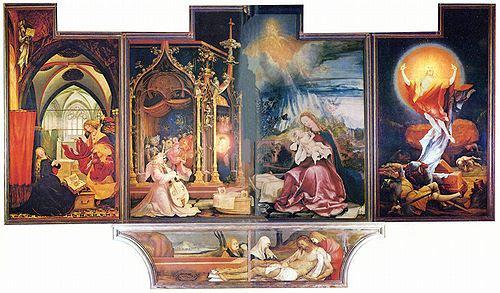
Second state of the Isenheim Altarpiece (Unterlinden Museum)
Locations
People
Groups
Topics
Subjects
Regions
Subregions
Related Events
Showing 10 events out of 106 total
Years: 1515 - 1515
Second state of the Isenheim Altarpiece (Unterlinden Museum)
Locations
People
Groups
Topics
Subjects
Regions
Subregions