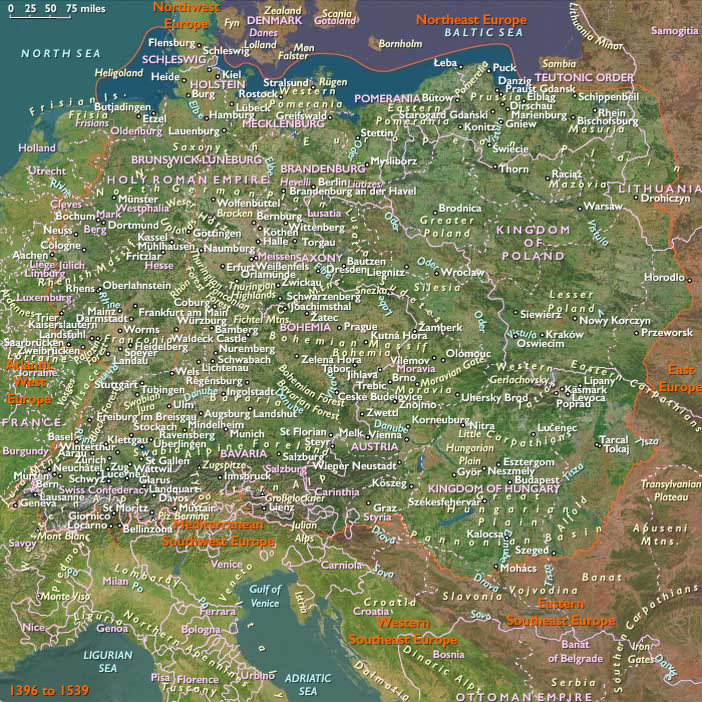
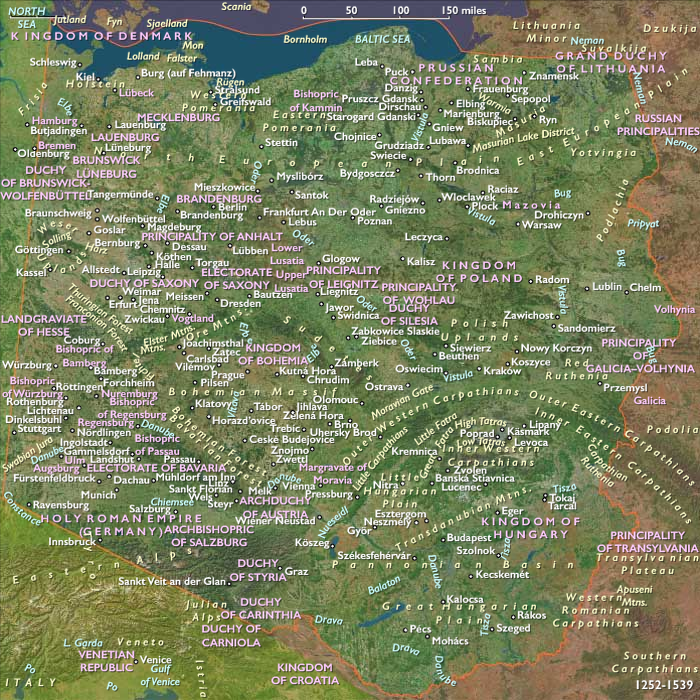
Matthias Corvinus transfers the capital of his …
Years: 1485 - 1485
Matthias Corvinus transfers the capital of his expanded realm to Vienna in 1485.
Locations
People
Groups
Subjects
Regions
Subregions
Related Events
Filter results
Showing 10 events out of 40500 total
Tver, situated on the upper Volga River and founded in the twelfth century, had become the center of an independent Russian principality that rivals Moscow until the elimination of its ruler by Ivan III and its consequent absorption by the Muscovite state in 1485.
Poland’s King Casimir IV, his commerce threatened by the Turk’s seizure of the ports of Kiliya and Akkerman, organizes a league against the Ottoman empire, forcibly expels the Turks from Moldavia, and marches twenty thousand troops to Kolomyya on the Pruth River in 1485, where Ottoman sultan Bayezid II enters into peace negotiations.
Although a truce is arranged, the disposition of captured fortresses on both sides cannot be successfully negotiated.
However, the diversion of Poland by the threat of Muscovy under Ivan III the Great leaves Poland's southeastern front quiet after 1484.
The Sect of Skhariya the Jew will spread over Moscow in the late fifteenth and early sixteenth century.
In 1480, even Grand Prince Ivan III himself invites a few prominent adherents to visit the city.
The Grand Prince's seemingly strange behavior can be explained by the fact that he has sympathized with heretics’ ideas of secularization and the struggle against feudal division.
Thus, the Judaizers enjoy the support of high-ranking officials, statesmen, merchants, Yelena Stefanovna (wife of Ivan the Young, heir to the throne) and Ivan's favorite deacon and diplomat Feodor Kuritsyn.
The latter even decides to establish his own club in 1485 that later will be considered heretical.
Kuritsyn, who is against monasteries and monasticism, expresses ideas about freedom of human will ("autocracy of the soul"), which he interprets in a much broader sense than orthodox theology allows.
Despite the growing popularity of this religious movement in Novgorod and Moscow, Ivan III is wary of the fact that it could irreversibly infiltrate broader masses of ordinary people and deprive him of ecclesiastic support in his foreign policy.
Indeed, a denial of the Trinity and the divinity of Christ will destroy Christianity, while the adherents' opposition to the clergy and the secular authorities will undermine the entire society.
This makes Ivan III renounce his ideas of secularization and ally with the clergy.

The Turks, having increased the pressure on Moldavia during the last decades of Stephen's reign and captured key Black Sea ports, burn Moldavia's capital, Suceava, in 1485.
Bayezid now turns to the east, where previous conquests as far as the Euphrates had brought the Ottomans up to the borders of the Mamluk empire.
A dispute arises in 1485 over a Turkmen territory ruled by the Mamluk-supported Duldakir (Dhu al-Qadr dynasty in Cappadocia), which controls much of Cilicia and the mountains south of Lake Van.
The fortunes of the Granadan internal conflict shift in 1485 yet again.
Boabdil is expelled from the Albayzín, his base of power, by Hasan's brother al-Zagal.
Al-Zagal also takes command of the nation itself, dethroning his aging brother, who dies shortly thereafter.
Boabdil is obliged to flee to Ferdinand and Isabella's protection.
The continuing division within the Muslim ranks and the cunning of the Marquis of Cádiz allows the western reaches of Granada to be seized with unusual speed in 1485.
Ronda falls to him after a mere fifteen days, thanks to his negotiations with the city's leaders.
Ronda's fall allows Marbella, a base of the Granadan fleet, to come into Christian hands next.
Ghirlandaio is among the Florentine painters who had received van der Goes’s “Portinari Altarpiece” with great enthusiasm.
He borrows van der Goes's shepherds for his Adoration of the Shepherds, painted in 1485 for the Church of Santa Trinita in Florence.
Sandro Botticelli and his Florentine workshop have from 1482 produced numerous paintings of all types: mythologies, portraits, small-scale devotional pictures, and altarpieces, such as the “St. Barnabas Altarpiece” created in about 1488.
Botticelli paints his celebrated (and widely imitated) “Madonna of the Magnificat” in around 1483-85.
He paints in about 1485, hone of his most famous works, the large-scale Birth of Venus, another of the mythological paintings in which he celebrates in Neoplatonic symbolism the beneficence and wisdom of Medici rule.
Alberti's primary literary work, De re aedificatoria, an influential ten-book Latin treatise on architecture, is published posthumously in 1485 (although it was probably already known in manuscript to Alberti's contemporaries).