Mas'ud I of Ghazni enters Tabaristan via …
Years: 1035 - 1035
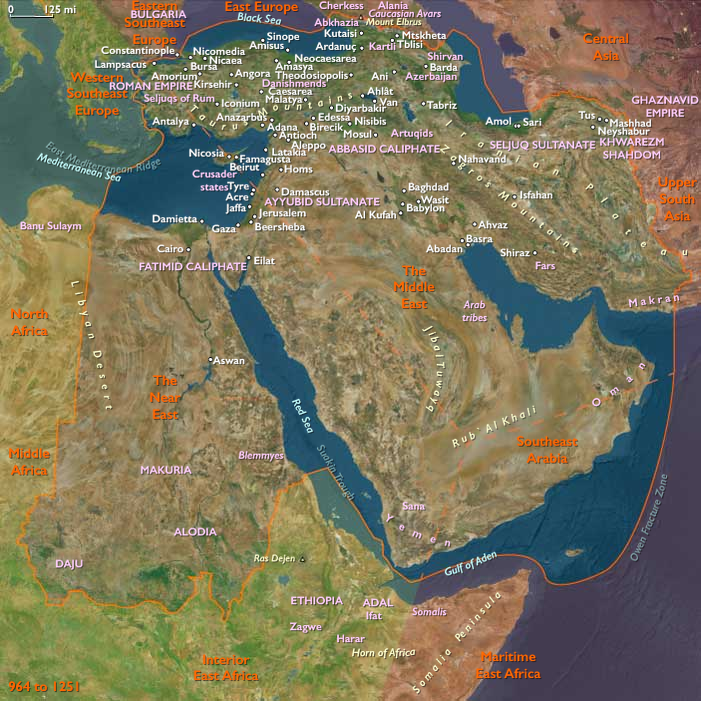
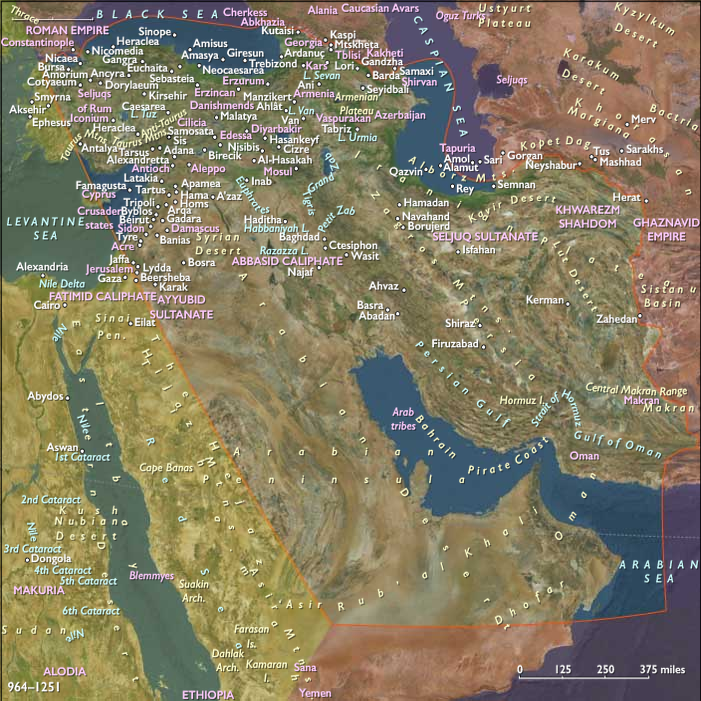
Mas'ud I of Ghazni enters Tabaristan via Gorgan in 1034-35, marching an army to Amol to collect tribute.
Mas'ud sacks Amol for four days and later burns it to the ground.
Locations
People
Groups
Subjects
Regions
Subregions
Related Events
Filter results
Showing 10 events out of 51491 total
Airlangga is the son-in-law of Dharmavamsa, whose Javanese kingdom had been dismembered by the Srivijaya Empire at the beginning of the eleventh century.
In 1019, after several years in self-imposed exile in Vanagiri hermitage, Airlangga had rallied the support of officials and regents loyal to the former Isyana dynasty and had begun to unite the areas that had formerly been ruled by Medang kingdom, which had disintegrated after Dharmawangsa's death.
He has consolidated his authority, established a new kingdom and made peace with Srivijaya.
The new kingdom is called the Kingdom of Kahuripan, and stretches from Pasuruan in the east to …
…Madiun in the west.
The decline of Srivijaya due to the Chola invasion has given Airlangga the opportunity to consolidate his kingdom without foreign interference.
Airlangga, in taking advantage of Srivijayan vulnerability following the attacks of the Indian Cholas, has reestablished the eastern Javanese empire, establishing his capital near modern Surabaya.
Airlangga is known for his religious tolerance, and is a patron of both the Hindu and Buddhist religions.
In 1035, Airlangga constructs a Buddhist monastery named Srivijayasrama dedicated for his queen consort Dharmaprasadottungadewi.
The monastery bearing the name of Srivijaya suggests that his queen consort was probably a Srivijayan princess, a close relative, probably daughter, of the Srivijayan king Sangramavijayattungavarman.
She had taken refuge in East Java after her father was taken prisoner and her kingdom was raided through series of Indian Chola raids.
The king seems to be sympathetic to the fate of the Srivijayan princess, having lost her family and her kingdom, and probably genuinely fell in love and was devoted to her, thus promoting her as prameswari (the queen consort).
Airlangga went further, naming his daughter from queen Dharmaprasadottungadewi as heiress, the future queen regnant of Kahuripan.
He eventually extends his kingdom to Central Java and Bali.
The north coast of Java, particularly Surabaya and …
…Tuban, for the first time become important centers of trade.
Although there are few surviving archaeological remains dating from his time, Airlangga is known to have been a keen patron of the arts, notably literature.
In 1035, the court poet Mpu Kanwa composes the Kakawin Arjunawiwaha, which is adapted from the Mahabharata epic.
This text tells the story of Arjuna, an incarnation of Indra, but is also an allegory for Airlangga's own life, the tale of which is illustrated in the Belahan Temple on the flanks of Mount Penanggungan, where he was portrayed in stone as Vishnu on Garuda.
Magnus is an illegitimate son of King Olaf Haraldsson (later St. Olaf), by his English concubine Alfhild, originally a slave (thrall) of Olaf's queen Astrid Olofsdotter.
Born prematurely, the child was weak and unable to breathe for the first few minutes, and he was probably not expected to survive.
Olaf was not present at the child's birth, and his Icelandic skald Sigvatr Tordarson became his godfather.
In a hasty baptism, Sigvatr named Magnus after the greatest king he knew of, also Olaf's greatest role model, Karla Magnus, or Charlemagne.
Against the odds, Magnus had gone on to grow strong and healthy, and he had become of vital importance to Olaf as his only son.
When Olaf was dethroned by the Danish king Cnut the Great in 1028, he had gone into exile with his family and court, including the young Magnus.
They had traveled over the mountains and through Eidskog during the winter, entered Värmland, and had been given shelter by a chieftain called Sigtrygg in Närke.
After a few months, they departed Närke, and by March went eastwards towards Sigtuna, where the Swedish king Anund Jacob had left them a ship.
The party thereafter sailed through the Baltic Sea and into the Gulf of Finland, eventually landing in Kievan Rus' (Gardaríki).
They had made their first stop at Staraya Ladoga (Aldeigjuborg) to organize the further journey.
From there, they had traveled southwards to Novgorod (Holmgard), where Olaf had sought assistance from Grand Prince Yaroslav the Wise.
Yaroslav, however, had not wanted to become directly involved in the Scandinavian power-struggles, and declined to help.
After some time, in early 1030, Olaf had learned that the Earl of Lade Håkon Eiriksson, Cnut's regent in Norway, had disappeared at sea, and gathered his men to make a swift return to Norway.
Magnus was left to be fostered by Yaroslav and his wife Ingegerd.
A party including Magnus's uncle Harald Sigurdsson (later also to be king and then known as Harald Hardrada) had arrived in early 1031 to report the news of his father's death at the Battle of Stiklestad.
Magnus had for the past few year been educated in Old Russian and some Greek and has been trained as a warrior.
After Cnut's death in 1035, the Norwegian noblemen do not want to be under the oppressive rule of his son Svein and his mother Ælfgifu (known as Álfífa in Norway) any longer.
Einar Thambarskelfir and Kalf Arnesson, who had both sought to be appointed regents under Cnut after Olaf's death in 1030 (Cnut had instead appointed Svein and Ælfgifu), go together to Kievan Rus' to bring the boy back to rule as the King of Norway.

Einar Thambarskelfir and Kalf Arnesson, after receiving the approval of Ingegerd, return from Novgorod with Magnus to Sigtuna in early 1035, and receive backing from the Swedish king, brother of Magnus's stepmother Astrid.
Astrid immediately becomes an important supporter of Magnus, and an army is gathered in Sweden, headed by Einar and Kalf, to place Magnus on the Norwegian throne.
Ælfgifu and Svein have made themselves unpopular by heavy taxation and favoring Danish advisers over the Norwegian nobles, and when Magnus of Norway, the son of the former King of Norway, Olaf, invades in 1035, they are forced to flee to Harthacnut's court.
Magnus is proclaimed king in 1035, at eleven years of age; Svein dies shortly after.
Magnus at first seeks revenge against his father's enemies, but on Sigvatr's advice he stops doing so, which is why he becomes known as "good" or "noble”.
Bretislaus helps Emperor Conrad II in 1035 in his war against the Lusatians.
Jaromír, who has been imprisoned at Lysá nad Labem and dies (assassinated by one of the Vršovci) on November 6, 1035, a year after the death of his brother.
The Pisans launch a naval assault in 1035 against the Saracen pirates strongholds in the Lipari Islands.