Mastino II della Scala, Can Grande’s successor …
Years: 1339 - 1339
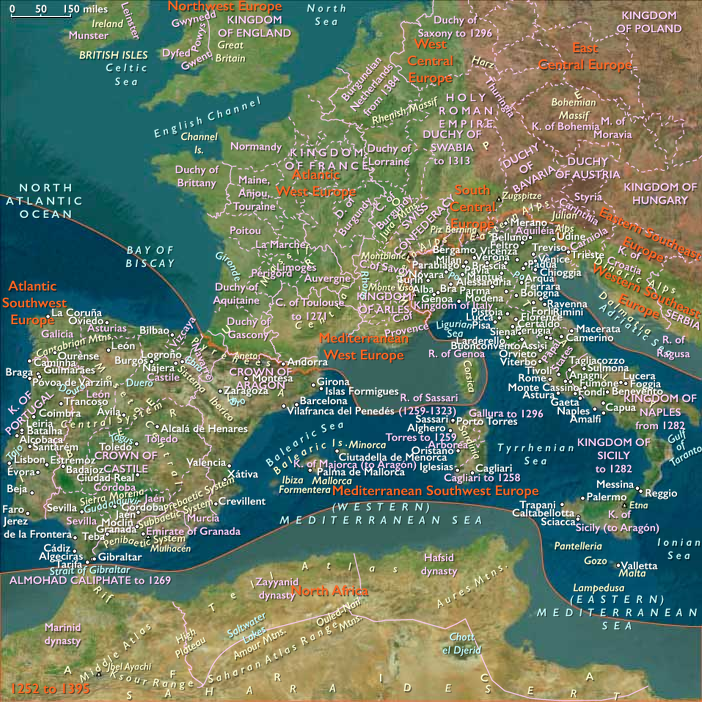
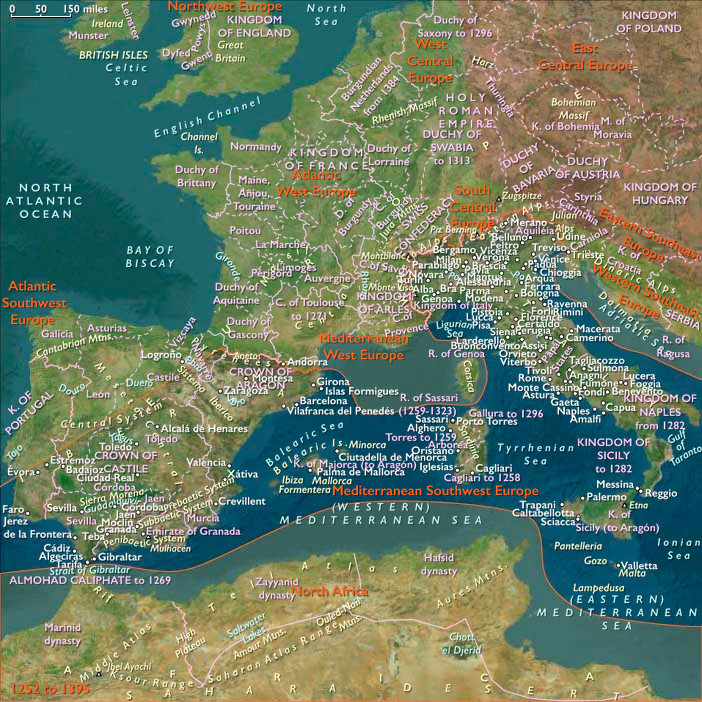
Mastino II della Scala, Can Grande’s successor as lord of Verona, loses his predecessor’s conquests, including the cities of …
Locations
People
Groups
Topics
Commodoties
Subjects
Regions
Subregions
Related Events
Filter results
Showing 10 events out of 44488 total
Hungary, enriched by renewed Western cultural influences from Italy and France under the rule of Angevin king Charles I, once more becomes a significant power in central Europe.
Charles’s successful foreign policy, based on strong ties with Poland, has resulted in the extension of Hungary's influence into southern Italy.
The third son of Charles I of Hungary and his wife, Elizabeth of Poland, born on March 5, 1326, is named for his father's uncle, Louis, Bishop of Toulouse, canonized in 1317.
The first-born son of Louis's parents, Charles, died before Louis's birth.
Louis became his father' heir in 1329 after the death of his brother Ladislaus.
He has had a liberal education by the standards of his age and learned French, German and Latin.
He showed a special interest in history and astrology.
A cleric from Wrocław, Nicholas, had taught him the basic principles of Christian faith.
However, Louis's religious zeal is due to his mother's influence In a royal charter, Louis will remember that in his childhood, a knight of the royal court, Peter Poháros, often carried him on his shoulders.
His two tutors, Nicholas Drugeth and Nicholas Knesich, had saved the lives of both Louis and his younger brother, Andrew, when Felician Záh attempted to assassinate the royal family in Visegrád on April 17, 1330.
He was only nine when he stamped a treaty of alliance between his father and John of Bohemia.
A year later, Louis had accompanied his father in invading Austria.
On March 1, 1338, John of Bohemia's son and heir, Charles, Margrave of Moravia, signed a new treaty with Charles I of Hungary and Louis in Visegrád.
According to the treaty, Charles of Moravia acknowledges the right of Charles I's sons to succeed their maternal uncle, Casimir III of Poland, if Casimir dies without a male issue.
Louis also pledges that he will marry the margrave's three-year-old daughter, Margaret.
Casimir III's first wife, Aldona of Lithuania, dies on May 26, 1339.
Two leading Polish noblemen—Zbigniew, chancellor of Cracow, and Spycimir Leliwita—had persuaded Casimir, who had not fathered a son, to make his sister, Elizabeth, and her offspring his heirs.
Historian Paul W. Knoll writes that Casimir preferred his sister's family to his own daughters or a member of a cadet branch of the Piast dynasty, because he wanted assure the king of Hungary's firm against the Teutonic Knights.
Louis's father and uncle sign a treaty in Visegrád in July whereby Casimir III makes Louis his heir if he dies without a son.
In exchange, Charles I pledges that Louis will reoccupy Pomerania and other Polish lands lost to the Teutonic Order without Polish funds and will only employ Poles in the royal administration in Poland.
Louis receives the title of Duke of Transylvania from his father in 1339, but he does not administer the province.
According to a royal charter from the same year, Louis's bride, Margaret of Bohemia, lived in the Hungarian royal court.
Louis's separate ducal court is first mentioned in a royal charter of 1340.
The expansionist Swiss of the free imperial city of Bern have, throughout the early 1300s, extended their control by annexing surrounding territories.
To counter this growth, the Burgundians invade with a fifteen thousand man force, including cavalry and infantry, and lay siege to the town of Laupen, a Bernese acquisition.
Laupen’s Bernese defenders receive help from the three nuclear Forest cantons of the Everlasting League—Uri, Schwyz, and Unterwalden—and although outnumbered three to one, the Swiss infantry charges, routing the Burgundians on the field on June 21, 1339, and withstanding a strong counterattack by the Burgundian cavalry.
The siege is lifted, the Swiss having demonstrated, for the first time, their military valor and resolution; ...
...Bern becomes the established leader of the evolving polity of Switzerland.
The University of Grenoble is founded in 1339 by Dauphin Humbert II of Viennois and Pope Benedict XII to teach civil and canon law, medicine, and the liberal arts.
However, the institution lacks resources and will dissolved after Humbert’s death.
…Treviso, …
…Feltro, and …
…Belluno, to …
…Florence and …
…Venice in 1339.
Lodrisio Visconti, the son of Pietro, of the powerful House of Visconti of Milan, and Antiochia Crivelli, had, after military training under his father, helped his cousin Matteo Visconti and the latter's son Galeazzo in the reconquest of Milan against the Torriani in 1312.
Galeazzo had been named capitano del popolo in Milan in 1322, but was soon forced to leave the city due to a revolt set up by his cousin Lodrisio Visconti.
With the support of Emperor Louis IV, Galeazzo had defeated an army sent against him by the Pope at Vaprio.
Azzone Visconti, born in Ferrara to Beatrice d'Este as the sole legitimate son of Galeazzo, was lord of Piacenza in 1322, but in the same year, together with his father, had been forced to flee.
In 1325, he had taken part in the victorious Battle of Altopascio against the Guelphs.
In 1328, after accusations of betrayal from his brother Marco, as well as that of the assassination of his brother Stefano Visconti, the emperor had him imprisoned in Monza.
Lodrisio, together with another cousin, Marco, he had been instrumental in the imprisonment of Galeazzo and his son.
When the two were freed in March of that year, Lodrisio had fled to his territory of Seprio.
Azzone had besieged him and destroyed his castle, but Lodrisio was able to escape to Vicenza, being hired by Mastino II della Scala, lord of Verona.
Azzone’s uncle, Luchino Visconti, a son of Matteo I Visconti and Bonacossa Borri, and ruler of Pavia from 1315, was from 1320 podestà of Vigevano, where he erected the castle that is still visible.
In 1323, along with all his family, he was excommunicated with the charge of heresy.
His younger brother Giovanni had been elected archbishop by the Capitol of Milan in 1317, but Pope John XXII had refused to confirm the election and instead raised Aircardus from Comodeia to that position.
In 1323 John had excommunicated him, together with his entire family, with an accusation of heresy.
Visconti had found an ally in the antipope Nicholas V, who gave him the title of cardinal.
In 1331, he became bishop and lord of Novara.
Meanwhile, his nephew Azzone had bought, for sixty thousand (or one hundred and twenty-five thousand) florins the title of imperial vicar of Milan by the emperor Louis IV in opposition to the Pope, who nominally held the right of the nomination.
Azzone had paid only twelve thousand of the promised florins, the feeble Louis being unable to force the payment.
In the same years he was named as one of the assassins of his uncle Marco Visconti, but was never condemned.
On March 15, 1330, Azzone had been appointed perpetual lord of Milan.
He had married Caterina di Savoia, daughter of Louis II of Vaud, in 1331.
That same year, Charles of Bohemia, the son of King John of Bohemia and future emperor as Charles IV, was nearly poisoned to death at a banquet in Pavia.
Azzone was again suspected.
In August of the same year he allied with Theodore I, Marquess of Montferrat, against King Robert of Anjou, in order to capture his possessions in northwestern Italy.
In 1332 he also conquered Bergamo and Pizzighettone, continuing in 1335 with Lodi, Crema and other Lombardy lands who had ceded themselves to the Papal States, as well as Vercelli and Cremona.
Lodrisio has meanwhile assembled a company of mercenary troops with the help of the Scaligers of Verona, who seek vengeance for Azzone's support to Venice during the war with Verona.
In January 1339 he musters a large army, mostly from Germany, with twenty-five hundred cavalry, eight hundred infantry and two hundred crossbowmen: baptized Compagnia di San Giorgio ("Company of St. George"), it is the first organized compagnia of mercenaries led by an Italian condottiero.
After invading the territory of Milan, Lodrisio's army is defeated in early February at the Battle of Parabiago, in which Azzone, suffering from gout, does not participate.
He is captured and, together with his son Ambrogio, imprisoned within an iron cage in the castle of San Colombano al Lambro.
Here he will remain for ten years, until he is freed by the new Milanese lord, archbishop Giovanni Visconti.