
Filters:
Master Honoré and the Evolution of Illumination …
Years: 1295 - 1295
Master Honoré and the Evolution of Illumination (1295)
Master Honoré, a Parisian miniaturist, was one of the first manuscript illuminators to emerge from a secular workshop, rather than a monastic scriptorium. Working for the court of King Philip IV (Philip the Fair), he played a key role in shaping late 13th-century manuscript illumination, particularly in the increasing use of illusionism.
- In 1295, Honoré completed the "Prayer Book of Philip the Fair," a masterpiece that showcased innovative techniques in shading and highlights, creating an illusion of three-dimensionality.
- While his figures remained two-dimensional, his careful application of light and shadow on drapery and facial features gave his compositions a greater sense of depth and realism.
- His work inspired later Gothic manuscript illumination, setting the stage for the more advanced illusionistic effects of the 14th and 15th centuries.
The Auld Alliance: Scotland and France Unite Against England (1295)
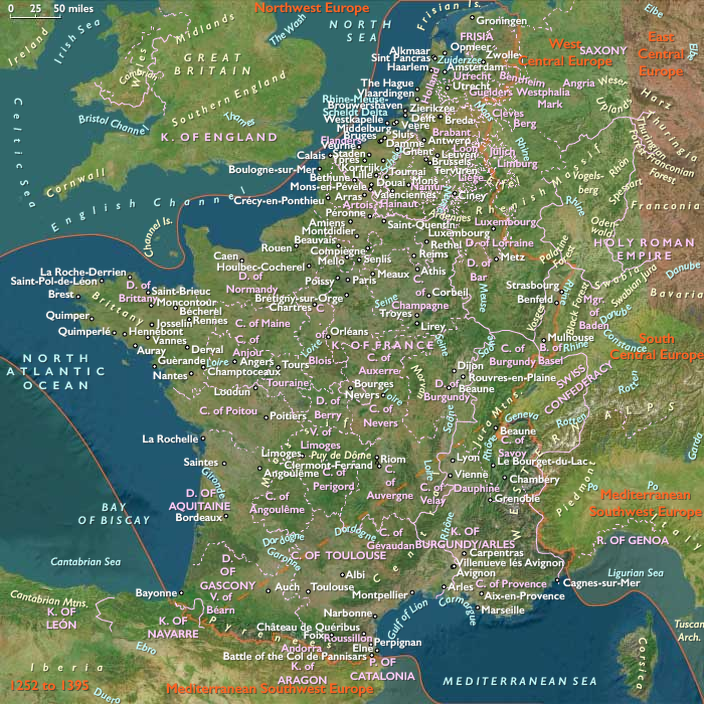
In 1295, following increasing tensions with King Edward I of England, John de Balliol, King of Scots, sought an alliance with France to counter English aggression.
- On October 23, 1295, the first formal treaty of the Auld Alliance was signed in Paris, officially binding Scotland and France against England.
- The treaty guaranteed mutual military support, ensuring that if one nation was attacked by England, the other would provide aid.
- This alliance set the foundation for centuries of Franco-Scottish cooperation, enduring even beyond the Middle Ages and influencing the diplomatic landscape of Britain and France well into the 16th century.
Long-Term Impact of the Auld Alliance
- The Auld Alliance played a crucial role in Scotland’s resistance to English rule, most notably during the Wars of Scottish Independence (1296–1357).
- France and Scotland remained close allies for over 250 years, until the Treaty of Edinburgh (1560) formally ended their military cooperation.
- The alliance also influenced trade, culture, and diplomacy, fostering strong Franco-Scottish relations that persisted even after Scotland’s union with England in 1707.
Conclusion
The year 1295 marked significant cultural and political developments:
- Master Honoré’s innovations in manuscript illumination paved the way for a more illusionistic style in Gothic art.
- The Auld Alliance treaty cemented a long-standing Franco-Scottish relationship, shaping medieval and early modern European geopolitics.
Both events exemplify the interplay between artistic evolution and political maneuvering in late 13th-century Europe.
Locations
People
Groups
Topics
Commodoties
Subjects
Regions
Subregions
Years: 1295 - 1295
Locations
People
Groups
Topics
Commodoties
Subjects
Regions
Subregions