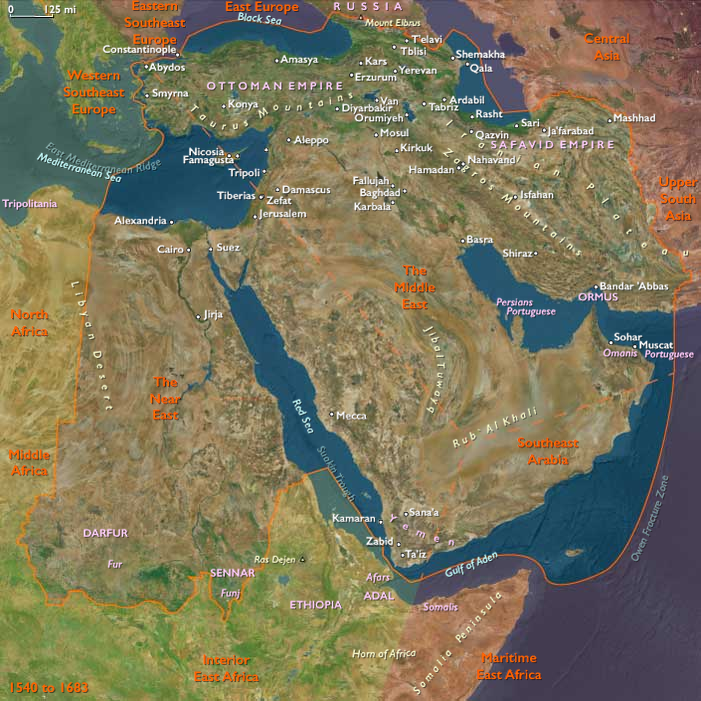
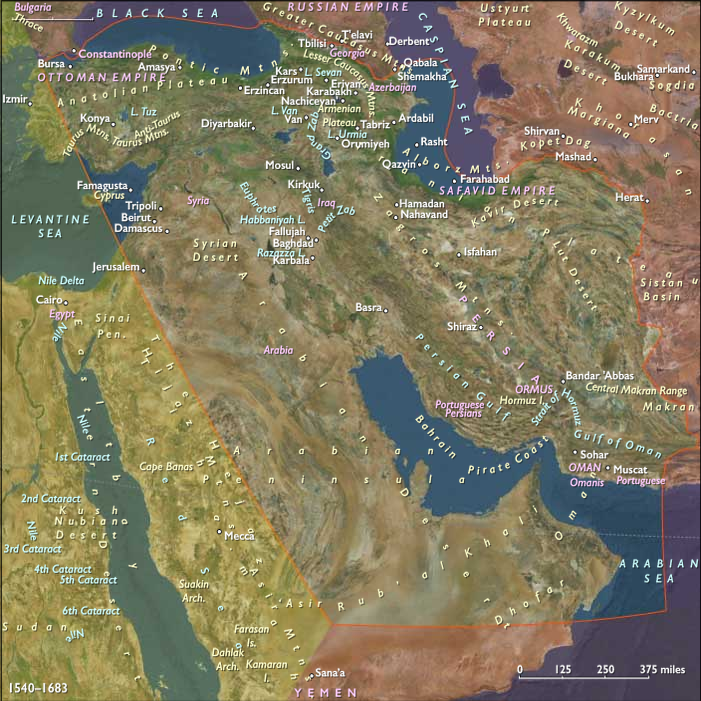
...Mashhad, site of the shrine of Imam …
Years: 1601 - 1601
...Mashhad, site of the shrine of Imam Reza, which Abbas restores (it had been despoiled by the Uzbeks).
Since Sunni Islam is the religion of Iran's main rival, the Ottoman Empire, Abbas often treats Sunnis living in western border provinces harshly.
Locations
People
Groups
Commodoties
Subjects
Regions
Subregions
Related Events
Filter results
Showing 10 events out of 33897 total
The Kingdom of Ayutthaya, ruled from 1590 by Naresuan, had reached its greatest extent in 1600.
The Dutch receive the king’s permission in 1601 to open a trading post in the Ayutthayan vassal state of Pattani in the south.
Pattani province has historically been the center of the semi-independent Malay Sultanate of Patani Darul Makrif, but has paid tribute to the Thai kingdoms of Sukhothai and Ayutthaya.
Francis Xavier, Spanish priest and missionary and founding member of the Society of Jesus, had in 1552 made the first attempt by the Jesuits to reach China.
Xavier had never reached the mainland, dying after only a year on the Chinese island of Shangchuan.
Three decades later, in 1582, Jesuits had once again initiated mission work in China, led by several figures including the Italian Matteo Ricci, introducing Western science, mathematics, astronomy, and visual arts to the imperial court, and carrying on significant intercultural and philosophical dialogue with Chinese scholars, particularly representatives of Confucianism.
Ricci is in 1601 invited to become an advisor to the Imperial court of the Wanli Emperor, thus becoming the first Westerner to be invited into the Forbidden City.
This honor is in recognition of Ricci's scientific abilities, chiefly his predictions of solar eclipses, which are significant events in the Chinese world.
Although Ricci is given free access to the Forbidden City, he never meets the reclusive Wanli Emperor; however, Wanli does grant him patronage by allotting to Ricci a generous stipend that helps the Jesuits in China.
The Jesuit China missions provide contacts for Portuguese and Dutch access to trade and trafficking routes in eastern Asia.

Inuyama Castle, located in the city of Inuyama, Aichi Prefecture, Japan, overlooks the Kiso River, which serves as the border between Aichi and Gifu prefectures.
Inuyama Castle is often claimed as the oldest castle in Japan, with original construction being done in 1440.
According to Engishiki (a Heian Period-book), Harigane Shrine (a Shinto shrine) was moved to make way for the castle.
That structure has been heavily augmented over time, and the current towers were completed in 1537, by Oda Nobuyasu, Oda Nobunaga's uncle.
Though the antiquated architectural style of the watchtower atop the tenshu has in the past led many historians to believe this to be the oldest extant tenshu in Japan, that honor goes to Maruoka castle, built in 1576.
Construction on the main tenshu (donjon) at Inuyama begins in 1601, and will continue through 1620.
Inuyama Castle is one of the twelve castles still in existence in Japan that were built before the Edo period.
The records of Bulguksa, a Buddhist temple in present North Gyeongsang province of South Korea, state that a small temple was built on this site under King Beopheung in 528.
The Samguk Yusa records that the current temple was constructed under King Gyeongdeok in 751, begun by Prime Minister Kim Daeseong to pacify the spirits of his parents.
The building was completed in 774 by the Silla royal court, after Gim's death, and given its current name Bulguksa (Temple of the Buddha Land).
The temple was renovated during the Goryeo Dynasty and the early Joseon Dynasty.
During the Japanese invasions between 1592 and 1598, the wooden buildings had been burned to the ground.
After 1604, reconstruction and expansion of Bulguksa begins, to be followed by about forty renovations until 1805.
Considered a masterpiece of the golden age of Buddhist art in the Silla kingdom, Bulguksa is currently the head temple of the eleventh district of the Jogye Order of Korean Buddhism and home to seven National treasures of South Korea, including Dabotap and Seokgatap stone pagodas, Cheongun-gyo (Blue Cloud Bridge), and two gilt-bronze statues of the Buddha.
The Portuguese, from their client state-of Ormus between the Persian Gulf and the Indian Ocean, have made several abortive attempts, notably in 1550, to seize control of Basra from the Safavid rulers of Persia.
Portugal has ruled Bahrain’s inhabitants forcibly through a series of Ormusi governors for eighty years.
However, the Sunni Ormusis are not popular with Bahrain's Shia population, which suffers religious disadvantages, prompting rebellion.
In one case, the Ormusi governor had been crucified by rebels.
Portuguese rule comes to an end in 1601 after the current Ormusi governor, who is a relative of the Ormusi king, starts executing members of Bahrain's leading families.
The uprising coincides with regional disputes between the Portuguese and rival European powers.
Shah Abbas had in 1598 moved his capital from Qazvin to the more central and more Persian Isfahan, located along the south bank of the river Zayandeh River.
Like all other Safavid monarchs, Abbas is a Shi'ite Muslim.
He has a particular veneration for Imam Hussein.
He makes a pilgrimage in 1601 on foot from Isfahan to ...
Caravaggio goes on to secure a string of prestigious commissions for religious works featuring violent struggles, grotesque decapitations, torture and death.
For the most part each new painting increases his fame, but a few are rejected by the various bodies for whom they are intended, at least in their original forms, and have to be repainted or find new buyers.
The essence of the problem is that while Caravaggio's dramatic intensity is appreciated, his realism is seen by some as unacceptably vulgar.
His first version of Saint Matthew and the Angel, which featured the saint as a bald peasant with dirty legs attended by a lightly clad over-familiar boy-angel, had been rejected and a second version had to be painted as The Inspiration of Saint Matthew.
Similarly, The Conversion of Saint Paul had been rejected, and while another version of the same subject, the Conversion on the Way to Damascus, is accepted, it features the saint's horse's haunches far more prominently than the saint himself, prompting this exchange between the artist and an exasperated official of Santa Maria del Popolo: "Why have you put a horse in the middle, and Saint Paul on the ground?"
"Because!"
"Is the horse God?"
"No, but he stands in God's light!"
Oñate had journeyed east from New Mexico, crossing the Great Plains and encountering two large settlements of people he called Rayados, most certainly Wichita, and Escanjaques, who may be identical with the Aguacane who live along the tributaries of the Red River in western Oklahoma.
If so, they are probably related to the people later known as the Wichita.
The Escanjaques try to persuade Oñate to plunder and destroy "Quiviran" villages.
The Rayado city is probably on the Walnut River near Arkansas City, Kansas.
Oñate describes the city as containing "more than twelve hundred houses" which would indicate a population of about twelve thousand.
His description of the Etzanoa is similar to that of Coronado's description of Quivira.
The homesteads are dispersed; the houses round, thatched with grass and surrounded by large granaries to store the corn, beans, and squash they grow in their fields.
Oñate's Rayados are probably the Wichita sub-tribe later known as the Guichitas.
What the Coronado and Oñate expeditions show is that the Wichita people of the sixteenth century are numerous and widespread.
They are not, however, a single tribe at this time but rather a group of several related tribes speaking a common language.
The dispersed nature of their villages probably indicates that they are not seriously threatened by attack by enemies, although that will change as they will soon be squeezed between the Apache on the West and the powerful Osage on the East.
European diseases will also probably be responsible for a large decline in the Wichita population in the seventeenth century.
Recent research, however, has shown that the tribe inhabited northwestern Oklahoma in 1601.