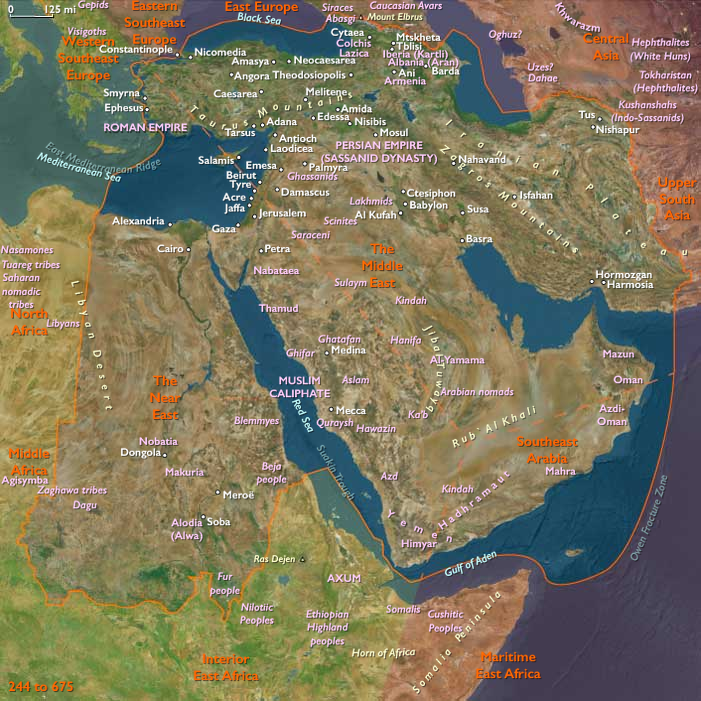
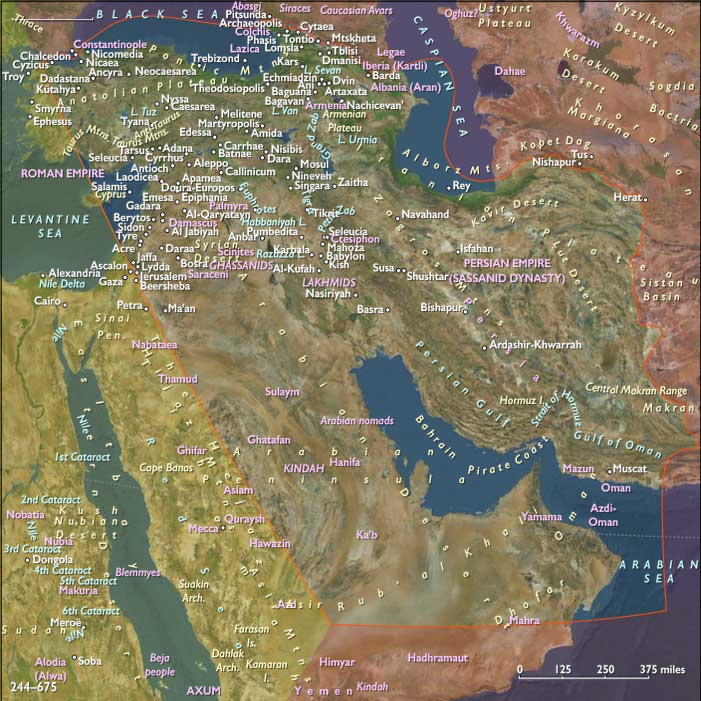
…Martyropolis on the upper Tigris.The Persian …
Years: 625 - 625
…Martyropolis on the upper Tigris.
The Persian army in northern Mesopotamia withdraws westward across the Euphrates.
Heraclius pursues into Cilicia, accompanied by a great train of booty.
Locations
People
Groups
- Persian people
- Zoroastrians
- Jews
- Cilicia (Roman province)
- Mesopotamia (Roman province)
- Persian Empire, Sassanid, or Sasanid
- Syria Prima (Roman province)
- Christianity, Chalcedonian
- Greeks, Medieval (Byzantines)
- Armenia, (Roman vassal) Principality of
- Roman Empire, Eastern: Heraclian dynasty
Topics
Commodoties
Subjects
Regions
Subregions
Related Events
Filter results
Showing 10 events out of 56871 total
Emperor Gaozu, facing constant Eastern Turkish incursions, seriously considers burning Chang'an to the ground and moving the capital to Fancheng (in modern Xiangfan, Hubei), a suggestion that Li Jiancheng, Li Yuanji, and the chancellor Pei Ji agree with.
Li Shimin is opposed, however, and the plan is not carried out.
Li Shimin himself is meanwhile sending his confidants to Luoyang to build up personal control of the army here.
After an incident in which Li Shimin suffers a severe case of food poisoning after feasting at Li Jiancheng's palace—an event that both Emperor Gaozu and Li Shimin apparently interpret as an assassination attempt—Emperor Gaozu considers sending Li Shimin to guard Luoyang to prevent further conflict, but Li Jiancheng and Li Yuanji, after consulting one another, believe that this would only give Li Shimin an opportunity to build up his personal power here, and therefore oppose it.
Emperor Gaozu therefore does not carry out the plan.
The imperial campaigns of 624 and 625 have ranged across northern Syria and Mesopotamia.
Heraclius marches with his forces west through the mountains of Corduene.
In less than seven days, he bypasses Mount Ararat and, traveling along the Arsanias River, captures the strategic fortresses Amida and …
Heraclius is encamped in April 625 on the west bank of the Sarus River when Shahrbaraz's Persian forces appear on the opposite bank.
Many of his men rush impetuously across the bridge and are ambushed and annihilated by the enemy.
Emerging from his tent, Heraclius sees the triumphant Persians crossing the bridge.
Seizing his sword, he runs to the bridge and strikes down the Persian leader.
His soldiers close rank behind him and beat back the foe.
Heraclius recaptures Cappadocia and Pontus, and returns to Trapezus to spend the winter.
Shahrbaraz retreats in good order, and is able to continue his advance through Asia Minor towards Constantinople.
Some persons in Yathrib, who had satirized Muhammad in verse, speaking of his cruelties, are assassinated, possibly with his connivance, following the Muslim victory over the Meccans at Badr.
Asma Bint Merwan, a married woman with five children, and reputedly Median's most popular poetess, is stabbed to death by a group of Muslims who break into her house at night as she lies in her bedroom breast-feeding her newborn child, who is then hacked to pieces.
Soon afterward, Abu Afek, an elderly poet respected for his sense of fairness, meets a similar fate.
Another, a renowned Arab poet named Kaab Ibn Ashraf of the Tribe of Tai, who resides with the Jewish clan Banu Nadir, had composed a lament for the Quraysh leaders of who had been massacred in the battle of Badr.
Four Muslims drag ibn Ashraf from his bed and stab him to death in full view of his family.
Muhammad also uses a minor disturbance as a pretext for expelling the Jewish clan that operates the market.
This weakens his most serious opponent there, the “hypocrite” (munafiq), or nominal Muslim, 'Abd Allah ibn Ubayy, who is allied with the local Jews.
As the remaining fence sitters among the Arabs of Yathrib probably become Muslims about this time, the victory of Badr greatly strengthens Muhammad.
Concurrently, he employs marriage relationships to bring greater cohesion to the emigrants.
His daughter Fatimah is married to Abu Talib's son Ali (later fourth caliph), and Umm Kulthum to Uthman (third caliph).
Muhammad himself marries the newly widowed Hafsah, daughter of 'Umar (later second caliph), whose previous husband was one of the Muslims killed at Badr.
He continues, with some success, to lead larger Muslim forces on razzias against hostile nomadic tribes.
Abu Sufyan, meanwhile, has energetically mobilized vengeful Meccan forces, who declare their intention to make the Muslims pay several times over for Badr.
On March 11, 625, with Abu Sufyan at the helm, the Meccans—anxious to avenge their defeat at Badr—raise another force numbering three thousand and set out for the Muslim base in Medina.
Rather than attacking Medina itself, which is populated by numerous strongholds that would require long sieges to overcome, they camp on the pastures north of the city, hoping that the Muslims will come out to meet them.
According to the early Muslim historian Ibn Ishaq, a number of Meccan women are said to have accompanied Abu Sufyan's army to provide vocal support, including Hind bint Utbah, his wife.
A scout alerts Muhammad of the Meccan army's presence and numbers late on Thursday March 21.
The next morning, a Muslim conference of war convenes, and there is dispute over how best to repel the Meccans.
Muhammad and many of the senior figures suggest that it would be safer to fight within Medina and take advantage of its heavily fortified strongholds.
Younger Muslims argue that the Meccans are destroying their crops, and that huddling in the strongholds will destroy Muslim prestige.
Muhammad eventually concedes to the wishes of the latter, and readies the Muslim force for battle.
The Muslim force, now numbering around seven hundred, is stationed on the slopes of Uhud, facing Medina with the rear being protected by the towering mount itself.
Before the battle, Muhammad had assigned fifty archers on a nearby rocky hill at the West side of the Muslim camp.
This was a strategic decision in order to shield the vulnerable flanks of the outnumbered Muslim army; the archers on the hill are to protect the left flank, while the right flank is to be protected by the Mount of Uhud situated on the east side of the Muslim camp.
Protecting the flanks of the Muslim army means that the Meccan army will not be able to turn around the Muslim camp, and thus the Muslim army won't be surrounded or encircled by the Meccan cavalry, keeping in mind that the Meccan cavalry outnumbers the Muslim cavalry with a 50:1 ratio.
Muhammad orders the Muslim archers to never, under any circumstances, leave their positions on the hill unless ordered to do so by him only.
The Meccan army positions itself facing the Muslim lines, with the main body led by Abu Sufyan, and the left and right flanks commanded by Ikrimah ibn Abi-Jahl and Khalid ibn al-Walid respectively.
'Amr ibn al-'As is named the commander of cavalry and his task is to coordinate attack between the cavalry wings.
The Meccans attack with their initial charge led by the Medinan exile Abu ‘Amir.
Thwarted by a shower of stones from the Muslims, Abu ‘Amir and his men are forced to retire and tend to the camps behind the Meccan lines.
The Meccan standard-bearer, Talhah ibn Abi Talhah al-‘Abdari, advances and challenges the enemy to a duel.
Ali (Ali ibn Abi Talib), the young cousin of Muhammad, rushes forth and strikes Talhah down in a single blow.
Talhah's brother, `Uthman, runs forward to pick up the fallen banner—the Meccan women willing him on with songs and the loud beating of timbrels.
Hamza ibn ‘Abd al-Muttalib emerges from the Muslim ranks, bringing him to a similar fate as Talhah.
It is their family that is responsible for the Meccan army's standard-bearing, and thus one by one, Talhah's brothers and sons go to retrieve the Meccan banner and fight unsuccessfully, until they all eventually perish.
Following the duels, general engagement between the two armies commences.
Meccan confidence quickly begins to dissolve as the Muslims sweep through their ranks.
The Meccan army is pushed back, and repeated attempts by its cavalry to overrun the left Muslim flank are negated by the Muslim archers.
Enjoying the best of these early encounters, the Muslims pierce the Meccan lines, with victory appearing certain.
However, it is the detachment of the Muslim archers, disobeying Muhammad's strict orders to remain stationary, that shifts the outcome of the battle, as they run downhill to join in the advance and despoil the Meccan camp, leaving the flank vulnerable.
At this critical juncture, the Meccan cavalry led by Khalid ibn al-Walid exploits this move and attacks the remaining minority of Muslim archers who had refused to disobey Muhammad's orders and are still positioned on the hill.
From there, the Meccans are then able to target and overrun the Muslim flank and rear.
Confusion ensues, and numerous Muslims are killed.
Most notable among the casualties is Hamza, who had been thrown down in a surprise attack by the javelin of the Ethiopian slave of Hind, Wahshi ibn Harb.
While the Meccan riposte strengthens, rumors circulate that Muhammad too had perished.
It emerges, however, that Muhammad had only been wounded—due to missiles of stone which resulted in a gash on his forehead and lip.
It is recorded that Ali ibn Abi Talib alone remained, fending off the assaults of Khaleed's cavalrymen.
After fierce hand-to-hand combat, most of the Muslims manage to withdraw and regroup higher up on the slopes of Uhud.
A small faction is cut off and tries to make its way back to Medina, though many of these are killed.
The Meccans' chief offensive arm, its cavalry, is unable to ascend the slopes of Uhud in pursuit of the Muslims, and so the fighting ceases.
Hind and her companions are said to have mutilated the Muslim corpses, cutting off their ears and noses and making the relics into anklets.
Hind is reported to have cut open the corpse of Hamza, taking out his liver which she then attempted to eat.
Abu Sufyan, after some brief verbal exchanges with Muhammad's companion, Umar (Umar ibn al-Khattab), decides to return to Mecca without pressing his advantage.
Muhammad and the Muslims bury the dead on the battlefield, returning home that evening.
The battle is generally believed by scholars to be a defeat for the Muslims, as they had incurred greater losses than the Meccans.
The battle is also noted for the emergence of the military leadership and tactical military genius of Khalid ibn al-Walid, who will later become the most famous of all Arab generals during the Islamic expansion era, in conquering the Sassanid Empire and Constantinople-held Syria.

The Meccans retire for the evening at a place called Hamra al-Asad, a few miles away from Medina.
The next morning, Muhammad sends out a small force to hurry the Meccan army on their way home.
The sources greatly diverge on what happened in the aftermath of the Jewish revolt against Heraclius.
According to some, in 625 the imperial army under the emperor’s brother Theodore reconquers the territory, and the Jews, disillusioned with Persian promises, offer to side with Constantinople in return for immunity for acts against Christians, which they, including Benjamin of Tiberias, receive.
King Edwin marries Æthelburga of Kent, who, as a Christian, brings her personal chaplain, Paulinus, and encourages her husband to convert to Christianity.
Li Shimin is by 626 fearful that he will be killed by Li Jiancheng, and his staff members Fang Xuanling, Du Ruhui, and Zhangsun Wuji are repeatedly encouraging Li Shimin to attack Li Jiancheng and Li Yuanji first—while Wei Zheng is encouraging Li Jiancheng to attack Li Shimin first.
Li Jiancheng persuades Emperor Gaozu to remove Fang and Du, as well as Li Shimin's trusted guard officers Yuchi Jingde and Cheng Zhijie , from Li Shimin's staff.
Zhangsun, who remains on Li Shimin's staff, continues to try to persuade Li Shimin to attack first.
In summer 626, the Eastern Turkish khaganate is making another attack, and under Li Jiancheng's suggestion, Emperor Gaozu, instead of sending Li Shimin to resist the Turks as he was inclined initially, decides to send Li Yuanji instead.
Li Yuanji is given command of much of the army previously under Li Shimin's control, further troubling Li Shimin, who believes that with the army in Li Yuanji's hands, he will be unable to resist an attack.
Li Shimin has Yuchi summon Fang and Du back to his mansion secretly, and then on one night submits an accusation to Emperor Gaozu that Li Jiancheng and Li Yuanji are committing adultery with Emperor Gaozu's concubines.
Emperor Gaozu, in response, issues summonses to Li Jiancheng and Li Yuanji for the next morning, convening the senior officials Pei Ji, Xiao Yu, and Chen Shuda to examine Li Shimin's accusations.
As Li Jiancheng and Li Yuanji approach the central gate leading to Emperor Gaozu's palace, Xuanwu Gate, Li Shimin carries out the ambush he had set.
He personally fires an arrow that kills Li Jiancheng.
Subsequently, Yuchi kills Li Yuanji.
Li Shimin's forces enter the palace and, under the intimidation of Li Shimin's forces, Emperor Gaozu agrees to create Li Shimin crown prince, and two months later passes the throne to him (as Emperor Taizong).
Li Jiancheng's and Li Yuanji's sons are all executed as well, with Emperor Gaozu not daring to oppose the action.
Emperor Gaozu, as retired emperor, does not appear to have tried to exert much influence in the reign of his son Emperor Taizong, and not much is recorded about his activities.
Indeed, Emperor Taizong, almost immediately, begins reversing some of his policies, including his policies of creating many relatives to be imperial princes (which Emperor Taizong reverses later in 626, reducing the ranks of most of those princes to dukes) and Emperor Gaozu's gathering of many ladies in waiting (which Emperor Taizong will reverse in 628, releasing about three thousand ladies in waiting from service, although Emperor Taizong himself, later in his reign, appears to have gathered as many if not more).
Years: 625 - 625
Locations
People
Groups
- Persian people
- Zoroastrians
- Jews
- Cilicia (Roman province)
- Mesopotamia (Roman province)
- Persian Empire, Sassanid, or Sasanid
- Syria Prima (Roman province)
- Christianity, Chalcedonian
- Greeks, Medieval (Byzantines)
- Armenia, (Roman vassal) Principality of
- Roman Empire, Eastern: Heraclian dynasty