Martini paints a panel, Saint Louis of …
Years: 1317 - 1317
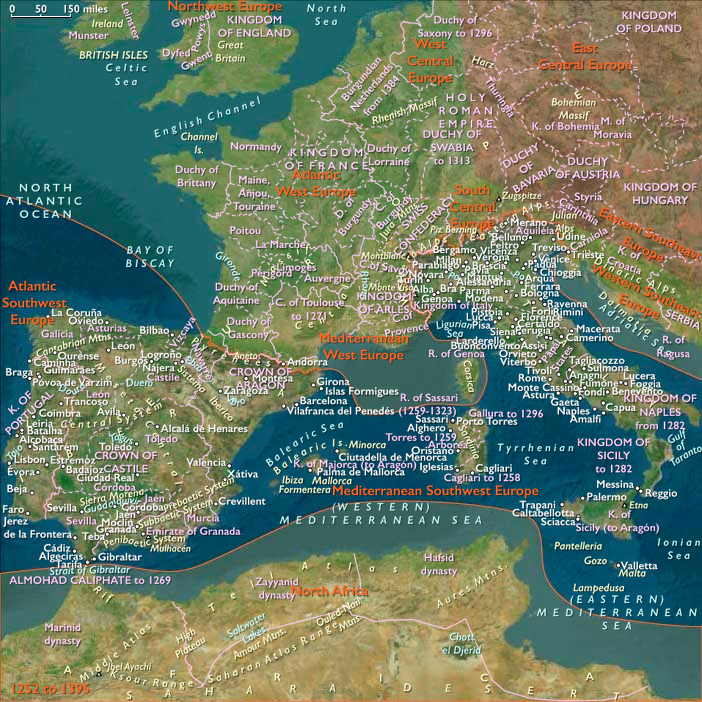
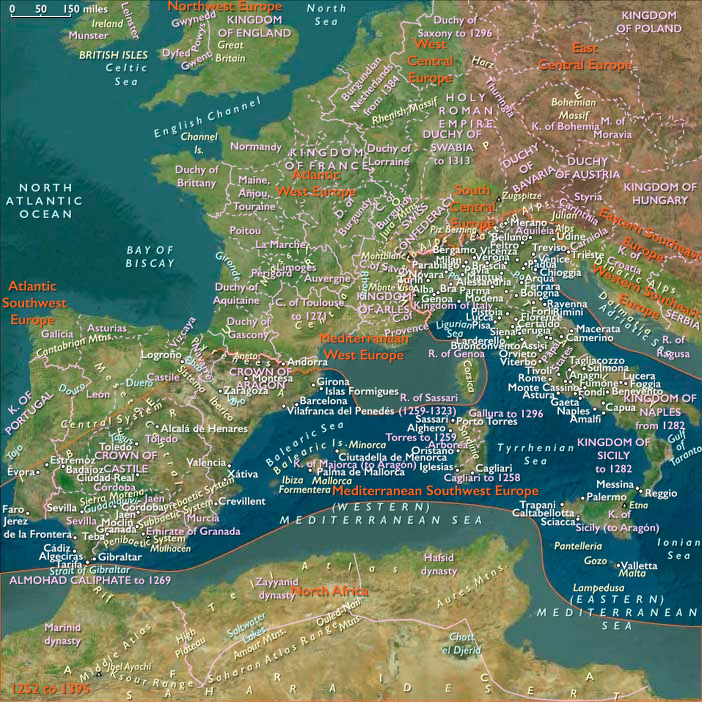
Martini paints a panel, Saint Louis of Toulouse Crowning Robert of Anjou King of Naples, in 1317.
Like his earliest dated work, the colossal Maesta, the Neapolitan panel is characterized by complex and rhythmic linear patterns, sumptuous, glowing color, and the lavish use of gold.
Locations
People
Groups
Topics
Subjects
Regions
Subregions
Related Events
Filter results
Showing 10 events out of 44761 total
As a consequence, the Bishop of Nitra excommunicates him and his followers once again.
The city of Lublin, located about one hundred miles (one hundred and sixty kilometers) southeast of Warsaw and founded in the late ninth century, grows around a twelfth-century castle and is chartered in 1317.
Robert of Clermont and the Foundation of the Bourbon Dynasty (c. 1272–1317)
Robert of Clermont, the sixth son of King Louis IX of France (Saint Louis) and Margaret of Provence, played a pivotal role in establishing the House of Bourbon, which would later become one of the most powerful dynasties in French history.
Marriage and the Bourbon Inheritance
- Around 1272, Robert married Beatrice of Burgundy, the heiress to the Seigneury of Bourbon.
- Through this marriage, he secured the Bourbon lands, laying the foundation for the House of Bourbon.
- Although Bourbon was initially a lordship, it was later elevated to a duchy in 1327, under Robert's son, Louis I, Duke of Bourbon.
Robert of Clermont’s Role in French Politics
- Despite being a prince of royal blood, Robert’s role in French politics was relatively limited, as he was not expected to inherit the throne.
- He was injured at the Battle of Furnes (1297), which left him with mental impairments, preventing him from taking an active role in government.
The Bourbon Dynasty’s Future
- Robert died in 1317, but the House of Bourbon continued through his son, Louis I, who would become the first Duke of Bourbon in 1327.
- The Bourbon dynasty gained increasing prominence over the next two centuries, culminating in the accession of Henry IV in 1589, making the Bourbons the ruling house of France until the French Revolution.
Robert of Clermont’s marriage to Beatrice of Burgundy ensured the rise of the Bourbon dynasty, which would eventually produce some of the most influential monarchs in European history.
The Succession Crisis of 1316–1317 and the Origins of the Salic Law Interpretation
Upon the death of Louis X of France in 1316, his only son, John I, posthumously born on November 15, 1316, became king. However, John lived only a few days, dying on November 19, 1316. His eldest uncle, Philip of Poitiers, had been acting as regent but now saw an opportunity to claim the throne for himself.
Philip V’s Claim and the Exclusion of Joan
- John I’s death created uncertainty, as Louis X had also left behind a daughter, Joan (born in 1312), who by traditional inheritance laws should have succeeded him.
- However, Philip of Poitiers, Louis X’s twenty-three-year-old younger brother, disregarded Joan’s claim, arguing that a woman could not inherit the throne.
- To legitimize his claim, Philip convened an assembly of prominent citizens in 1317, which declared that a woman could not succeed as ruler of France.
- He was crowned Philip V in January 1317, solidifying his rule.
The Establishment of the Male-Only Succession Rule
- Although no formal "Salic Law" (excluding female succession) was yet established, Philip V’s succession set a powerful precedent that later French kings and legal scholars would invoke.
- This principle would be fully codified in the 15th century, but its origins trace back to this 1316–1317 succession crisis.
- The exclusion of Joan of Navarre from the French throne had long-term consequences, particularly in the Hundred Years' War (1337–1453), when England’s Edward III used his maternal descent from Philip IV to justify his claim to the French crown.
Navarre’s Separation from France
- While Philip V successfully secured the French throne, Joan’s exclusion from France's succession did not go unchallenged elsewhere.
- In Navarre, where inheritance laws did allow female succession, Joan’s claim was later recognized, and she became Queen Joan II of Navarre in 1328, effectively separating Navarre from France after nearly thirty years of union.
Legacy
- The events of 1316–1317 shaped the future of French succession law, ensuring that only male heirs could inherit the throne, a rule that remained in force until the end of the monarchy.
- Philip V’s strategic maneuvering prevented the Capetian line from passing through a female heir, securing his family's continuity in power.
- The exclusion of female heirs later became a key point of contention in European dynastic disputes, influencing both internal French politics and international conflicts.
Philip V’s assumption of the throne in 1317 not only determined the immediate succession crisis but also set the foundation for centuries of male-only inheritance in France, ultimately influencing the course of European history.
Chế Nang had led the Chams in rebellion against the Vietnamese on the abdication of Tran Ahn-tong in 1314, but the new Vietnamese king, Tran Minh Tong, dispatches generals Tran Quoc Chan and Pham Ngu Lao in 1318 to defeat Chế Nang, who escaped to Java.
Tran Minh Tong appoints General Chế Anan as the new feudal ruler of Champa, but the general, seeking and obtaining Mongol support to regain Champa’s independence, will battle the Vietnamese to achieve this end.
Epirus has been called Albania since its conquest in the late thirteenth century by Charles d’Anjou, King of Naples.
The kingdom of Albania, a distinct entity from the Kingdom of Naples, has the nature of a military oriented political structure, with the organs of government located in Durrës.
At the head of this governmental body is the captain-general, who has the status of a viceroy.
These persons usually have the title of capitaneus et vicarius generalis and are the head of the army also, while the local forces are commanded by persons who hold the title marescallus in partibus Albaniae.
The royal resources, especially income from salt production and trade, are paid to the thesaurius of Albania.
The port of Durrës and sea trade are essential to the kingdom.
The port is under the command of a prothontius and the Albanian fleet has its own captain.
Other offices are created and function under the authority of the viceroy.
With the attrition of the territory of the kingdom, the persons appointed as captain-generals had begun losing their powers, becoming more like governors of Durrës, than representatives of the king.
The role of local Albanian lords has become increasingly important to the fate of the kingdom, and the Angevins integrate them into their military structure, especially in the second phase of the kingdom.
When Philip of Taranto returned in 1304, one Albanian noble, Gulielm Blinishti, had been appointed head of the Angevin army in the Kingdom of Albania with the title marascallum regnie Albaniae.
He is succeeded in 1318 by Andrea I Muzaka.
Other western titles of nobility are from 1304 on bestowed by the Angevins upon the local Albanian lords.

The Catalan Grand Company occupies the southern districts of Thessaly from 1318; …
…the northern regions remain independent under the ruler Stephen Gabrielopoulos.
Edward the Bruce and his brother Robert had campaigned as far south as Limerick in 1317, but the heavy damage they inflicted has caused them to lose support in Ireland.
Failing to establish strongholds, they and their forces had been pushed back to Ulster by Anglo-Irish forces under Roger de Mortimer, English lord lieutenant.
Robert had returned to Scotland; Edward, emerging from Ulster in 1318, fights Mortimer at Faughard near Dundalk and dies here.