
Martin Luther, born on November 10, 1483, …
Years: 1505 - 1505
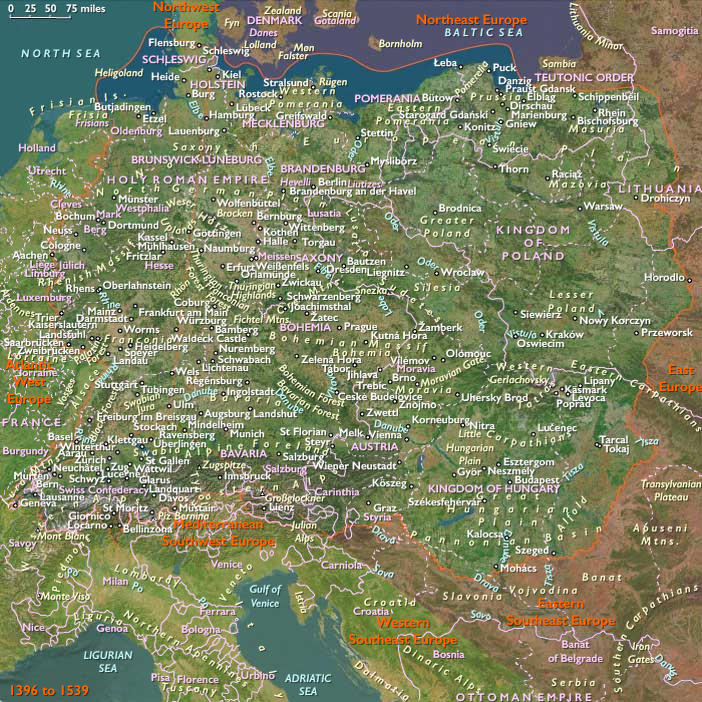
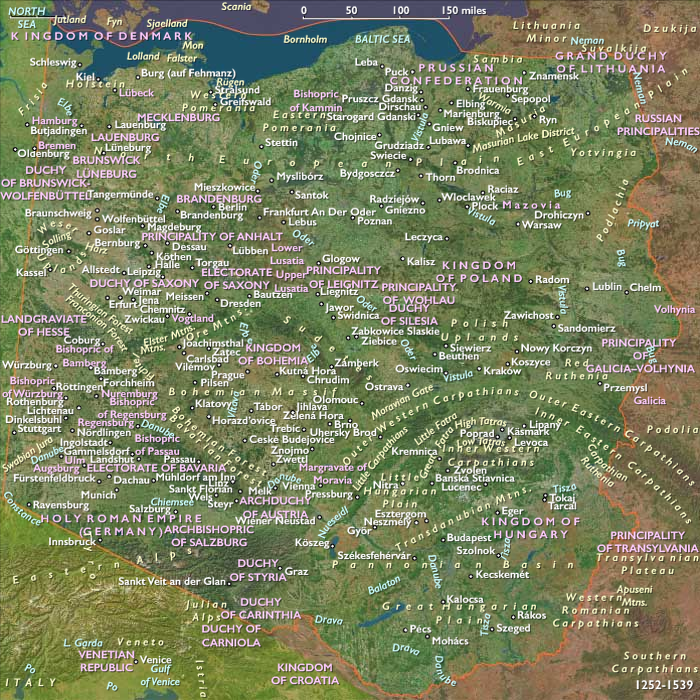
Martin Luther, born on November 10, 1483, at Eisleben to Saxon miner Hans Luder (or Ludher, later Luther)and his wife Margarethe (née Lindemann), had been baptized as a Catholic the next morning on the feast day of St. Martin of Tours.
His family had moved to Mansfeld in 1484, where his father was a leaseholder of copper mines and smelters and served as one of four citizen representatives on the local council.
He has several brothers and sisters, and is known to have been close to one of them, Jacob.
Hans Luther is ambitious for himself and his family, and he is determined to see Martin, his eldest son, become a lawyer.
He had sent Martin to Latin schools in Mansfeld, then Magdeburg in 1497, where he attended a school operated by a lay group called the Brethren of the Common Life, and Eisenach in 1498.
The three schools focused on the so-called "trivium": grammar, rhetoric, and logic.
Luther will later compare his education there to purgatory and hell.
In 1501, at the age of nineteen he entered the University of Erfurt, which he will later describe as a beerhouse and whorehouse; he had received his master's degree in 1505.
Founded in 1392, the University, together with that of Cologne, is one of the first city-owned universities in Germany; they are usually owned by the Landesherren.
The university had quickly became a hotspot of German cultural life in Renaissance humanism with scholars like Ulrich von Hutten, Helius Eobanus Hessus and Justus Jonas.
In accordance with his father's wishes, Luther enrolls in law school at the same university this year but drops out almost immediately, believing that law represents uncertainty.
Seeking assurances about life, Luther is drawn to theology and philosophy, expressing particular interest in Aristotle, William of Ockham, and Gabriel Biel.
He is deeply influenced by two tutors, Bartholomaeus Arnoldi von Usingen and Jodocus Trutfetter, who teach him to be suspicious of even the greatest thinkers and to test everything himself by experience.
Philosophy proves to be unsatisfying, offering assurance about the use of reason but none about loving God, which to Luther is more important.
Reason cannot lead men to God, he feels, and he thereafter develops a love-hate relationship with Aristotle over the latter's emphasis on reason.
For Luther, reason can be used to question men and institutions, but not God.
Human beings can learn about God only through divine revelation, he believes, and Scripture therefore becomes increasingly important to him.
He will later attributed his decision to an event: on July 2, 1505, he is returning to university on horseback after a trip home.
During a thunderstorm, a lightning bolt strikes near him.
Later telling his father he was terrified of death and divine judgment, he cries out, "Help!
Saint Anna, I will become a monk!"
He comes to view his cry for help as a vow he can never break.
He leaves law school, sells his books, and enters a closed Augustinian friary in Erfurt on July 17, 1505.
One friend blames the decision on Luther's sadness over the deaths of two friends.
Luther himself seems saddened by the move.
Those who attend a farewell supper walk him to the door of the Black Cloister.
"This day you see me, and then, not ever again," he said His father is furious over what he sees as a waste of Luther's education.
Luther dedicates himself to the Augustinian order, devoting himself to fasting, long hours in prayer, pilgrimage, and frequent confession.
He will later describe this period of his life as one of deep spiritual despair.
Johann von Staupitz, his superior, points Luther's mind away from continual reflection upon his sins toward the merits of Christ.
He teaches that true repentance does not involve self-inflicted penances and punishments but rather a change of heart.
Locations
People
Groups
- Christians, Roman Catholic
- Augustinians, or Order of St. Augustine
- Saxony, Electorate of
- Holy Roman Empire
Topics
Subjects
Regions
Subregions
Years: 1505 - 1505
Locations
People
Groups
- Christians, Roman Catholic
- Augustinians, or Order of St. Augustine
- Saxony, Electorate of
- Holy Roman Empire
Topics
Subjects
Regions
Subregions