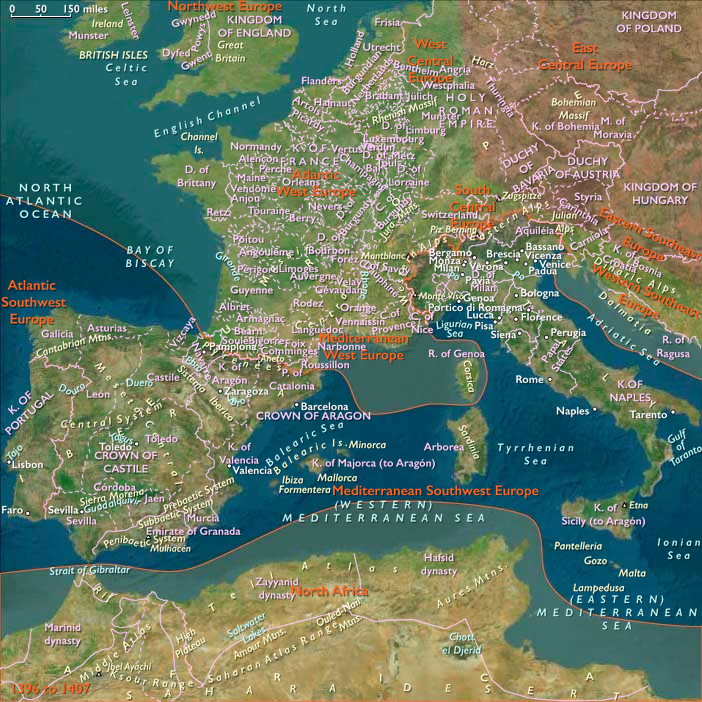
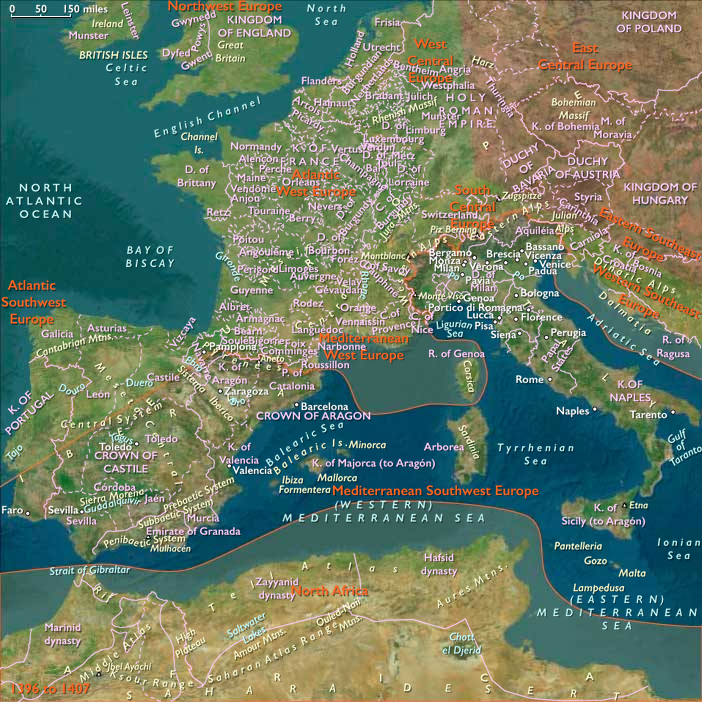
Martin launches crusades against the Moors in …
Years: 1399 - 1399
Martin launches crusades against the Moors in North Africa in 1398 and 1399.
Locations
People
Groups
Topics
Commodoties
Subjects
Regions
Subregions
Related Events
Filter results
Showing 10 events out of 42810 total
Yi Seonggye’s son Yi Gyeong had followed his father to various battlefronts and fought at his side during the latter days of the declining Goryeo Dynasty.
The king’s first wife, who gave birth to six of the king's sons including Yi Gyeong, had died before King Taejo was crowned.
Taejo had gotten two sons by his second wife; he favors his youngest son.
Prime Minister Jeong Dojeon also backs him as the heir apparent, to the great disappointment of the other princes.
In 1398, King Taejo's fifth son, Yi Bangwon, had led a coup staffed by several military officers and killed the queen, her two sons, Prime Minister Jeong, and many of his adherents.
Yi Bangwon, at pains not to be thought of as a usurper, had promoted Yi Gyeong, who is at this point the eldest son, as crown prince.
King Taejo, understandably upset, abdicates in disgust, and Yi Gyeong becomes King Jeongjong in 1399.
The same year, …
…Jeongjong moves the capital back to Kaesong, the old Goryeo capital, where he is believed to have been considerably more comfortable.
Meanwhile, Yi Bangwon, not in the least discouraged by the fact that his elder brother holds the throne, begins plotting to be invested as Royal Prince Successor Brother, the traditional title for brothers appointed as heir-presumptives to the throne when the incumbent has no issue.
However, Yi Bangwon's plans are opposed by Taejo's fourth son Yi Banggan, who also yearns for power.
Bayezid's advances have meanwhile attracted the attention of Timur, who has been building a powerful Tatar empire in Central Asia, Iran, Afghanistan, and Mesopotamia and whose invasion of India in late 1398, though successful, had been halted by his fear of the rising Ottoman power on his western flank.
Timur’s armies had left Delhi in early January 1399.
In April he had returned to his own capital beyond the Oxus (Amu Darya).
Immense quantities of spoils were taken from India.
According to Ruy Gonzáles de Clavijo, ninety captured elephants were employed merely to carry precious stones looted from his conquest, so as to erect a mosque at Samarkand--what historians today believe is the enormous Bibi-Khanym Mosque.
Ironically, the mosque had been constructed too quickly and will suffer greatly from disrepair within a few decades of its construction.
After years of insulting letters have passed between Timur and Bayezid, Timur, encouraged by several Turkmen princes who had fled to his court when their territories were taken by Bayezid, decides to destroy Bayezid's empire before resuming his campaigns in India.
He sets out before the end of 1399 on what is to be his last great expedition, in order to punish the Mamluk sultan of Egypt and the Ottoman sultan Bayezid for their seizures of certain of his territories.
Timur's stated motivation for attacking Bayezid and the Ottoman Empire is the restoration of the authority of the Seljuqs, who Timur sees as the rightful rulers of Anatolia as they had been granted rule by Mongol conquerors, illustrating again Timur's interest with Genghizid legitimacy.
Tokhtamysh will spend the next seven or eight years in hiding in Siberia, before being tracked down and killed by Egidu in 1407 or 1408.
Qutlugh, who in 1398 had begun coining his own money, dies in 1399 in a conflict with Toqtamysh's son during the battle of the Vorskla River, in which Edigu inflicts a crushing defeat on Tokhtamysh and Vytautas of Lithuania, hereby managing to unite under his rule all Jochi's lands, albeit for the last time in history.
Vytautas is barely able to escape alive, while many princes of his kin, possibly twenty or more, die in the battle, including such first cousins as Demetrius I Starszy, Grand Prince of Bryansk, and two brothers of Wladyslaw II Jagiełło.
The victorious Tatars besiege Kiev.
"And the Christian blood had flown like a water, up to the Kievan walls", as one chronicler put it.
After regaining Kievan tribute, …
… Edigu’s Tatars continue a scorched-earth campaign into Poland, pillaging as far west as Luts'k, in pursuit of Tokhtamysh.
Schwarzenberg (Czech: ze Švarcenberka) is the name of a Frankish and Bohemian aristocratic family that had first been mentioned in 1172.
A branch of the Seinsheim family (the non-Schwarzenberg portion eventually died out), the House of Schwarzenberg is created when Erkinger I of Seinshein acquires the Frankish barony of Schwarzenberg, the castle Schwarzenberg and the title Baron of Schwarzenberg, in 14051.
At this time the family also possesses some fiefdoms in Bohemia.
Poland’s King Casimir III had realized that the nation needed a class of educated people, especially lawyers, who could codify the laws and administer the courts and offices in the reunified state.
His efforts to found an institution of higher learning in Poland had been rewarded in 1364, when Pope Urban V granted him permission to open a university—the second oldest university in Central Europe after the University of Prague founded 4 years earlier—but its development had been stalled by the death of the king.
In 1399, the academy is reestablished by King Wladislaus Jagiełło and his wife Jadwiga, who donates all of her personal jewelry to the academy, allowing it to enroll 203 students.
A gentle woman of poor health, the twenty-seven-year-old queen gives birth on June 22 to a daughter, baptized Elżbieta Bonifacja; but within a month both mother and baby are dead from birth complications, leaving the fifty-year-old king sole ruler of Poland and without an heir.
(Jadwiga, soon venerated as a saint in Poland, is today the Patron Saint of queens, and of United Europe.
Known for the first 453 years of its history as the Kraków Academy, it would be renamed the Jagiellonian University in 1817 to commemorate the Jagiellonian dynasty of Polish-Lithuanian kings, in accordance with the Organic Statute issued by the Organisation Commission of the Free City of Kraków established in 1815.
Today ranked by the Times Higher Education Supplement as the best Polish university, it is one of the oldest universities in Europe.)
The difficulties in electing the King of the Germans, or Holy Roman Emperor, had eventually led to the emergence of a fixed college of electors, the Kurfürsten, whose composition and procedures had been set forth in the Golden Bull of 1356.
This development probably best symbolizes the emerging duality between Kaiser und Reich, emperor and realm, which were no longer considered identical.
This is also revealed in the way the post-Hohenstaufen kings attempted to sustain their power.
Earlier, the Empire's strength (and finances) greatly relied on the Empire's own lands, the so-called Reichsgut, which always belonged to the respective king (and included many Imperial Cities).
Its relevance had faded after the thirteenth century (even though some parts of it would remain until the Empire's end in 1806).
Instead, the Reichsgut has been increasingly pawned to local dukes, sometimes to raise money for the Empire but, more frequently, to reward faithful duty or as an attempt to civilize stubborn dukes.
The direct governance of the Reichsgut no longer matches the needs of either the king or the dukes.
Instead, the kings, beginning with Rudolph I of Habsburg, increasingly have relied on the lands of their respective dynasties to support their power.
In contrast with the Reichsgut, which is mostly scattered and difficult to administer, these territories are comparably compact and thus easier to control.
Rudolph I had thus lent Austria and Styria to his own sons in 1282.
The first Holy Roman Emperor since Frederick II had been crowned in 1312 as Henry VII of the House of Luxembourg.
From Henry, all kings and emperors will rely on the lands of their own family (Hausmacht): Louis IV of Wittelsbach (king 1314, emperor 1328–1347) had relied on his lands in Bavaria; Charles IV of Luxembourg, the grandson of Henry VII, had drawn strength from his own lands in Bohemia.
Interestingly, it has thus become increasingly in the king's own interest to strengthen the power of the territories, since the king profits from such a benefit in his own lands as well.
The thirteenth century also had seen a general structural change in how land was administered.
Instead of personal duties, money increasingly had become the common means to represent economic value in agriculture.
Peasants have been increasingly required to pay tribute for their lands.
The concept of "property" has more and more replaced more ancient forms of jurisdiction, although they remain very much tied together.
In the territories (not at the level of the Empire), power has become increasingly bundled: Whoever owns the land has jurisdiction, from which other powers derive.
It is important to note, however, that jurisdiction at this time does not include legislation, which will not exist until well into the fifteenth century.
Court practice heavily relies on traditional customs or rules described as customary.
The territories now begin to transform themselves into predecessors of modern states.
The process varies greatly among the various lands and is most advanced in those territories that are most identical to the lands of the old Germanic tribes, e.g., Bavaria.
It is slower in those scattered territories that have been founded through imperial privileges.
The "constitution" of the Empire is still largely unsettled at the beginning of the fifteenth century.
Although some procedures and institutions have been fixed, for example by the Golden Bull of 1356, the rules of how the king, the electors, and the other dukes should cooperate in the Empire much depends on the personality of the respective king.
At the beginning of this age, the German King (formally King of the Romans), by election in 1376, is Wenceslaus, called the Drunkard.
By inheritance King of Bohemia (as Wenceslaus IV) from 1378, he is the third Bohemian and second German monarch of the House of Luxembourg.
Two days after his election, a quarrel between the duke of Bavaria and the archbishop of Salzburg had given the signal for a general war in Swabia, in which the cities, weakened by their isolation, mutual jealousies and internal conflicts, had organized against the new king.
Defeated by Count Eberhard II at Doffingen (August 24, 1388), the cities had been severally taken and devastated.
Most of them had quietly acquiesced when King Wenceslaus proclaimed an arrangement at Eger in 1389 which prohibited all leagues between cities, whilst confirming the political autonomy of the cities.
This arrangement is to provide a modicum of stability for the next several decades.