
Mark Antony, a member of the Antonia …
Years: 57BCE - 57BCE
Mark Antony, a member of the Antonia clan (gens), is the homonymous and thus presumably the eldest son of Marcus Antonius Creticus (praetor 74 BCE, proconsul 73–71 BCE) and grandson of the noted orator Marcus Antonius (consul 99 BCE, censor 97–6 BCE) who had been murdered during the Marian Terror of the winter of 87–6 BCE.
Antony's father was incompetent and corrupt, and according to Cicero, he was only given power because he was incapable of using or abusing it effectively.
He had in 74 BCE been given imperium infinitum to defeat the pirates of the Mediterranean, but he died in Crete in 71 BCE without making any significant progress.
Creticus had two other sons: Gaius (praetor 44 BCE, born around 83 BCE) and Lucius (quaestor 50 BCE, consul 41 BCE, born around 81 BCE).
Antony's is cousin to Julius Caesar through his mother, Julia, a daughter of Lucius Caesar (consul 90 BCE, censor 89 BCE).
She had married Publius Cornelius Lentulus (consul 71 BCE), an eminent patrician, upon the death of her first husband.
Lentulus, despite exploiting his political success for financial gain, was constantly in debt due to the extravagance of his lifestyle.
He was a major figure in the second Catilinian conspiracy and was extrajudicially killed on the orders of Cicero in 63 BCE.
Antony had lived a dissipate lifestyle as a youth, and gained a reputation for heavy gambling.
According to Cicero, he had a homosexual relationship with Gaius Scribonius Curio.
There is little reliable information on his political activity as a young man, although it is known that he was an associate of Clodius.
He may also have been involved in the Lupercal cult, as he will be referred to as a priest of this order later in life.
Antony in 58 BCE had traveled to Athens to study rhetoric and philosophy, escaping his creditors.
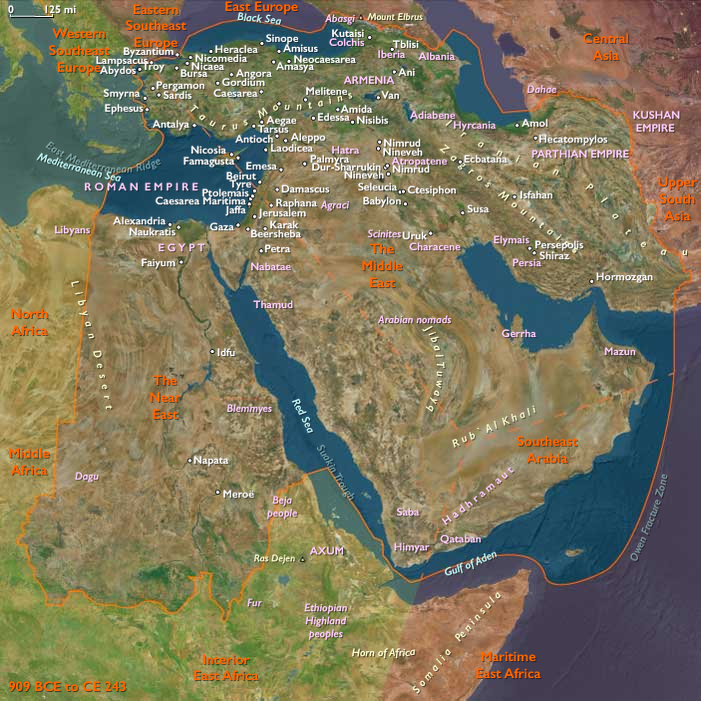
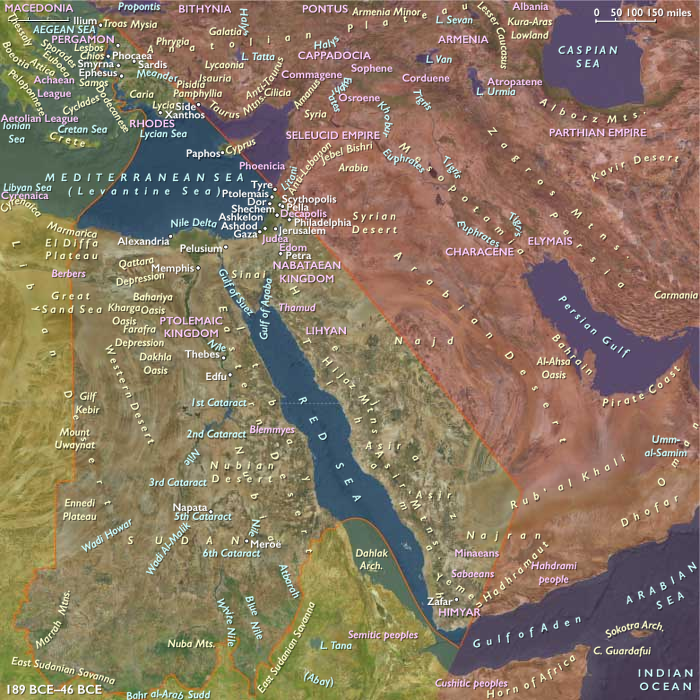
The next year, he is summoned by Pompey's lieutenant Aulus Gabinius, proconsul of Syria, to take part in the campaigns against Aristobulus II in Judea, as the commander of a Gallic cavalry regiment.
On Gabinius’ arrival, he reinstates Hyrcanus in the high-priesthood at Jerusalem, suppresses revolts, introduces important changes in the government of Judaea, and rebuilds several towns.
Antony achieves important victories at Alexandrium and Machaerus.
Locations
People
- Antipater the Idumaean
- Aristobulus II
- Aulus Gabinius
- Gaius Scribonius Curio
- Hyrcanus II
- Julius Caesar
- Mark Antony
- Pompey
- Publius Clodius Pulcher
Groups
Topics
Commodoties
Subjects
Regions
Subregions
Related Events
Showing 10 events out of 62573 total
Years: 57BCE - 57BCE
Locations
People
- Antipater the Idumaean
- Aristobulus II
- Aulus Gabinius
- Gaius Scribonius Curio
- Hyrcanus II
- Julius Caesar
- Mark Antony
- Pompey
- Publius Clodius Pulcher
Groups
Topics
Commodoties
Subjects
Regions
Subregions