
East Asia (909 BCE – 819 CE): …
Years: 909BCE - 819
East Asia (909 BCE – 819 CE): Empires of the Earth and Sea — Dynastic Order, Steppe Frontiers, and the Silk Roads
Regional Overview
From the Yellow River to the Pacific and from the Mongolian steppe to the Tibetan Plateau, East Asia during the first millennium BCE through the early centuries CE was a continent of convergences.
Agrarian states and dynastic empires took root along the river plains, while nomadic confederations and frontier kingdoms moved across the grasslands and highlands that rimmed them.
Maritime and overland corridors—Silk Roads on land, monsoon routes at sea—bound together worlds as different as the Confucian court and the shamanic tent.
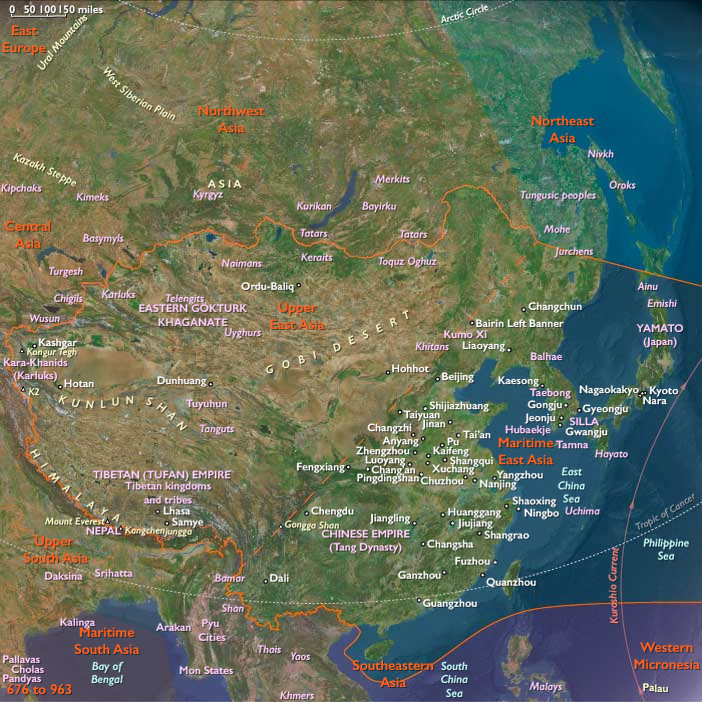
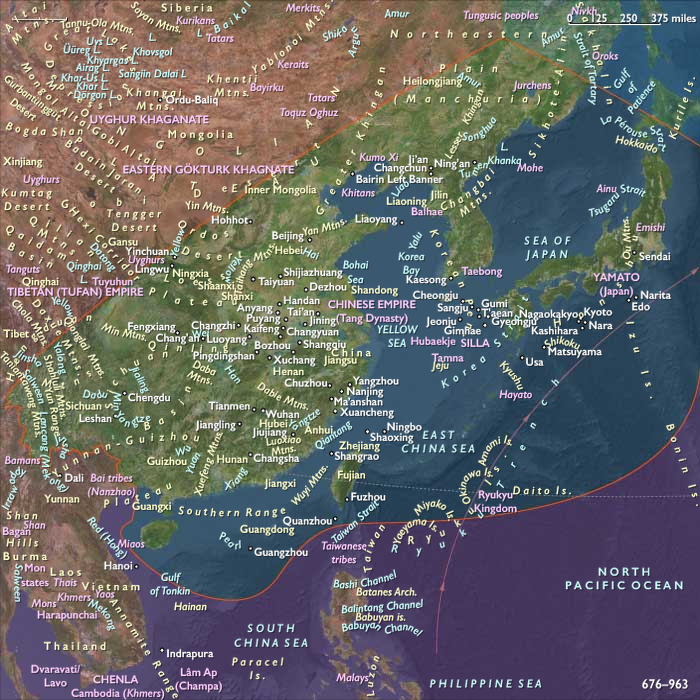
By the early Tang centuries (7th–8th CE), East Asia stood as a fully integrated macro-region, its heartland in the Chinese empires, its limbs stretching across Korea, Japan, and the nomadic and oasis realms of Central and Inner Asia.
Geography and Environment
East Asia straddles four great ecological zones:
-
The riverine basins of the Yellow and Yangtze Rivers, sustaining dense agrarian populations.
-
The steppe–desert belt of Mongolia and northern China, cradle of mounted nomadism.
-
The Himalayan and Tibetan highlands, where pastoralism and Buddhism would later entwine.
-
The maritime rim—Korea, Japan, Taiwan, and the coastal provinces of China—where oceanic and continental influences met.
Climate oscillated between colder, drier pulses and warmer, wetter intervals, influencing both dynastic expansion and steppe migrations.
The East Asian monsoon determined not only crop yields but also trade winds, linking agrarian cycles to navigation across the Yellow, East China, and South China Seas.
Societies and Political Developments
The Agrarian Heartlands
The Zhou dynasty (1046–256 BCE) initiated the feudal order that structured Chinese governance for centuries: hierarchies of lords, bureaucrats, and ritual specialists sustained by agricultural tribute.
Its decline gave rise to the Warring States era, when states such as Qin, Chu, and Zhao transformed warfare, irrigation, and administration.
The Qin dynasty (221–206 BCE) unified the empire under a legalist system, standardizing weights, measures, and the written script.
The Han dynasty (206 BCE–220 CE) institutionalized imperial bureaucracy and expanded agriculture through canal and dike construction, integrating frontier territories from Korea to Yunnan.
Later dynasties—the Three Kingdoms, Jin, and the Northern and Southern Dynasties—continued to compete for the central plain until the Tang (618–907 CE) restored durable unity and cultural brilliance.
The Northern and Western Frontiers
Beyond the Great Wall, nomadic confederations—the Xiongnu, Xianbei, and later the Türkic Khaganates—dominated the steppe.
Their mobility and horse mastery reshaped trade and war; their diplomacy alternated between alliance and incursion.
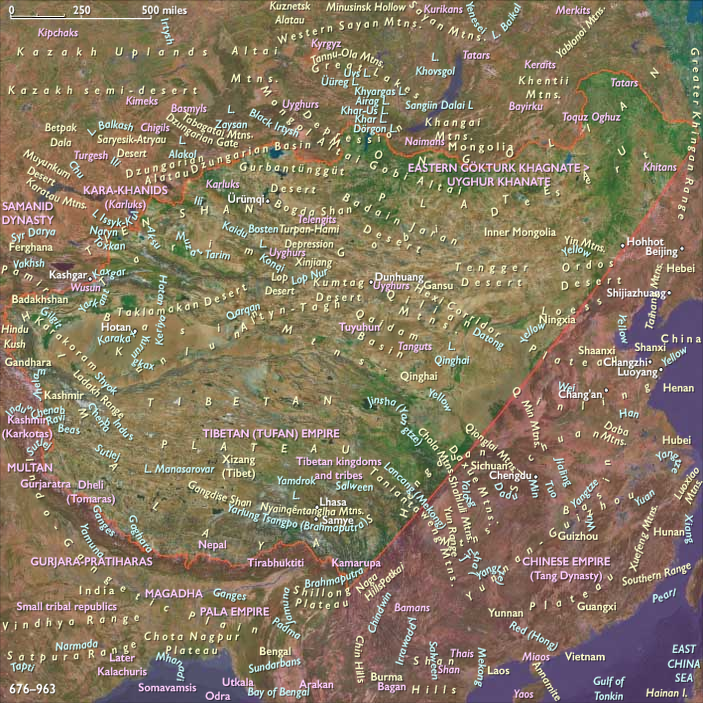
The Tibetan Plateau, unified under the Tubo Empire (7th–9th CE), became a trans-Himalayan power controlling routes to India and Central Asia.
In the Tarim Basin, oasis kingdoms such as Khotan, Turpan, and Kucha flourished as cosmopolitan waypoints on the Silk Road.
The Maritime Rim
Across the seas, Korea evolved through the Gojoseon and Three Kingdoms (Goguryeo, Baekje, Silla), culminating in Silla’s unification of the peninsula in the late 7th century CE.
Japan moved from the agrarian Yayoi period into the Kofun and Asuka ages, adopting writing, Buddhism, and bureaucratic models from the continent.
Taiwan’s Austronesian peoples remained within a maritime network stretching toward the Philippines and Southeast Asia, linking East Asia to the Pacific world.
Economy and Exchange
Agriculture—millet and wheat in the north, rice in the south—formed the imperial base, supported by state-run granaries and canal transport.
Artisan production and trade expanded through both overland and maritime routes:
-
The Silk Road carried textiles, jade, and lacquerware westward, returning with glass, horses, and precious metals.
-
The maritime circuits connected Guangzhou and the lower Yangtze with India, Southeast Asia, and Arabia, foreshadowing the oceanic commerce of later centuries.
Iron plows, blast furnaces, and advanced irrigation sustained population growth.
Urban markets in Chang’an, Luoyang, and coastal ports transformed consumption and social mobility, while border trade with nomads exchanged silk for horses, ensuring both sides’ survival.
Technology and Material Culture
Innovation defined the region:
-
Iron and steel tools revolutionized agriculture and warfare.
-
Papermaking (Han dynasty) and later printing (Tang) reshaped knowledge transmission.
-
Compass prototypes, sternpost rudders, and bulkheaded ships made China’s sailors the engineers of the early world ocean.
-
Bronze and lacquer arts, porcelain experiments, and calligraphy turned everyday materials into expressions of order and beauty.
Steppe metallurgy, Tibetan textiles, and Korean–Japanese bronze mirrors illustrate the dynamic exchange between frontier and heartland.
Belief and Symbolism
East Asia’s spiritual landscape was a triad of Confucian order, Daoist nature, and Buddhist transcendence, each blending with indigenous shamanic and animist traditions.
The Mandate of Heaven linked cosmic harmony to political legitimacy; rulers governed as intermediaries between Earth and Sky.
Buddhism, introduced via Central Asia in the first centuries CE, merged with local pantheons to produce new art, literature, and architecture—from Yungang’s cave temples to Nara’s wooden halls.
In the steppe, sky cults and ancestral rites sanctified mobility and kinship; in the islands, nature spirits, kami, and bodhisattvas intertwined.
Movement and Interaction Corridors
The Silk Road traversed deserts and mountains from Chang’an to Samarkand, distributing goods and ideas.
Parallel steppe corridors linked Mongolia to Eastern Europe, carrying mounted warriors and technologies westward.
The maritime highways—through the Korean Strait, Taiwan Strait, and South China Sea—connected East Asia to Southeast Asia and the Indian Ocean.
Collectively these arteries made the region not an isolated terminus but a circulatory system of the Old World.
Adaptation and Resilience
Environmental and political shocks—floods, nomadic invasions, dynastic collapse—were countered through infrastructural resilience: canals, dikes, and social hierarchies distributed risk.
In frontier zones, mixed economies (pastoral + agrarian) absorbed climate stress.
Maritime redundancy ensured trade continuity even when overland routes faltered.
Cultural syncretism itself became an adaptive strategy: by integrating outside ideas, East Asia renewed rather than ruptured its civilizational fabric.
Regional Synthesis and Long-Term Significance
By 819 CE, East Asia had matured into one of the world’s great civilizational ecosystems—a dynamic equilibrium of empire and frontier, plow and saddle, brush and sail.
Its Maritime sphere (China–Korea–Japan–Taiwan) perfected bureaucratic and technological systems that would radiate outward through the seas, while its Upper sphere (Mongolia–Tibet–Xinjiang) remained the strategic high ground linking China to the heart of Eurasia.
Together they formed a single macro-region defined by circulation: of goods, of peoples, of cosmologies.
Their differences—continental and oceanic, sedentary and nomadic, Confucian and shamanic—were not contradictions but complements.
Thus, the natural division of East Asia into its Maritime and Upper subregions mirrors its very logic: a world balanced between the order of the land and the freedom of the wind.
Groups
- Gojoseon (Choson)
- Austronesian peoples
- Chinese Kingdom, Zhou, or Chou, Western, Dynasty
- Japan, Final Jomon Period
- Qin, (Chinese) state of
- Chinese Kingdom, Zhou, or Chou, Eastern Dynasty
- Confucianists
- Buddhism
- Han, Chinese state of
- Gojoseon (Choson)
- Taoism
- Japan, Yayoi Period
- Qin Dynasty
- Han Dynasty (Western)
- Silla, Kingdom of
- Goguryeo (Koguryo), Kingdom of
- Baekje (or Paekche), Kingdom of
- Goguryeo (Koguryo), Kingdom of
- Japan, Yamato Kofun Period
- Buddhists, Zen or Chán
- Japan, Yamato Early Asuka Period
- Sui Dynasty (Imperial Chinese dynasty)
- Chinese Empire, Tang Dynasty
- Japan, Yamato Hakuho (Late Asuka) Period
- Silla, Unified or Later
- Balhae (Bohai, or Pohai), Kingdom of
- Japan, Nara Period
- Japan, Heian Period
Topics
- Bronze Age China
- Spring and Autumn Period in China
- Iron Age China
- Migration Period
- Migration Period Pessimum
Commodoties
Subjects
- Commerce
- Symbols
- Architecture
- Watercraft
- Painting and Drawing
- Decorative arts
- Conflict
- Faith
- Government
- Custom and Law
- Technology
Regions
Subregions
Years: 909BCE - 819
Groups
- Gojoseon (Choson)
- Austronesian peoples
- Chinese Kingdom, Zhou, or Chou, Western, Dynasty
- Japan, Final Jomon Period
- Qin, (Chinese) state of
- Chinese Kingdom, Zhou, or Chou, Eastern Dynasty
- Confucianists
- Buddhism
- Han, Chinese state of
- Gojoseon (Choson)
- Taoism
- Japan, Yayoi Period
- Qin Dynasty
- Han Dynasty (Western)
- Silla, Kingdom of
- Goguryeo (Koguryo), Kingdom of
- Baekje (or Paekche), Kingdom of
- Goguryeo (Koguryo), Kingdom of
- Japan, Yamato Kofun Period
- Buddhists, Zen or Chán
- Japan, Yamato Early Asuka Period
- Sui Dynasty (Imperial Chinese dynasty)
- Chinese Empire, Tang Dynasty
- Japan, Yamato Hakuho (Late Asuka) Period
- Silla, Unified or Later
- Balhae (Bohai, or Pohai), Kingdom of
- Japan, Nara Period
- Japan, Heian Period
Topics
- Bronze Age China
- Spring and Autumn Period in China
- Iron Age China
- Migration Period
- Migration Period Pessimum
Commodoties
Subjects
- Commerce
- Symbols
- Architecture
- Watercraft
- Painting and Drawing
- Decorative arts
- Conflict
- Faith
- Government
- Custom and Law
- Technology
Regions
Subregions