
Maritime East Asia (2637 – 910 BCE): …
Years: 2637BCE - 910BCE
Maritime East Asia (2637 – 910 BCE): River Valleys, Coastal Plains, and Early States
Geographic and Environmental Context
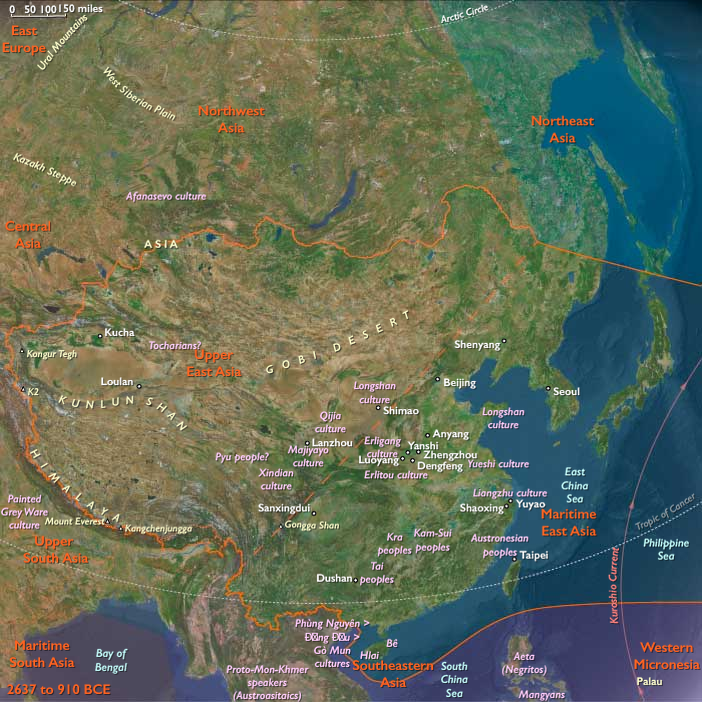
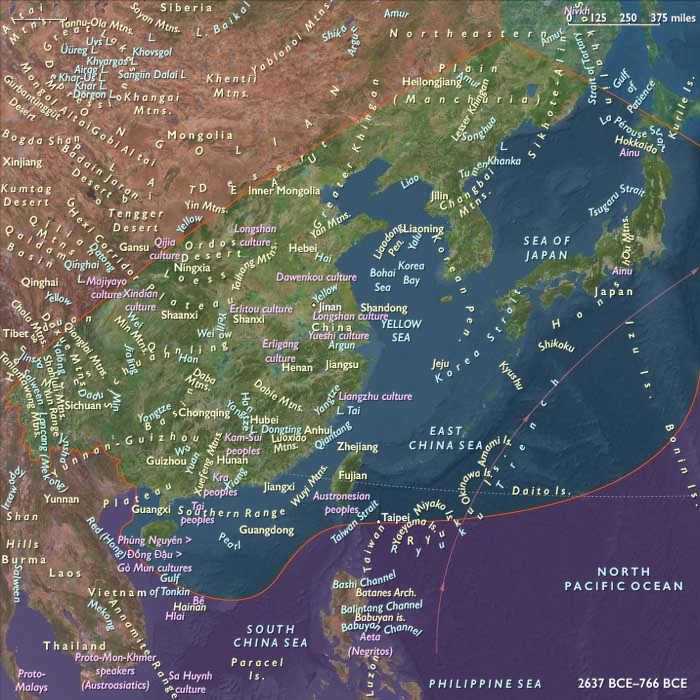
Martitime East Asia—including eastern China, Taiwan, the Korean Peninsula, and Japan—was anchored by fertile river basins such as the Yellow River and Yangtze River, alongside extensive coastal plains and sheltered inland seas. The Bohai Gulf, East China Sea, and Sea of Japan created maritime corridors, while inland mountain ranges like the Qinling and Taebaek defined cultural and ecological boundaries. The climate ranged from temperate in the north to subtropical in the south, fostering diverse agricultural systems.
Agriculture and Early Civilizations
By the mid–third millennium BCE, the north’s Yellow River basin supported millet and wheat farming, while the Yangtze basin cultivated rice in sophisticated paddy systems. These agricultural foundations sustained some of East Asia’s earliest complex societies.
-
In the Yellow River region, the late Longshan culture (c. 3000–1900 BCE) developed rammed-earth walled towns, elaborate pottery, and social stratification, laying the groundwork for the emergence of the Erlitou cultur e(c. 1900–1500 BCE), often identified with the semi-legendary Xia dynasty.
-
The Shang dynasty (c. 1600–1046 BCE) established one of the first fully documented states in East Asia, with urban centers, palatial compounds, and control over large territories through networks of allied and subordinate polities.
-
In the Yangtze basin, complex cultures such as Liangzhu (before c. 2300 BCE) and its successors specialized in jade production, hydrological engineering, and ceremonial centers.
Technological and Cultural Developments
Bronze metallurgy flourished under the Shang, producing ritual vessels, weapons, and chariot fittings of extraordinary skill. Oracle bone script emerged as the earliest known form of Chinese writing, used for divination and state record-keeping. Jade carving traditions—especially in Liangzhu-descended communities—produced bi disks and cong tubes, objects central to ritual and elite identity.
In Korea, the Mumun period (c. 1500–300 BCE) introduced intensive agriculture, large-scale dolmens, and bronze weaponry. In Japan, the Jōmon culture maintained a hunter-fisher-gatherer economy with some plant cultivation, producing highly distinctive cord-marked pottery and shell middens that attest to rich coastal subsistence.
Maritime Networks and Exchange
Coastal and riverine transport tied together communities across Lower East Asia. The Yangtze Deltaacted as a hub for trade in jade, ceramics, and textiles, while the Shandong Peninsula facilitated contact between northern China and the Korean Peninsula. Early seafaring along the East China Sea connected mainland cultures with Taiwan and the Ryukyu Islands, moving nephrite jade, shell ornaments, and possibly agricultural crops.
Cultural and Symbolic Expressions
In the north, Shang ritual life centered on ancestor worship, with elaborate bronze vessels used in feasts and sacrifices. In the south, water-focused cosmologies and earth–sky symbolism infused jade artistry and ceremonial landscapes. Across Korea and Japan, monumental burial sites—dolmens in Korea, shell mounds in Japan—served as both funerary monuments and markers of social memory.
Environmental Adaptation and Resilience
Communities engineered river levees, paddy fields, and irrigation channels to manage seasonal flooding and droughts. Coastal fishing villages diversified diets with shellfish, seaweed, and marine fish, buffering agricultural shortfalls. In Korea and Japan, seasonal resource scheduling allowed balanced exploitation of marine and terrestrial environments.
Transition to the Early First Millennium BCE
By 910 BCE, Martitime East Asia was a region of dynamic cultural interaction and technological sophistication. In China, the Shang state’s political, economic, and ritual systems set precedents for later dynasties, while in Korea and Japan, evolving agricultural and maritime traditions created the foundations for complex societies that would integrate more fully into continental networks in the centuries ahead.
People
Groups
- Liangzhu culture
- Longshan culture
- China, archaic (Three Sovereigns and Five Emperors)
- Gojoseon (Choson)
- Sanxingdui culture
- Erlitou culture
- Chinese Kingdom, Shang Dynasty
- Chinese Kingdom, Zhou, or Chou, Western, Dynasty
Topics
Commodoties
Subjects
- Commerce
- Watercraft
- Painting and Drawing
- Labor and Service
- Decorative arts
- Government
- Custom and Law
- Technology
- Invention
- Astronomy
Regions
Subregions
Related Events
Showing 10 events out of 186 total
Years: 2637BCE - 910BCE
People
Groups
- Liangzhu culture
- Longshan culture
- China, archaic (Three Sovereigns and Five Emperors)
- Gojoseon (Choson)
- Sanxingdui culture
- Erlitou culture
- Chinese Kingdom, Shang Dynasty
- Chinese Kingdom, Zhou, or Chou, Western, Dynasty
Topics
Commodoties
Subjects
- Commerce
- Watercraft
- Painting and Drawing
- Labor and Service
- Decorative arts
- Government
- Custom and Law
- Technology
- Invention
- Astronomy
Regions
Subregions