
Maritime East Africa (1828–1971 CE): Clove Empires, …
Years: 1828 - 1971
Maritime East Africa (1828–1971 CE): Clove Empires, Colonial Partition, and Island Independence
Geographic & Environmental Context
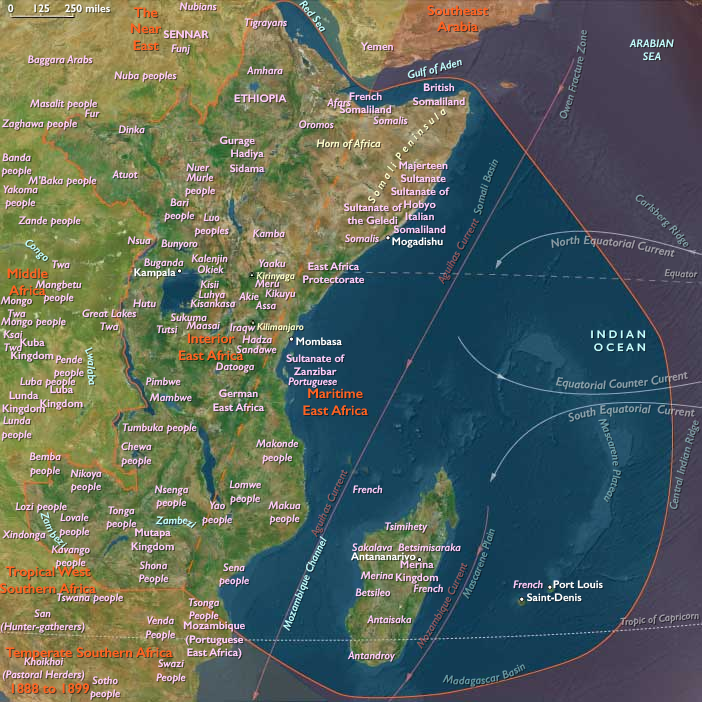
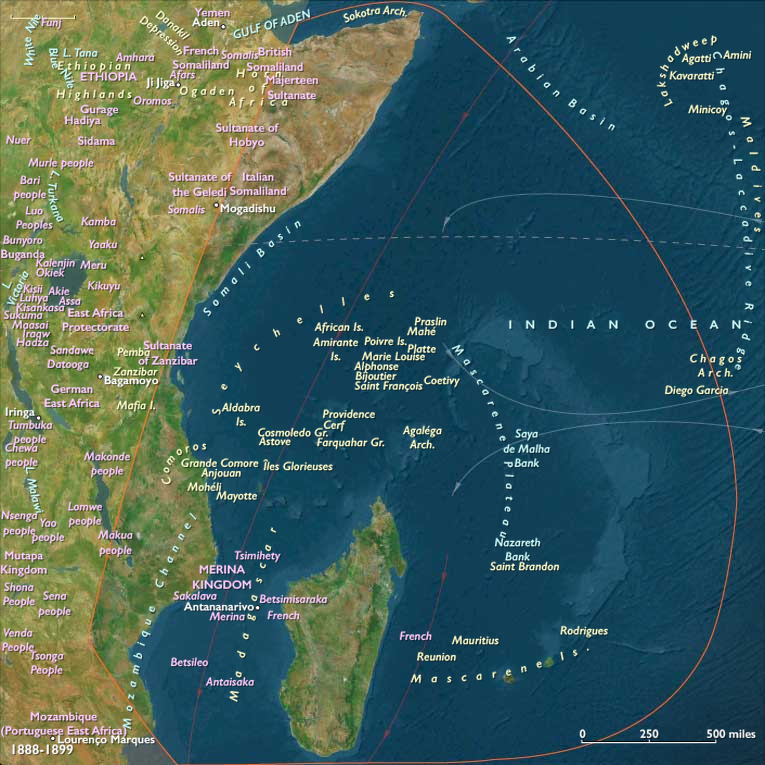
The subregion of Maritime East Africa includes Somalia, eastern Ethiopia, eastern Kenya, eastern Tanzania and its islands, northern Mozambique, the Comoros, Madagascar, Mauritius, and Seychelles. Anchors included the Swahili ports of Zanzibar, Mombasa, and Mogadishu; the clove plantations of Zanzibar and Pemba; the rice terraces of the Merina highlands in Madagascar; and the sugar estates of Mauritius and Seychelles. From coral rag coasts and mangrove estuaries to highland terraces and volcanic islands, this littoral zone became both a hub of global commerce and a theater of European colonization.
Climate & Environmental Shifts
The retreat of the Little Ice Age brought warming trends, though coastal and island regions continued to experience cyclones and drought cycles. Zanzibar endured periodic clove crop failures from pests and storms. Madagascar’s south suffered recurrent drought, while highland rice fields stabilized production. Mauritius and Seychelles faced hurricanes that devastated sugar and coconut crops. Coastal fisheries remained resilient but faced pressure from expanding populations and trade.
Subsistence & Settlement
-
Zanzibar and Pemba: Became global centers of clove cultivation under Omani sultans, relying on enslaved Africans from the mainland. Rice, cassava, and coconuts sustained islanders; fishing and trade supplemented diets.
-
Swahili coast (Kenya–Tanzania–Mozambique): Farmers grew millet, cassava, and maize in coastal hinterlands; fishing and mangrove harvesting persisted. Towns expanded around ports linked to Indian Ocean trade.
-
Somalia and eastern Ethiopia: Pastoralists herded camels, sheep, and goats, supplementing with sorghum and date cultivation in oases.
-
Madagascar: The Merina kingdom centralized power under Radama I and successors, expanding rice terraces and cattle herding; coastal groups (Sakalava, Betsimisaraka) farmed, fished, and engaged in maritime trade.
-
Comoros: Mixed subsistence of rice, cassava, coconuts, and fishing; cloves planted in the 19th century tied islands into world markets.
-
Mauritius and Seychelles: Sugar estates dominated, worked by enslaved laborers until emancipation (1830s–1840s) and later Indian indentured migrants; coconuts and spices diversified production.
Technology & Material Culture
Omani rulers built stone palaces, forts, and clove-processing houses in Zanzibar. Dhows remained central for Indian Ocean trade, carrying cloves, ivory, and slaves. Imported firearms armed coastal elites. In Madagascar, Merina kings constructed fortified hill capitals and expanded irrigation systems. French colonists introduced European-style architecture and mills in Madagascar, Comoros, Mauritius, and Seychelles. Textiles, pottery, and coral-stone mosques continued Swahili traditions; in the Mascarenes, creole architecture and music blended African, European, and Indian influences.
Movement & Interaction Corridors
-
Slave and ivory trade: In the early 19th century, dhows carried enslaved Africans from mainland ports (Bagamoyo, Kilwa, Mozambique Island) to Zanzibar and beyond; ivory caravans reached deep into the interior.
-
Abolition: Britain pressured Zanzibar into anti-slavery treaties (1822, 1873), though clandestine trade persisted into the late 19th century.
-
Colonial partition: Britain took Kenya, Zanzibar (protectorate, 1890), and Somaliland; Germany claimed Tanganyika; France colonized Madagascar (1896) and the Comoros; Portugal retained Mozambique. Mauritius and Seychelles passed to Britain (1810).
-
Labor migrations: Indian indentured workers moved to Mauritius, Seychelles, and coastal East Africa. African porters staffed ivory and rubber caravans inland.
-
20th-century transport: Railways (Uganda Railway to Mombasa, Tanga line) tied coast to interior; steamships and later air links bound islands to global routes.
Cultural & Symbolic Expressions
Swahili Islamic culture thrived in mosques, Qur’anic schools, and poetry; Omani rule reinforced Arabic scholarship. The Zanzibar court became a symbol of coastal Islamic power. In Madagascar, Merina rulers blended traditional rituals with European-style monarchy until French conquest. Catholic and Protestant missions spread across the coast, Madagascar, and the islands, establishing schools and churches. Creole cultures flourished in Mauritius and Seychelles, expressed in séga music, cuisine, and festivals. Oral traditions, ancestor veneration, and ritual feasts persisted across the subregion.
Environmental Adaptation & Resilience
Farmers incorporated cassava, maize, and cloves to buffer crop failures. Pastoralists shifted herds seasonally in Somali and Ethiopian lowlands. Merina highlanders expanded rice terraces, securing resilience against famine. After emancipation, plantation societies adapted through indentured labor systems. Coastal and islanders rebuilt after cyclones, diversifying crops and relying on fishing. Conservation initiatives began mid-20th century, especially in Madagascar’s forests and island ecosystems.
Technology & Power Shifts (Conflict Dynamics)
-
Omani Zanzibar: Under Said bin Sultan, Zanzibar became a clove empire and slave entrepôt; later sultans governed under British oversight.
-
Colonial conquest: France subdued Madagascar (1896); Germany ruled Tanganyika until World War I, when Britain assumed control. Somalia was partitioned between Britain, Italy, and France. Portugal tightened rule in Mozambique.
-
Resistance: Local revolts resisted colonial demands—e.g., Maji Maji Rebellion (1905–1907) in German East Africa. Malagasy uprisings (1947) challenged French rule.
-
Independence movements: Mauritius (1968), Somalia (1960), Madagascar (1960), Comoros (1975, just beyond this span), and Seychelles (1976, also just beyond) emerged from decolonization. Zanzibar’s revolution (1964) overthrew the sultanate, uniting with Tanganyika to form Tanzania.
Transition
By 1971 CE, Maritime East Africa had been transformed from a Swahili–Omani corridor into a mosaic of colonial and postcolonial states. Zanzibar’s clove plantations, Madagascar’s rice highlands, and Mauritius’s sugar estates tied the region to global markets, even as nationalist movements reshaped politics. Swahili culture, Islamic learning, and Malagasy ritual traditions persisted alongside new Christian and creole identities. Maritime East Africa entered the modern era as both a crossroads of global trade and a crucible of independence struggles.
People
- Jomo Kenyatta
- Julius Nyerere
- Philibert Tsiranana
- Radama II
- Rainilaiarivony
- Ranavalona I
- Ranavalona II
- Seewoosagur Ramgoolam
Groups
- Somalis
- Comoro Islands
- Christians, Roman Catholic
- Portuguese Empire
- Portuguese Mozambique
- Anglicans (Episcopal Church of England)
- Merina, Kingdom of
- Angola (Portuguese colony)
- Portugal, Bragança Kingdom of
- London Missionary Society
- United States of America (US, USA) (Washington DC)
- German Empire (“Second Reich”)
- Italy, Kingdom of
- France (French republic); the Third Republic
- British Somaliland
- East Africa, German
- Italian Somaliland
- Zanzibar, (British) Protectorate of
- East Africa, German
- Portuguese East Africa (Moçambique)
- East Africa Protectorate (Kenya)
- French Madagascar
- Seychelles, Crown Colony of the
- Kenya, (British) Protectorate of
- Union of Soviet Socialist Republics (USSR), or Soviet Union
- Tanganyika (territory)
- Britain (United Kingdom of Great Britain and Northern Ireland)
- Somaliland, British Military Administration in
- China, People's Republic of
- Malagasay Republic
- Somalia
- Uganda, Republic of
- Kenya, Republic of
- Tanzania, United Republic of
- Mauritius, Republic of
Topics
Commodoties
Subjects
Regions
Subregions
Related Events
Showing 10 events out of 19829 total
Years: 1828 - 1971
People
- Jomo Kenyatta
- Julius Nyerere
- Philibert Tsiranana
- Radama II
- Rainilaiarivony
- Ranavalona I
- Ranavalona II
- Seewoosagur Ramgoolam
Groups
- Somalis
- Comoro Islands
- Christians, Roman Catholic
- Portuguese Empire
- Portuguese Mozambique
- Anglicans (Episcopal Church of England)
- Merina, Kingdom of
- Angola (Portuguese colony)
- Portugal, Bragança Kingdom of
- London Missionary Society
- United States of America (US, USA) (Washington DC)
- German Empire (“Second Reich”)
- Italy, Kingdom of
- France (French republic); the Third Republic
- British Somaliland
- East Africa, German
- Italian Somaliland
- Zanzibar, (British) Protectorate of
- East Africa, German
- Portuguese East Africa (Moçambique)
- East Africa Protectorate (Kenya)
- French Madagascar
- Seychelles, Crown Colony of the
- Kenya, (British) Protectorate of
- Union of Soviet Socialist Republics (USSR), or Soviet Union
- Tanganyika (territory)
- Britain (United Kingdom of Great Britain and Northern Ireland)
- Somaliland, British Military Administration in
- China, People's Republic of
- Malagasay Republic
- Somalia
- Uganda, Republic of
- Kenya, Republic of
- Tanzania, United Republic of
- Mauritius, Republic of
Topics
Commodoties
Subjects
Regions
Subregions