
Maritime East Africa (1888–1899 CE): Colonial Rivalries, …
Years: 1888 - 1899
Maritime East Africa (1888–1899 CE): Colonial Rivalries, Resistance, and Territorial Transformations
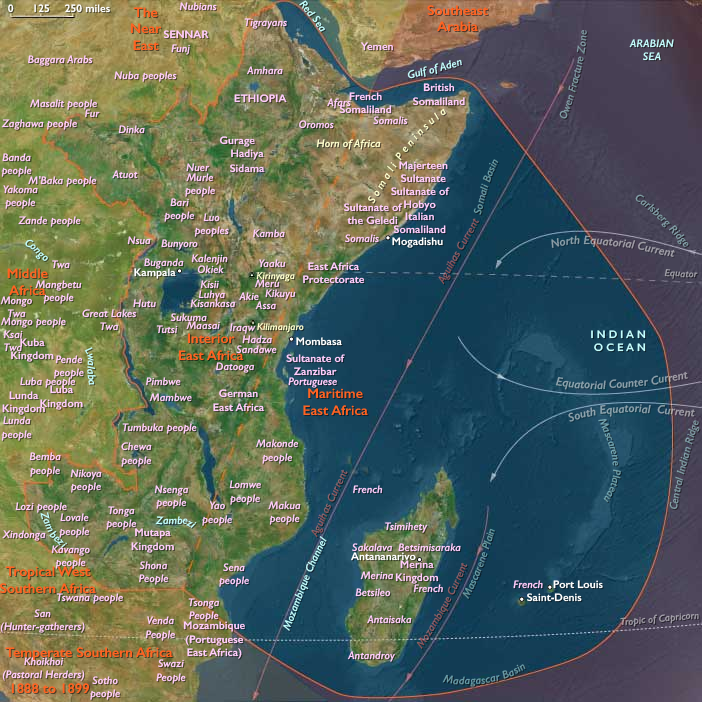
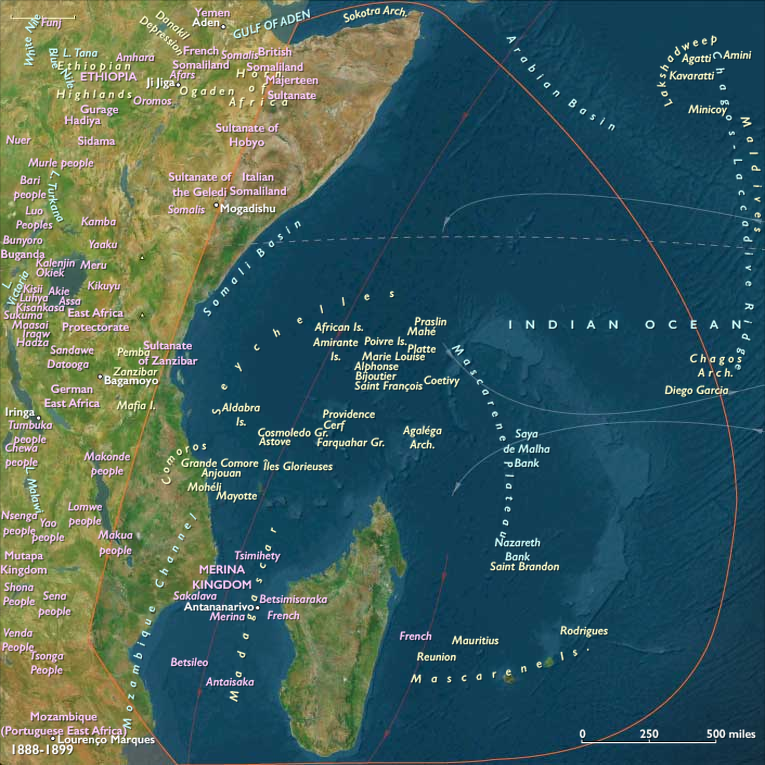
From 1888 to 1899 CE, Maritime East Africa—including the Swahili Coast, Comoros, Madagascar, Mauritius, Seychelles, and Somali coastal cities—undergoes profound changes driven by intensified European colonial ambitions, local resistance movements, and strategic geopolitical rivalries among European powers.
European Colonial Expansion and Rivalries
European powers increasingly seek territorial dominance along the East African coast during this era. The Imperial British East Africa Company establishes its presence in Kenya by 1888, eventually gaining control from Germany, which had earlier asserted influence over coastal possessions of the Sultan of Zanzibar in 1885. The British solidify their position through significant infrastructure projects, notably the construction of the Uganda Railway, attracting a substantial influx of Indian laborers who remain integral to the region’s demographic and economic fabric.
Germany, under Chancellor Otto von Bismarck, expands its reach by establishing the colony of German East Africa in 1885, imposing protectorates through aggressive naval demonstrations. Notable resistance movements against German rule emerge, particularly from the Hehe people, led by Chief Mkwawa, who fiercely resist German colonization between 1891 and 1898, ultimately succumbing due to internal divisions exploited by the Germans.
Madagascar: French Annexation and Resistance
In Madagascar, French colonial ambitions culminate in the declaration of a protectorate over the entire island by 1894. Queen Ranavalona III resists French dominion, triggering violent upheavals and eventually prompting France to forcibly occupy the capital, Antananarivo, in 1895. France officially declares Madagascar a colony in 1896, deporting the queen and imposing strict colonial administration.
Somali Peninsula: Fragmentation and Strategic Interests
The Somali Peninsula experiences strategic partitioning among European and regional powers. Italy, establishing its first footholds in 1888, gradually solidifies its control over southern Somalia, creating Italian Somaliland. Concurrently, Britain consolidates control over northern Somalia (British Somaliland), aiming to safeguard naval interests around Aden. France holds French Somaliland (Djibouti), and Ethiopia, under Emperor Menelik II, extends its influence over the Ogaden, profoundly reshaping regional geopolitics.
Portuguese Efforts and Continued Influence
Portugal renews its territorial ambitions in East Africa, notably attempting expeditions across the continent from Angola to Mozambique. Despite these extensive explorations by figures like Serpa Pinto, Capelo, and Ivens, Portuguese authority struggles to assert full dominance in the hinterlands, though they maintain coastal control, particularly around Mozambique, amidst growing competition from British and German interests.
Comoros: French Protectorates and Internal Fragmentation
The Comoros Islands undergo significant political restructuring under French influence. Protectorate treaties are signed with local rulers in 1886, marking a transitional phase from fragmented independent sultanates towards formal colonial annexation, despite persistent local instability and resistance.
Economic and Social Transformations
Economic activities in the region evolve significantly. Mauritius experiences fluctuations in its sugar economy, while the Seychelles transition to less labor-intensive agriculture after the abolition of slavery, becoming increasingly reliant on imported goods and small-scale trade.
Malawi and Mozambique
In southern Malawi, colonial administration under British control solidifies Blantyre as a critical hub of economic and political activity, further shaped by infrastructural developments and missionary education. Central and northern Mozambique witness aggressive Portuguese colonization, with intensive plantation economies dependent on forced African labor expanding rapidly along the Zambezi River and in coastal settlements such as Beira and Quelimane. Resistance among local communities occasionally erupts, reflecting deep-seated tensions in the region’s colonial experience.
Cultural Resilience and Integration
Throughout this era of colonial encroachment, the Swahili Coast and other regions of Maritime East Africa retain resilient cultural identities, integrating new influences while preserving local customs, languages, and traditions amidst dramatic political and social upheaval.
Legacy of the Era
Between 1888 and 1899 CE, Maritime East Africa witnesses dramatic geopolitical reconfigurations due to European colonial partitioning, vigorous local resistance, and complex economic transitions. These developments establish critical precedents for the region’s twentieth-century trajectories.
People
- Alexandre de Serpa Pinto
- Chief Mkwawa
- Hermenegildo Capelo
- Menelik II
- Otto von Bismarck
- Ranavalona III
- Roberto Ivens
- Yusuf Ali Kenadid
Groups
- Comoro Islands
- Portuguese Empire
- Portuguese Mozambique
- Protestantism
- Merina, Kingdom of
- Angola (Portuguese colony)
- Portugal, Bragança Kingdom of
- Britain (United Kingdom of Great Britain and Ireland)
- Mauritius, British
- Zanzibar, Omani Sultanate of
- France (French republic); the Third Republic
- German Empire (“Second Reich”)
- East Africa, German
- British East Africa Company, Imperial
- Zanzibar, (British) Protectorate of
- East Africa, German
- Nyasaland Districts Protectorate (British)
- Uganda, Protectorate of
- East Africa Protectorate (Kenya)
Topics
Commodoties
Subjects
Regions
Subregions
Related Events
Showing 10 events out of 10660 total
Years: 1888 - 1899
People
- Alexandre de Serpa Pinto
- Chief Mkwawa
- Hermenegildo Capelo
- Menelik II
- Otto von Bismarck
- Ranavalona III
- Roberto Ivens
- Yusuf Ali Kenadid
Groups
- Comoro Islands
- Portuguese Empire
- Portuguese Mozambique
- Protestantism
- Merina, Kingdom of
- Angola (Portuguese colony)
- Portugal, Bragança Kingdom of
- Britain (United Kingdom of Great Britain and Ireland)
- Mauritius, British
- Zanzibar, Omani Sultanate of
- France (French republic); the Third Republic
- German Empire (“Second Reich”)
- East Africa, German
- British East Africa Company, Imperial
- Zanzibar, (British) Protectorate of
- East Africa, German
- Nyasaland Districts Protectorate (British)
- Uganda, Protectorate of
- East Africa Protectorate (Kenya)
Topics
Commodoties
Subjects
Regions
Subregions