
East Africa (1828–1971 CE) Caravans, Kingdoms, …
Years: 1828 - 1971
East Africa (1828–1971 CE)
Caravans, Kingdoms, Empires, and Independence
Geography & Environmental Context
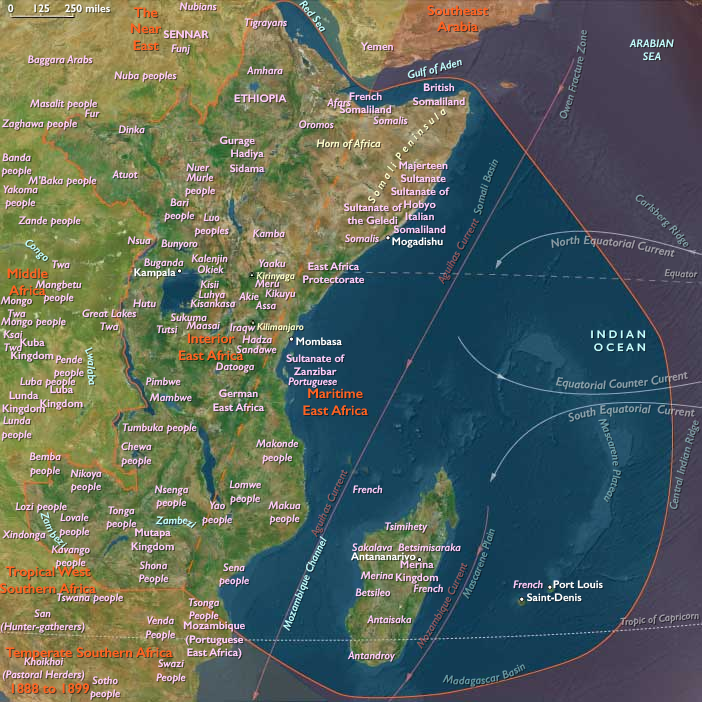
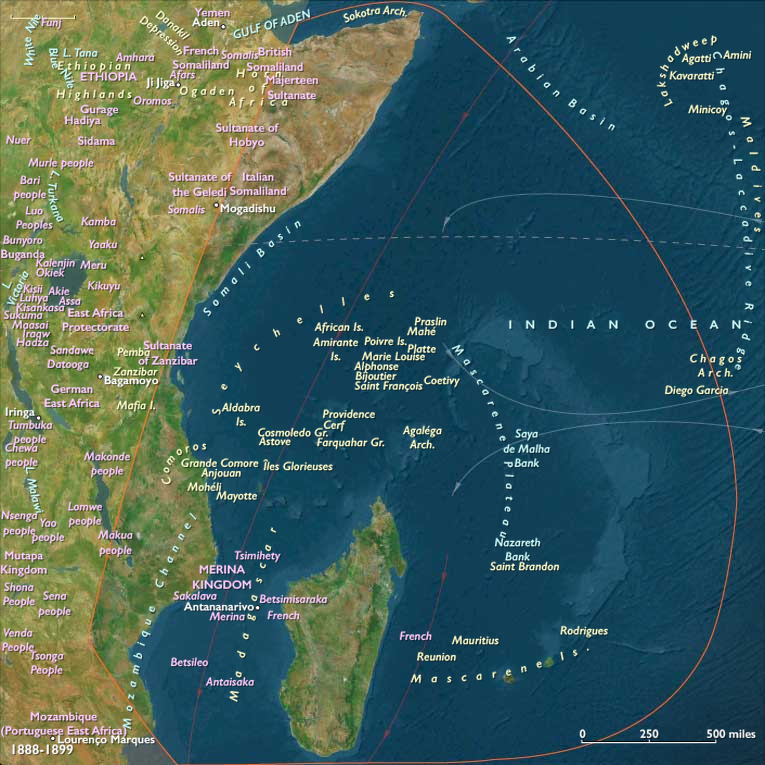
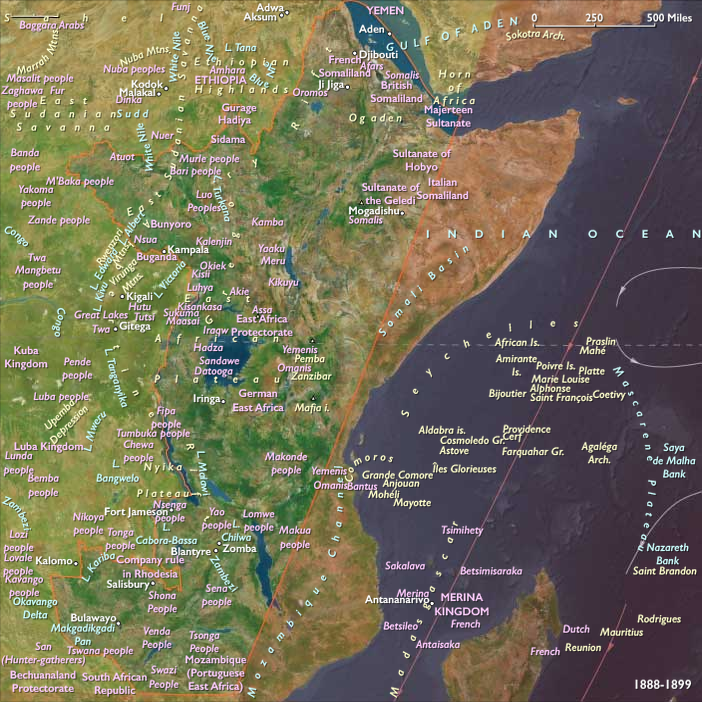
East Africa comprises two fixed subregions:
-
Maritime East Africa — Somalia, eastern Ethiopia, eastern Kenya, eastern Tanzania (including Zanzibar and Pemba), northern Mozambique, southern Malawi, and the island nations of Comoros, Madagascar, Mauritius, and Seychelles.
-
Interior East Africa — Eritrea, Djibouti, Ethiopia, South Sudan, Uganda, Rwanda, Burundi, Zambia’s northwestern margin, northern Zimbabwe, northern Malawi, northwestern Mozambique, inland Tanzania, and inland Kenya.
Anchors include the Great Rift Valley, Lake Victoria, Lake Tanganyika, and Lake Malawi, the Ethiopian Highlands, the Swahili coast, and the Indian Ocean islands. The region stretches from coral coasts and monsoon ports to volcanic highlands and plateau kingdoms.
Climate & Environmental Shifts
Monsoon winds sustained coastal trade, while alternating wet and dry seasons structured inland life. The late 19th century saw famine and rinderpest (1890s) devastate livestock and populations. The 20th century brought ecological engineering—railways, irrigation, and conservation parks—alongside deforestation and soil erosion. Drought cycles recurred in the Horn and interior; locusts and tsetse flies remained persistent threats. Climatic contrasts between humid coasts and arid hinterlands shaped political geography, as highland states and lowland caravan routes competed for control of trade and people.
Subsistence & Settlement
-
Maritime East Africa: Coastal communities combined fishing, coral gardening, and small-scale farming of coconuts, cloves, and grains. On Zanzibar and Pemba, the clove plantations established under Sultan Seyyid Said thrived on enslaved labor. In Madagascar, the Merina Kingdom unified the central highlands and expanded wet-rice farming.
-
Interior East Africa: Highland polities such as Buganda, Bunyoro, and Ethiopia’s Shewa expanded through trade and conquest. Maize and banana cultivation sustained dense populations. After 1890, British, German, and Belgian colonial powers imposed hut taxes and cash-crop systems (cotton, coffee, sisal). Settler estates in Kenya and Tanganyika displaced African farmers; pastoralists adapted by engaging in labor markets or moving into reserves.
Technology & Material Culture
Caravan trade used oxen, donkeys, and later porters to carry ivory and slaves inland to coastal markets. The Uganda Railway (1896–1901) and the Tanga and Central Lines in German East Africa opened the interior to global commerce. Mission presses introduced literacy; railways and telegraphs expanded administration. In the 20th century, imported bicycles, radios, and sewing machines joined local crafts—basketry, textiles, wood carving, and ironwork—forming hybrid material cultures. Coastal stone architecture and carved doors persisted beside new cement towns.
Movement & Interaction Corridors
-
Indian Ocean monsoon routes connected Zanzibar, Mombasa, Lamu, Sofala, Aden, and Bombay; dhows carried people, ivory, slaves, and spices.
-
Caravan routes—notably those of Tippu Tip and Hamed bin Muhammad—linked the interior lakes to the coast.
-
Pilgrimage and diaspora: Muslim scholars traveled to Mecca; Indian, Arab, and Comorian traders settled in coastal cities.
-
Mission and education networks: CMS, White Fathers, and Jesuits spread Christianity, schools, and medical missions inland.
-
War and liberation corridors: WWII troop movements (Abyssinia Campaign, 1940–41), Mau Mau resistance in Kenya (1952–60), and Tanzania’s and Zambia’s postwar support for southern African liberation linked East Africa to wider continental struggles.
Cultural & Symbolic Expressions
The Swahili language and Islamic culture unified coastal societies, while inland oral traditions preserved lineage, cattle, and warrior ideals. Christianity expanded literacy and hymnody; Islam deepened scholarly and mercantile ties. Literature, from Hamitic chronicles to Swahili poetry, blended Arabic script and local forms. In the 20th century, anticolonial writers such as Ngũgĩ wa Thiong’o, Okot p’Bitek, and Julius Nyerere’s political essays articulated new visions of identity. Coastal music (taarab) and inland dances symbolized cultural fusion.
Environmental Adaptation & Resilience
Rotational cultivation and fallowing preserved soil fertility; pastoralists tracked rainfall patterns and rebuilt herds after rinderpest. Irrigation terraces in Ethiopia, banana groves in Buganda, and shifting cultivation in Madagascar reflected ecological diversity. In the 20th century, national parks (e.g., Serengeti, 1951; Tsavo, 1948) institutionalized conservation but often displaced local communities. Rural cooperatives, ujamaa villages, and community irrigation projects (1960s–70s) reflected adaptation to postcolonial development goals.
Political & Military Shocks
-
Colonial conquest: The Scramble for Africa (1880s–90s) divided the region among Britain, Germany, Belgium, France, and Portugal.
-
Ethiopia’s resilience: The Battle of Adwa (1896) preserved Ethiopian independence under Menelik II; Italian invasion (1935–41) under Mussolini was defeated in WWII with Allied support.
-
Resistance and uprisings: The Maji Maji Rebellion (1905–07) in German East Africa, the Hehe resistance, and the Somali Dervish movement (1899–1920) testified to enduring autonomy.
-
World Wars: East Africa was a key front in both conflicts; labor and resources were conscripted for imperial armies.
-
Decolonization:
-
Tanzania (1961), Uganda (1962), Kenya (1963), Malawi (1964), Zambia (1964), and Madagascar (1960) achieved independence.
-
Somalia unified its British and Italian territories (1960); Comoros and Mauritius followed later in the 1970s.
-
Eritrea was federated with Ethiopia (1952) and annexed (1962), sowing seeds of later conflict.
-
Regional federations such as the East African Community (1967) sought economic unity.
-
Transition
Between 1828 and 1971, East Africa transformed from a network of coastal sultanates and caravan kingdoms into a mosaic of colonial states and independent nations. The Swahili coast, once dominated by monsoon commerce and slavery, gave way to global trade in cash crops and labor migration. Inland, Christianity, Islam, and anticolonial nationalism remade political identity. Railways and cash crops reoriented the economy; liberation movements redrew its moral geography. By 1971, East Africa had become a region of independent states—from Ethiopia’s highlands to Madagascar’s forests—poised between the legacies of empire and the aspirations of Pan-African renewal.
People
- Jomo Kenyatta
- Julius Nyerere
- Philibert Tsiranana
- Radama II
- Rainilaiarivony
- Ranavalona I
- Ranavalona II
- Seewoosagur Ramgoolam
Groups
- Somalis
- Comoro Islands
- Christians, Roman Catholic
- Portuguese Empire
- Portuguese Mozambique
- Anglicans (Episcopal Church of England)
- Merina, Kingdom of
- Angola (Portuguese colony)
- Portugal, Bragança Kingdom of
- London Missionary Society
- United States of America (US, USA) (Washington DC)
- German Empire (“Second Reich”)
- Italy, Kingdom of
- France (French republic); the Third Republic
- British Somaliland
- East Africa, German
- Italian Somaliland
- Zanzibar, (British) Protectorate of
- East Africa, German
- Portuguese East Africa (Moçambique)
- East Africa Protectorate (Kenya)
- French Madagascar
- Seychelles, Crown Colony of the
- Kenya, (British) Protectorate of
- Union of Soviet Socialist Republics (USSR), or Soviet Union
- Tanganyika (territory)
- Britain (United Kingdom of Great Britain and Northern Ireland)
- Somaliland, British Military Administration in
- China, People's Republic of
- Malagasay Republic
- Somalia
- Uganda, Republic of
- Kenya, Republic of
- Tanzania, United Republic of
- Mauritius, Republic of
Topics
Commodoties
Subjects
Regions
Subregions
Related Events
Showing 10 events out of 19829 total
Years: 1828 - 1971
People
- Jomo Kenyatta
- Julius Nyerere
- Philibert Tsiranana
- Radama II
- Rainilaiarivony
- Ranavalona I
- Ranavalona II
- Seewoosagur Ramgoolam
Groups
- Somalis
- Comoro Islands
- Christians, Roman Catholic
- Portuguese Empire
- Portuguese Mozambique
- Anglicans (Episcopal Church of England)
- Merina, Kingdom of
- Angola (Portuguese colony)
- Portugal, Bragança Kingdom of
- London Missionary Society
- United States of America (US, USA) (Washington DC)
- German Empire (“Second Reich”)
- Italy, Kingdom of
- France (French republic); the Third Republic
- British Somaliland
- East Africa, German
- Italian Somaliland
- Zanzibar, (British) Protectorate of
- East Africa, German
- Portuguese East Africa (Moçambique)
- East Africa Protectorate (Kenya)
- French Madagascar
- Seychelles, Crown Colony of the
- Kenya, (British) Protectorate of
- Union of Soviet Socialist Republics (USSR), or Soviet Union
- Tanganyika (territory)
- Britain (United Kingdom of Great Britain and Northern Ireland)
- Somaliland, British Military Administration in
- China, People's Republic of
- Malagasay Republic
- Somalia
- Uganda, Republic of
- Kenya, Republic of
- Tanzania, United Republic of
- Mauritius, Republic of
Topics
Commodoties
Subjects
Regions
Subregions