
East Africa (1684–1827 CE) Omani Seas, …
Years: 1684 - 1827
East Africa (1684–1827 CE)
Omani Seas, Highland Courts, and the Caravan Turn
Geography & Environmental Context
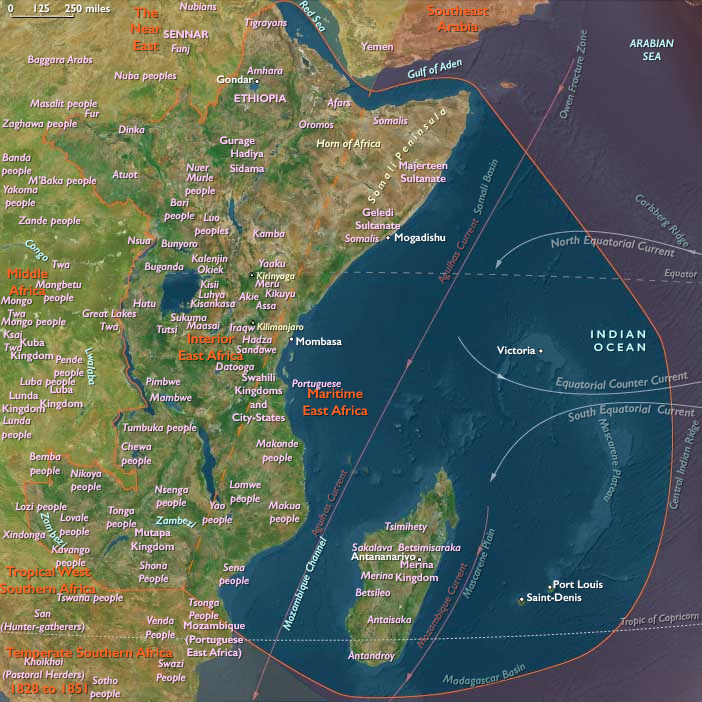
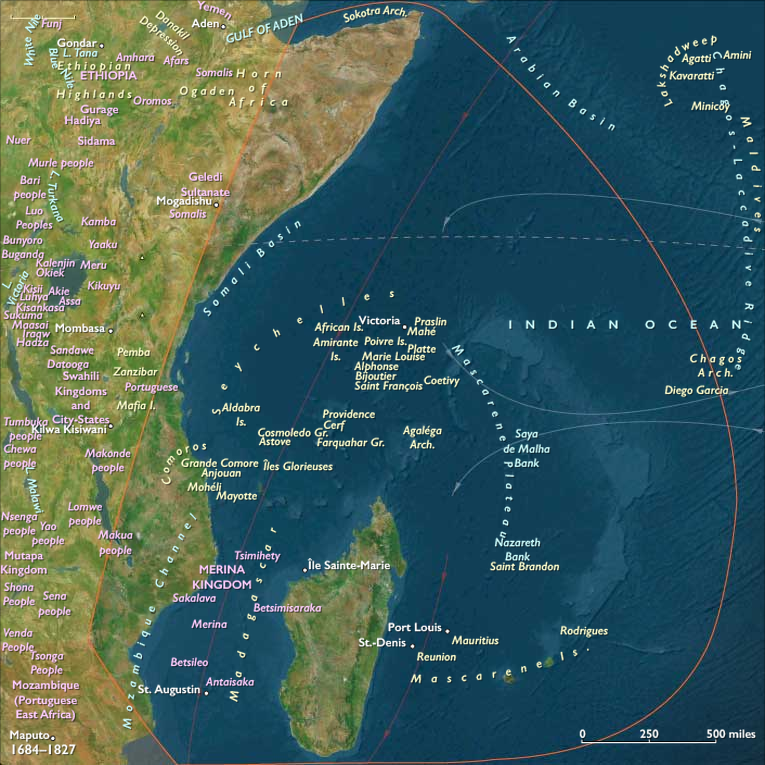
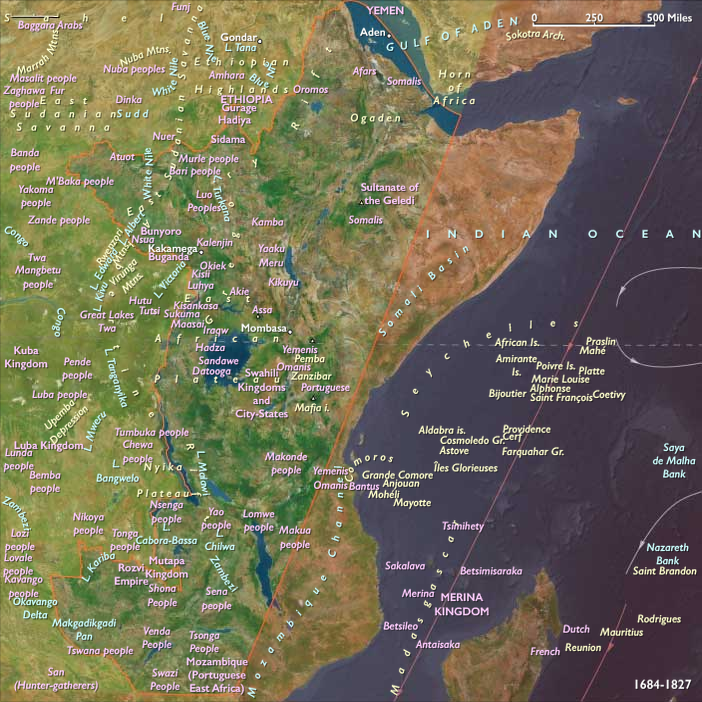
East Africa in this age braided the Indian Ocean littoral—Somalia, eastern Ethiopia/Kenya/Tanzania, northern Mozambique, Comoros, Zanzibar–Pemba, Madagascar, Mauritius, Seychelles—with the interior highlands and lake plateaus—Eritrea/Ethiopia, South Sudan, Uganda, Rwanda, Burundi, inland Kenya/Tanzania, northern Malawi, northwestern Mozambique, Zambia, northern Zimbabwe. Anchors ranged from Swahili port cities(Mogadishu, Mombasa, Kilwa, Sofala, Zanzibar) and island crossroads (Comoros, Mascarenes) to Gondar and the Ethiopian escarpments, the Great Rift lakes (Victoria, Tanganyika, Kivu, Turkana), the inter-lacustrine plateaus, and the savanna woodlands of inland Tanzania and Zambia.
Climate & Environmental Shifts
The waning Little Ice Age brought alternating droughts and floods. Pastoral belts in the Horn suffered grazing crises; cyclones periodically battered Comoros, Mauritius, Seychelles; southern Madagascar swung between famine and recovery while the highlands expanded irrigated rice. Rift-lake levels fluctuated, altering fisheries and lakeshore fields; coastal farmers diversified to cushion rainfall volatility.
Subsistence & Settlement
-
Littoral & islands: Swahili towns remained Islamic mercantile hubs; diets widened with cassava and maize. Zanzibar–Pemba cultivated rice, coconuts, and, in the early 1800s, rapidly expanding clove plantations under Omani rule; Comoros balanced gardens, rice, and fishing; Mauritius/Seychelles developed sugar and copra plantations with enslaved labor.
-
Madagascar: Merina highland consolidation (late 18th–early 19th c.) intensified rice terracing, tribute, and firearms-backed expansion; Sakalava coastal polities sustained cattle, raiding, and slave exports.
-
Highlands & plateaus: Ethiopian/Eritrean terraces produced teff, barley, wheat; church forests and ox-plough agriculture anchored villages. Great Lakes polities (Buganda, Bunyoro, Rwanda, Burundi) rested on banana gardens, sorghum/millet, beans, and cattle, with dense settlement and court redistribution.
-
Savannas & pastoral belts: Sorghum/millet/maize mosaics spread; fishing and hunting remained key; South Sudan–Turkana–Karamoja transhumance tracked pastures and wells.
Technology & Material Culture
-
Oceanic kit: Dhows with lateen sails stitched ports to Arabia/India; coral-stone mosques, carved doors, and merchant houses framed Swahili towns.
-
Highland engineering: Stone terraces, canals, ox traction, and manuscript ateliers at Gondar; royal compounds and muraled churches.
-
Court regalia & crafts: Drums, ivory trumpets, barkcloth and raffia weaving, lake canoes; island sugar mills, Seychellois coconut presses.
-
Arms & imports: Firearms and powder into coastal and Malagasy polities; in the interior, guns followed caravan lines, supplementing spears and shields.
Movement & Interaction Corridors
-
Omani ascendancy: Oman expelled Portugal from Mombasa (1698) and built a coastwise regime centered on Zanzibar, re-routing Indian Ocean commerce.
-
Caravan turn: Ivory and slave caravans from the Tanzania–Mozambique interior converged on Kilwa, Bagamoyo, Zanzibar, Mozambique Island; inland copper and cattle moved along the Zambezi/central Zambian routes.
-
Madagascar–Mascarenes link: Merina and Sakalava exported captives and cattle to the Mascarenes; textiles, beads, and firearms returned.
-
Horn & Red Sea spurs: Ethiopian caravans carried salt, honey, grain to coastal markets when warfare allowed.
-
Lake corridors: Canoe routes on Victoria and Tanganyika fed court capitals and fisheries.
Cultural & Symbolic Expressions
-
Coast & islands: Islamic learning (mosques, madrasas, Arabic-script poetry) flourished under Omanipatronage; plantation societies in the Mascarenes blended French Catholicism, African traditions, and creole forms.
-
Highlands: The Gondarine era left castles and muraled churches; Christian feast calendars, monasteries, and pilgrimage routes ordered time.
-
Great Lakes courts: Regnal drums, sacred groves, and oral epics legitimated kingship; clientship(ubuhake/ubugabire) bound households to lords; rainmaking rituals linked rule to fertility.
-
Pastoral rites: Cattle rituals, age-grades, and clan shrines regulated law and memory.
Environmental Adaptation & Resilience
-
Crop portfolios: Cassava/maize/banana diversification stabilized coastal and savanna diets; highland rice terraces buffered famine.
-
Mobility & storage: Transhumance and widened grazing circuits; dried fish, grain pits, and caravan grain purchases bridged lean years.
-
Rebuilding after storms: Island societies replanted coconuts/rice and repaired harbors; plantation colonies depended on forced labor and imports to absorb shocks.
-
Institutional cushions: Church granaries, court redistribution, waqf and guild charity mitigated crises.
Political & Military Shocks
-
Coastal realignment: Portuguese forts waned as Omani fleets and cannon secured the main ports; Zanzibaremerged as the political–commercial capital.
-
Interior militarization: Merina centralization (c. 1787–1810 →) expanded with firearms; Sakalava raiding persisted. Great Lakes—Buganda pushed lakeward with canoe fleets; Rwanda intensified hill-country tribute; Bunyoro contested supremacy.
-
Slave & ivory booms: Demand from Zanzibar/Mascarenes widened raiding zones in Tanzania, Mozambique, Madagascar; caravan chiefs and coastal patrons gained leverage.
Transition
Between 1684 and 1827, East Africa pivoted from a Portuguese littoral to an Omani oceanic order, while interior kingdoms—from Gondar to Buganda and the Merina highlands—refined statecraft under climatic strain and a growing gun–caravan economy. By the 1820s, Zanzibar orchestrated coastwise trade; Merina hegemony reshaped Madagascar; Great Lakes courts consolidated; and plantation regimes in the Mascarenes took root. The stage was set for the nineteenth-century surge in slave and ivory exports, deeper Indian Ocean entanglement, and, soon after, more direct European intervention.
People
Groups
- Austronesian peoples
- Bantu peoples
- Arab people
- Omanis
- Somalis
- Madagascar
- Nilotic peoples
- Sakalava people
- Merina people
- Swahili people
- Comoro Islands
- Islam
- Antanosy people
- Kilwa Sultanate
- Mecca, Sharifate of
- Ajuran Sultanate
- Merina, Kingdom of
- Mauritius, Dutch
- Oman, Second Imamate of
- Mazrui
- Boina, Sakalava Kingdom of
- Britain, Kingdom of Great
- East India Company, British (United Company of Merchants of England Trading to the East Indies)
- Betsimisaraka confederation
- Oman, Sultanate of
Commodoties
Subjects
Regions
Subregions
Years: 1684 - 1827
People
Groups
- Austronesian peoples
- Bantu peoples
- Arab people
- Omanis
- Somalis
- Madagascar
- Nilotic peoples
- Sakalava people
- Merina people
- Swahili people
- Comoro Islands
- Islam
- Antanosy people
- Kilwa Sultanate
- Mecca, Sharifate of
- Ajuran Sultanate
- Merina, Kingdom of
- Mauritius, Dutch
- Oman, Second Imamate of
- Mazrui
- Boina, Sakalava Kingdom of
- Britain, Kingdom of Great
- East India Company, British (United Company of Merchants of England Trading to the East Indies)
- Betsimisaraka confederation
- Oman, Sultanate of
Commodoties
Subjects
Regions
Subregions