
Maritime East Africa (1540–1683 CE): Portuguese Hegemony, …
Years: 1540 - 1683
Maritime East Africa (1540–1683 CE): Portuguese Hegemony, Swahili Resilience, and Island Societies
Geographic & Environmental Context
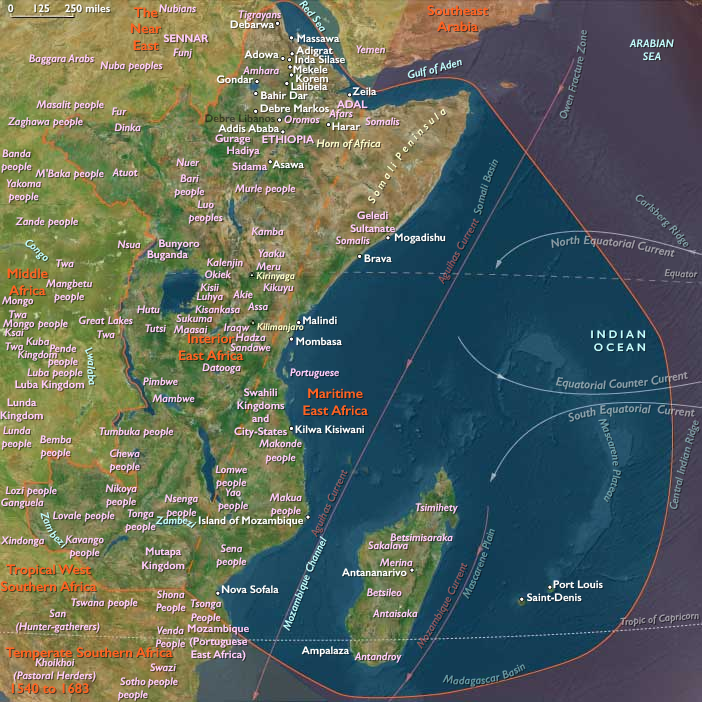
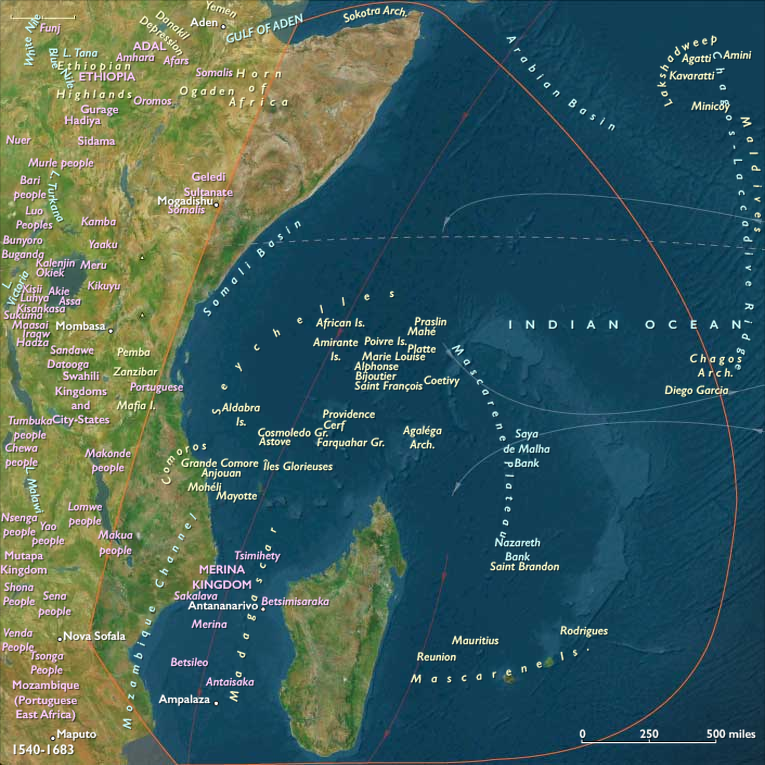
The subregion of Maritime East Africa includes Somalia, eastern Ethiopia, eastern Kenya, eastern Tanzania and its islands, northern Mozambique, the Comoros, Madagascar, Mauritius, and Seychelles. Anchors included the Swahili port cities of Mombasa, Malindi, Kilwa, Sofala, and Mogadishu; the islands of Zanzibar, Pemba, and the Comoros; the coral coasts and mangrove estuaries of the western Indian Ocean; and the highlands and lagoons of Madagascar. Outlying Mauritius and Seychelles remained uninhabited but gained increasing importance as waypoints for long-distance navigation.
Climate & Environmental Shifts
The Little Ice Age continued, with alternating drought and flood cycles shaping Horn pastoralists, coastal rice growers, and Malagasy farmers. Monsoon winds structured maritime travel, while occasional cyclones struck the Comoros, Madagascar, Mauritius, and Seychelles. In Madagascar, multi-year droughts in the south pressured herders and foragers; in wetter highlands, rice terraces expanded.
Subsistence & Settlement
-
Swahili towns: Despite Portuguese domination, urban diets blended rice, millet, coconuts, fish, and imported goods. Hinterland caravans carried ivory, gold, and slaves.
-
Islands (Zanzibar, Pemba, Comoros): Supported coconut, banana, rice, and clove orchards (cloves introduced later but initial spice planting underway). Fishing and inter-island trade thrived.
-
Madagascar: Highlanders expanded rice terraces; coastal Sakalava states consolidated cattle-based economies and coastal raiding. Cattle remained both subsistence and symbolic wealth.
-
Mauritius and Seychelles: Still uninhabited, but Portuguese sailors occasionally landed for water, wood, and tortoises.
Technology & Material Culture
Portuguese introduced stone fortresses, cannon, and the cartaz system (ship passes). They repaired or rebuilt coral-stone mosques and warehouses at captured ports. Dhows with lateen sails remained the main local shipping craft. Imported textiles, beads, and firearms circulated inland. In Madagascar, iron spearheads, canoes, and rice terracing technologies defined everyday life, while cattle corrals and tomb monuments embodied ritual prestige.
Movement & Interaction Corridors
-
Portuguese Estado da Índia: Controlled Sofala, Mozambique Island, Kilwa, Mombasa, and other key ports; naval patrols enforced the cartaz.
-
Caravan routes: Continued to funnel ivory and captives from inland Tanzania, Mozambique, and Kenya to ports.
-
Madagascar: Exported cattle, rice, and slaves to the Comoros and Swahili coast. Sakalava states on the west coast became regional powers in these circuits.
-
Comoros: Served as provisioning stations for Portuguese and other sailors, trading coconuts, rice, and captives.
-
Mauritius and Seychelles: Functioned as landmarks for pilots, charted by Europeans but not yet settled.
Cultural & Symbolic Expressions
Swahili culture remained vibrantly Islamic, expressed in coral-stone mosques, Arabic-script chronicles, and courtly poetry. Portuguese Catholic missions introduced chapels and crosses but converted few beyond elites. On Madagascar, ancestor veneration through tomb construction, cattle sacrifices, and spirit mediums remained central. In the Comoros, Islamic festivals and dhikr ceremonies structured community time. Imported ceramics and cloth symbolized coastal elites’ prestige.
Environmental Adaptation & Resilience
Coastal farmers adapted to Portuguese disruption by diversifying crops, planting cassava (introduced mid-period), and relying on fishing. Malagasy highlanders expanded irrigated rice to buffer famine; Sakalava herders redistributed cattle after drought losses. Comorian islanders mixed gardens, fishing, and inter-island trade to withstand cyclones. Communities used ritual feasts, kin networks, and reciprocal trade to absorb climatic and political shocks.
Technology & Power Shifts (Conflict Dynamics)
Portuguese cannon and forts disrupted Swahili autonomy. Mombasa’s repeated sackings, Kilwa’s decline, and Sofala’s capture reoriented Indian Ocean trade toward Lisbon. Yet Swahili merchants adapted, sustaining inland ties and clandestine routes beyond Portuguese control. In Madagascar, Sakalava dynasties expanded through cattle wealth and maritime raiding. Coastal skirmishes continued between Portuguese fleets and local towns; resistance occasionally ousted Portuguese garrisons, revealing the fragility of European dominance.
Transition
By 1683 CE, Maritime East Africa had become a hybrid world. Portuguese forts and patrols dotted the coast, but Swahili towns retained vitality through inland trade and cultural continuity. Sakalava polities on Madagascar expanded their reach; Comoros balanced subsistence with regional trade; Mauritius and Seychelles stood uninhabited but charted. The Indian Ocean world was reshaped—no longer solely Swahili-Arabian, but not yet wholly European-controlled.
People
Groups
- Khoisan
- Austronesian peoples
- Bantu peoples
- Arab people
- Omanis
- Somalis
- Madagascar
- Nilotic peoples
- Persian Empire, Sassanid, or Sasanid
- Dutch people
- Merina people
- Swahili people
- Comoro Islands
- Islam
- Antanosy people
- Kilwa Sultanate
- Mecca, Sharifate of
- Ajuran Sultanate
- Portugal, Avizan (Joannine) Kingdom of
- Ottoman Empire
- Merina, Kingdom of
- Netherlands, United Provinces of the (Dutch Republic)
- France, (Bourbon) Kingdom of
- Mauritius, Dutch
Topics
- Colonization of Asia, Portuguese
- Colonization of Asia, Dutch
- Colonization of Asia, French
- Fort Dauphin, Massacre of
Commodoties
Subjects
Regions
Subregions
Related Events
Showing 10 events out of 37475 total
Years: 1540 - 1683
People
Groups
- Khoisan
- Austronesian peoples
- Bantu peoples
- Arab people
- Omanis
- Somalis
- Madagascar
- Nilotic peoples
- Persian Empire, Sassanid, or Sasanid
- Dutch people
- Merina people
- Swahili people
- Comoro Islands
- Islam
- Antanosy people
- Kilwa Sultanate
- Mecca, Sharifate of
- Ajuran Sultanate
- Portugal, Avizan (Joannine) Kingdom of
- Ottoman Empire
- Merina, Kingdom of
- Netherlands, United Provinces of the (Dutch Republic)
- France, (Bourbon) Kingdom of
- Mauritius, Dutch
Topics
- Colonization of Asia, Portuguese
- Colonization of Asia, Dutch
- Colonization of Asia, French
- Fort Dauphin, Massacre of
Commodoties
Subjects
Regions
Subregions