
Margat is located on a hill formed …
Years: 1285 - 1285
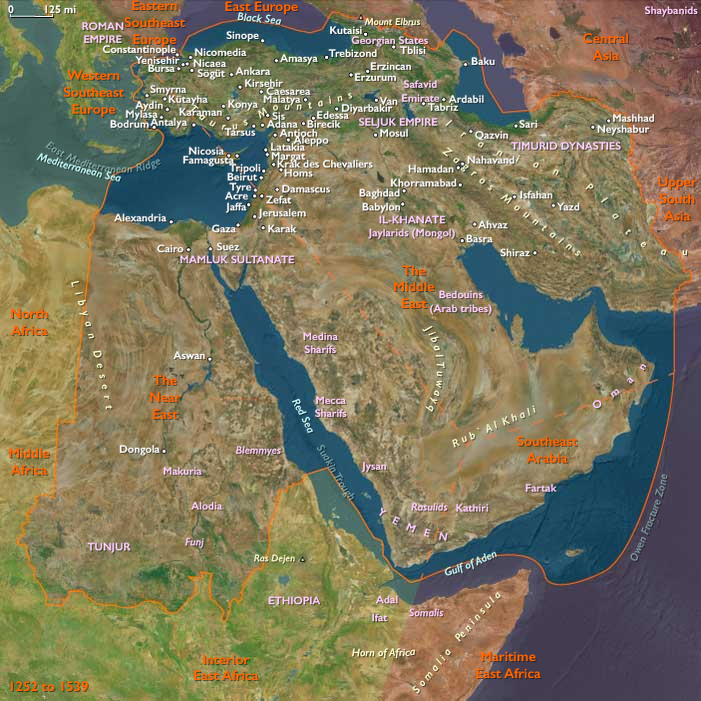
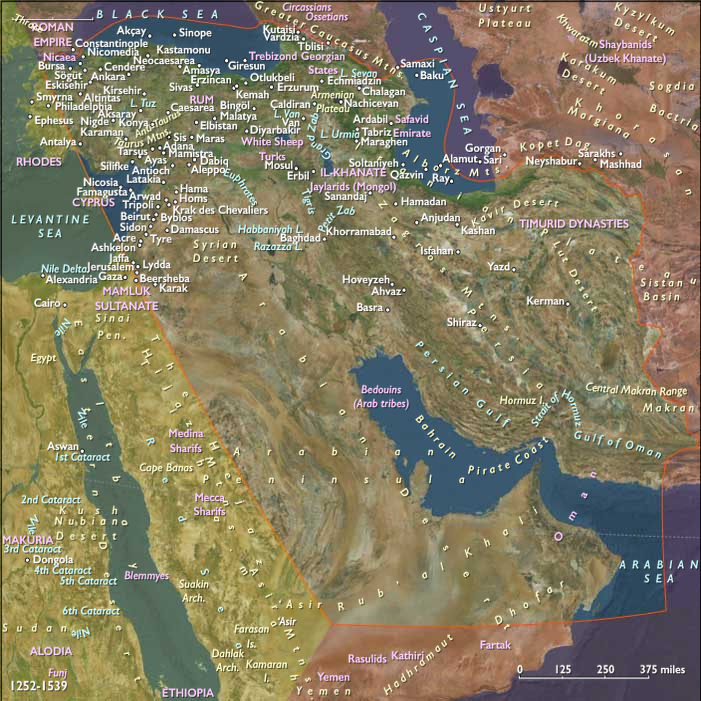
Margat is located on a hill formed by an extinct volcano about three hundred and sixty meters (1,180 ft) above sea level on the road between Tripoli and Latakia, overlooking the Mediterranean Sea.
According to Arab sources, the site of Margat Castle was first fortified in 1062 by Muslims who continued to hold it within the Christian Principality of Antioch in the aftermath of the First Crusade.
When the Principality was defeated at the Battle of Harran in 1104, the East Roman Empire took advantage of their weakness and captured Margat from the Muslims.
A few years later it was captured by Tancred, Prince of Galilee, regent of Antioch, and became part of the Principality.
It was controlled in the 1170s by Reynald II Mazoir of Antioch as a vassal of the count of Tripoli.
The fortress was so large that it had its own household officials and a number of rear-vassals.
Reynaud's son Bertrand sold it to the Hospitallers in 1186 as it was too expensive for the Mazoir family to maintain.
After some rebuilding and expansion by the Hospitallers it became their headquarters in Syria.
Under Hospitaller control, its fourteen towers were thought to be impregnable.
Saladin marched on Margat in 1188, having left Krak des Chevaliers in search of easier prey.
According to Abu'l-Fida, "Recognizing that Maqab was impregnable and that he had no hope of capturing it, he passed on to Jabala".
(Kennedy, Hugh (1994), Crusader Castles, Cambridge: Cambridge University Press, p. 164) It was one of the few remaining territories left in Christian hands after Saladin's conquests.
By the beginning of the thirteenth century, the Hospitallers controlled the surrounding land and roads and made a large profit from travelers and pilgrims passing through.
Isaac Komnenos of Cyprus was imprisoned here after Richard I of England captured Cyprus from him during the Third Crusade.
The bishop of nearby Valenia also used Margat as his headquarters after around 1240.
Margat is second in size and power only to the other Hospitaller fortress to the south, Krak des Chevaliers.
In September 1281 the Hospitallers of Margat had dispatched a contingent of troops to support the Mongol invasion of Syria, which the Mamluk sultan of Egypt Qalawun had successfully prevented after defeating the coalition at Homs.
To punish the Hospitallers, Qalawun clandestinely raises an army in Damascus and besieges Margat on April 17, 1285.
After a thirty-eight day siege, during which sappers and miners manage to dig several tunnels underneath the fortress's walls, a mine destroys a salient of the southernmost wall.
The defenders panic and on discovering the numerous tunnels around the fortress, surrender to the Mamluk commander Fakhr al-Din Mukri on May 23, with Qalwun entering Margat two days later.
The siege was witnessed by eleven-year old Abu'l Fida and his father, the Ayyubid governor of Hama.
Qalawun allows the Hospitallers to leave with everything they can carry.
Rather than destroy Margat as he did with other fortresses, he repairs its defenses and places a strong garrison here due to its strategic value.
Locations
People
Groups
- Muslims, Sunni
- Christians, Roman Catholic
- Jerusalem, Latin Kingdom of
- Hospitallers of St. John of Jerusalem
- Cyprus, Kingdom of
- Egypt and Syria, Mamluk Bahri Sultanate of
Topics
Commodoties
Subjects
Regions
Subregions
Years: 1285 - 1285
Locations
People
Groups
- Muslims, Sunni
- Christians, Roman Catholic
- Jerusalem, Latin Kingdom of
- Hospitallers of St. John of Jerusalem
- Cyprus, Kingdom of
- Egypt and Syria, Mamluk Bahri Sultanate of
Topics
Commodoties
Subjects
Regions
Subregions